The Crystal Atrium was the kind of ballroom that made a person whisper without realizing it. Light spilled from chandeliers like melted ice, catching on sequins and cufflinks, on flutes of champagne raised as if to toast the ceiling itself. The guests wore their wealth like perfume—expensive, invisible, and choking if you stood too close.
Elias Vane stood at the center of it all, a man so accustomed to being listened to that even his laughter came with a command. He had built a fortune out of quiet acquisitions and louder lawsuits, then built a reputation out of charity that arrived precisely where cameras waited. Tonight’s event, a benefit for “the arts,” was mostly an excuse for the city’s affluent to remember they still had hearts.
Near the black grand piano, a waiter moved like a shadow with a silver tray balanced on his palm. He looked almost too plain for the room: crisp white shirt, black vest, hair kept short, expression kept shorter. Yet he carried himself with a calm that didn’t fit the uniform, as if he’d worn finer things before and simply chose not to now.
When Elias noticed him, it was with the casual cruelty of a man testing how much the world would flinch on his behalf. “You there,” he called, voice bright with mockery. The room’s hum thinned. “Don’t tell me you’re here to entertain us too. You?” His gaze flicked to the piano. “Play it, then. Give us a song. Or do you only serve drinks?”
Soft laughter scattered beneath the chandelier light. A few guests leaned in, eager for humiliation dressed up as a joke. The waiter didn’t flinch. He stepped closer to the piano and set his tray down with careful precision, aligning it with the edge of a marble table as if the angle mattered. Then he looked at the bench and, without raising his voice, asked, “May I?” The steadiness in his tone pinched the air; even the giggles seemed to reconsider.
Elias waved a permissive hand, smile sharp. “By all means. Impress us.”
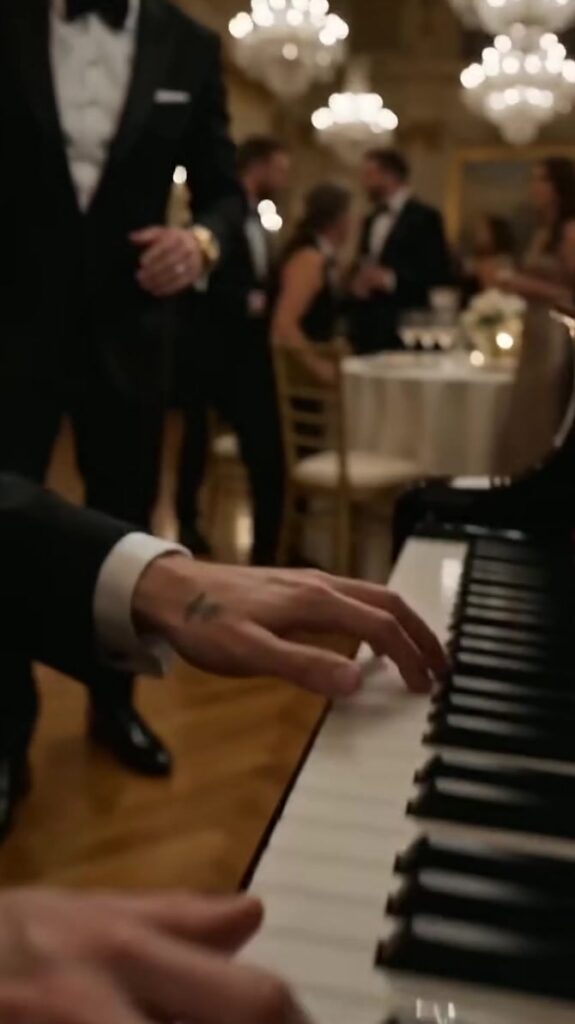
The waiter sat. The bench creaked once, then held. Silence gathered in a way that felt unnatural for a party—like a curtain drawn by invisible hands. He placed his fingers on the keys and played a single note: soft, impossibly clean. It wasn’t a flourish meant to win applause. It was a statement. The next note followed with the same restraint, then the next, each one laid down like a stone set into a path.
The melody began to unfurl—slow at first, then subtly sure. Conversations stalled as if someone had turned down the volume on the world. The music wasn’t the kind people requested to seem cultured. It carried an intimacy that had no business in a room full of strangers. A minor chord slipped in, and the tone changed from elegant to haunting, as though the piano itself remembered something it wanted to confess.
Elias’s smile faltered. He took an involuntary step forward, drawn as much by irritation as by recognition. The waiter’s hands moved with a discipline that came from years, not practice stolen in spare minutes. His touch was controlled, but the sound had breath in it—pain shaped into beauty.
As Elias moved closer, the waiter’s cuff shifted. A small tattoo—five thin lines with clustered notes—briefly revealed itself near the wrist. Elias stared as if he’d been struck. That exact mark had once been sketched in ink on a napkin at a restaurant he owned, years ago, when his wife Mara laughed and said, half-joking, “If I ever run away, I’ll leave music where you can’t buy it back.”
The melody deepened, turning toward a phrase Elias knew too well. It was the tune Mara used to hum when she worked late in her studio, brushing paint across canvases no one was allowed to see. She had called it “a key for a locked door.” Elias had dismissed it as one of her artistic moods. Then one autumn night she vanished—no note, no luggage, just her wedding ring left on the kitchen counter beside an empty glass.
He whispered without meaning to, “That… that’s hers.” His voice came out smaller than he expected, swallowed by the music. The guests nearby sensed the shift; their curiosity sharpened into unease. A woman in emerald silk lowered her champagne flute as if the bubbles might betray her.
The waiter played on, and then he did something Elias hadn’t heard before: a sequence at the edge of the melody, a dark turn like a hidden corridor branching from a familiar hall. Elias’s throat tightened. “No,” he breathed. “She never played that part for anyone.”
The waiter’s hands didn’t stop, but his head angled slightly, as if he were listening to Elias rather than the piano. He still didn’t look up. “She played it for the person who needed to hear it,” he said, voice quiet enough that only the closest could catch it.
A glass slipped from someone’s fingers and shattered with a delicate, final sound. No one moved to pick it up. The room had become a stage without a script.
Elias leaned closer, the scent of cologne and panic mixing. “Where is she?” he demanded, and the demand carried a tremor. “If you know her—if she taught you—tell me where she is.”
The waiter’s fingers slowed, drawing the melody out until each note felt like a footstep on a staircase descending into dark. Then, with a deliberate gentleness, he ended on a single sustained tone and lifted his hands. The note hung in the air, refusing to die.
He finally turned, and his eyes were not the eyes of a servant. They were steady, old with purpose. “You keep asking where she is,” he said, “as if the world owes you an answer.” He stood, smoothing his vest as if he were preparing for something more formal than service. “You were the last person who saw her living.”
Elias’s mouth opened, then closed. The accusation was so simple it was almost polite. “That’s absurd,” he snapped, but the snap was brittle. “She left. She abandoned—”
“She escaped,” the waiter corrected, and the word carried weight, like a door locking behind someone. He reached into his vest pocket and withdrew a folded paper, edges worn as if handled many times. He set it on the piano’s glossy lid. “She asked me to deliver this when you could no longer laugh in a room full of witnesses.”
Elias stared at the paper as if it might bite him. His hand trembled when he picked it up. Inside was a sketch: five lines of a staff, notes arranged into that melody, and beneath them, Mara’s handwriting—sharp, slanted, unmistakable.
If you ever hear this, it means you couldn’t silence me anymore. Don’t look for me. Look at what you did.
The ink bled into a second line.
And remember: the last thing I said to you was not goodbye. It was a warning.
Elias’s knees threatened to fold. The ballroom, the chandeliers, the money—all of it suddenly felt like a hollow set built around a single terrible truth. He looked up, searching for a weakness in the waiter’s face, an opening to bargain through. “Who are you?” he asked, voice hoarse.
The waiter stepped back from the piano, and for the first time his calm seemed less like politeness and more like restraint. “Someone she trusted,” he said. “Someone who heard what you couldn’t hear over your own applause.”
He glanced toward the crowd, and it wasn’t a glance of fear. It was a glance of assessment, as if he were counting allies and exits. “You invited cameras tonight,” he added. “You wanted a performance.”
Elias swallowed, eyes darting to the phones discreetly raised, the faces turned pale with fascination. “What are you doing?” he rasped.
The waiter placed his fingertips on the piano again—not to play, but to claim it. “I’m giving her back her voice,” he said. “And I’m taking yours.”
Then he walked away from the bench, leaving the grand piano like an open mouth that had just finished speaking. Behind him, the room stayed frozen, not because it was enchanted, but because it had finally understood: the music wasn’t entertainment. It was evidence.