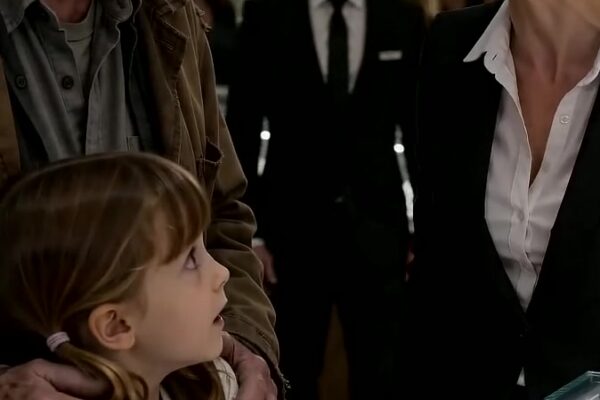
“DON’T TOUCH ANYTHING!”
The warning detonated inside the boutique like a glass bottle thrown against marble. Heads lifted. Conversations died mid-syllable. Even the soft instrumental music seemed to pull back, as if the speakers had suddenly grown ashamed of their own sweetness.
Nina’s fingers froze a breath away from the display case. She had been reaching for the tiny porcelain bird perched on velvet—white as milk, painted with a line of gold that caught the light and made it look alive. Her hand hovered, then dropped to her side as though it had been struck. Beside her, her grandfather stiffened. He was small, shoulders drawn in, coat too thin for the season, but the way he turned his body between her and the saleswoman felt enormous.
The saleswoman stood rigid behind the counter, lip curled as if she’d tasted something sour. Her palm was pressed against the glass, not to protect it from a child’s curiosity, but to mark her territory. “This isn’t a museum,” she said, voice clipped and loud enough to be an announcement. “These pieces are expensive.”
“I was just looking,” Nina murmured. She tried to make her eyes brave, but they watered anyway. It wasn’t the bird she wanted so badly—it was the permission to be in a place that gleamed with quiet money, to belong for one minute without being reminded she didn’t.
Her grandfather cleared his throat. “She meant no harm.” His words were gentle, the kind that asked rather than demanded. “I’ll keep her close.”
The saleswoman’s gaze slid over him—his worn shoes, the fraying cuff of his sleeve—then settled on Nina like a judgment. “Then take her to a toy store,” she said, lowering her voice only enough to make it more cutting. “Somewhere appropriate.”
Silence spread in the way perfume spreads: invisible, insistent, filling the spaces between strangers. A woman in a camel coat pretended to study a necklace but watched from the corner of her eye. A man by the window held a shopping bag like a shield. Nina’s face went hot. She stepped behind her grandfather, clutching the back of his coat as if it were the last solid thing in a room full of sinking floors.
“That’s enough.”
The words came from the far end of the boutique, calm and heavy. A man in a tailored suit approached with slow precision, the kind of measured stride that suggested he believed he owned the air. His name tag read MARTIN, MANAGER, as if the letters alone were meant to command respect.
Martin didn’t look at Nina first. He looked at the saleswoman. “Mara,” he said, warning threaded through the softness. “Step back.”
Mara’s mouth opened—ready with an excuse, a policy, a justification—but Martin lifted a hand, not to silence her, but to pause the entire room. “Sir,” he said to Nina’s grandfather, “I apologize for the disturbance.” His voice was professional, practiced. “But I have to ask—why are you here today?”
The old man blinked, as if surprised the question had found him. His eyes, pale and tired, moved across the boutique—over the chandelier shaped like a frozen waterfall, over the shelves lined with polished wood, over the brass trim that framed the mirrors. Something in his expression tightened, a pain he refused to name. “To see,” he said finally. “To make sure it’s still standing.”
A faint, uneasy laugh came from somewhere near the perfume display. Mara straightened, emboldened by the sound. “People come in to ‘see’ all the time,” she said. “It doesn’t mean—”
Martin’s gaze snapped toward the wall behind the counter where a series of framed photographs hung like awards. Most were black-and-white: ribbon cuttings, socialites smiling, a younger version of Martin shaking hands with men who wore their wealth like armor.
“Do you know who built this store?” Martin asked, and the question landed not as trivia, but as a challenge. Mara hesitated. The customers leaned in, the way people do when they sense a story about to crack open.
Martin walked to the wall and touched one of the frames with two fingers, careful, reverent. He didn’t lift it. He simply angled it toward the light so the image inside sharpened. “Look,” he said.
The photograph showed the boutique in its earliest days—simpler, smaller, but unmistakable. In front of the original storefront stood a man in suspenders and rolled sleeves, smiling with the exhausted pride of someone who built something with his hands. The sign above the door bore the boutique’s name in the same elegant script still used on the shopping bags. The man in the photograph held a hammer in one hand and an infant in the other, balanced on his hip like a promise.
Martin turned slowly, frame still tilted. His eyes moved from the photo to the old man standing by the display case. The resemblance was not subtle. It was time-worn, but undeniable: the same set of the jaw, the same deep lines at the corners of the mouth, the same look that said I have endured.
A ripple went through the room—breaths catching, shoes shifting. Someone whispered, “No way.” Mara’s face drained of color.
Nina peeked around her grandfather’s coat, confusion turning to awe. “Grandpa?” she said, as if the word itself might explain why strangers were staring.
He closed his eyes for a moment. When he opened them again, there was a sheen there that wasn’t quite tears, but something close. “I built it,” he said quietly. “With my wife. With my brother. I put in the floors. I chose the glass. I carried the first cases up those stairs until my back was on fire.”
Martin’s composure faltered. The suit, the badge, the authority—none of it protected him from the sudden, uncomfortable possibility that the boutique’s legend had been living outside its doors all this time. “That can’t be,” he breathed. “The company records—”
The old man’s laugh was short, humorless. “Records can be rewritten,” he said. He looked around at the boutique as if it were both a masterpiece and a theft. “When my wife got sick, I signed papers I didn’t understand. Someone promised protection, promised partnership. They said it was temporary. Then the name on the deeds changed. Then the locks changed. Then the phone stopped ringing.”
The room seemed to tilt. Mara swallowed hard, staring at the man she had just tried to exile. “Sir,” she began, but the word sounded too late, too small.
Martin stepped closer, the manager’s mask cracking under something that looked like shame. “Why didn’t you come sooner?” he asked.
“I did,” the old man said. “Years ago. I stood right where you’re standing and told a different manager that the floors were mine. He told me to leave before he called security.” He lowered his gaze to Nina. “I promised her she could see the bird today.”
Nina’s eyes widened. “The bird?”
He nodded toward the porcelain figure in the case. “Your grandmother painted the first one. She said a shop should have a guardian, something small and bright to remind people to be kind.” His voice broke on the last word, and the break was louder than any shout.
Martin looked at the bird as though he were seeing it for the first time. Then he turned to Mara. “Go to the back,” he said, and there was no argument left in his tone. “Now.”
Mara retreated, heels clicking like nervous punctuation.
Martin faced the old man again. “If what you’re saying is true,” he said slowly, “then this isn’t… this isn’t just a misunderstanding.”
“No,” the old man replied, and the boutique felt smaller around the truth. “It’s a wound that never healed.”
He reached for Nina’s hand, and she slipped her fingers into his without hesitation. Together they stood in the center of the polished floor while strangers watched, newly uncertain of what their money meant in a room built by someone they had been taught to overlook.
Outside, traffic moved as if nothing had happened. Inside, the air held its breath. And in the glass case, the porcelain bird caught the chandelier’s light and threw it back in a thin gold line—like a warning, like a promise, like the first crack in a story that had been sealed too long.