The shout cracked through the boutique like a stone through a stained-glass window. One syllable, sharp enough to slice music from the air and turn every head. “Thief!” It landed before the sound finished traveling, as if the accusation had weight, as if it could bruise skin.
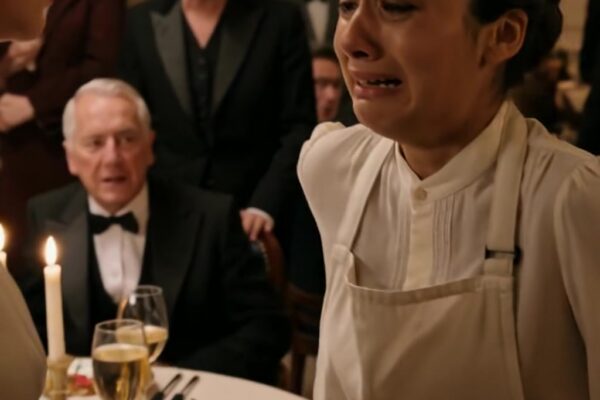
Mara’s heel caught the edge of the display platform. She stumbled back and collided with the glass counter, the impact ringing up her arm and into her teeth. Under the white lights, her hands looked borrowed—too pale, too trembling—hovering above velvet trays arranged like small altars. A second ago she’d been doing what she always did: wiping fingerprints, aligning tags, rehearsing that practiced smile customers liked. Now the room tilted as phones rose in unison and whispers spread from mouth to mouth, fast as flame through dry paper.
Celeste Harrow stood near the center, draped in a cream coat that probably cost more than Mara’s car. Her diamond earrings caught the light with cruel cheer. Celeste lunged forward with an elegance that made the motion feel rehearsed, snatching a ring from Mara’s palm as if plucking a bug from a sleeve. “You reached for what you’ll never deserve,” she said, loud enough for the security camera in the corner to hear. Not just loud—certain. Like verdict.
Mara didn’t flinch away. She didn’t grab back. Her throat tightened so hard it felt stitched closed. She could feel the eyes of strangers cutting her into a story they were eager to believe: the assistant with the frayed cuffs, the scuffed shoes, the too-quiet voice. The kind of girl who must want things that belong to people like Celeste. Her vision blurred, not from the blow but from the sudden heat behind her eyes. Still, she forced air into her lungs and lifted her chin, the way her mother had taught her on days when the world insisted on making you smaller.
“Turn it over,” Mara said. The words barely made it past her tongue. Yet the simplicity of them, the refusal to beg, made the surrounding murmurs hiccup into confusion. She looked past Celeste to the man beside her—Elliot Vane, the groom-to-be, all tailored charcoal and charm. He had been in twice already this month, slipping in when the shop was quiet, asking for “something timeless,” smiling as though time itself answered to him.
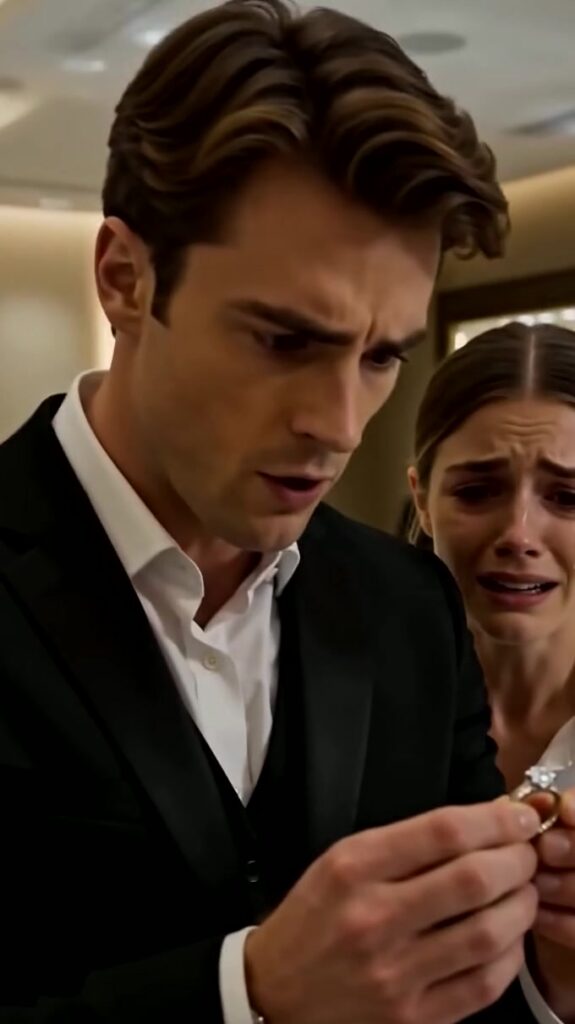
Elliot took the ring from Celeste’s fingers with the ease of someone used to taking. He held it like a trinket—casual, almost bored—until his thumb found the inner band. His smile faltered. Something in his face tightened, a shutter dropping over bright windows. The boutique seemed to lean toward him, every breath suspended in anticipation of whatever he’d just read.
Mr. Sato, the elderly jeweler who owned the boutique, had been silent through the commotion, standing behind the counter with his hands folded as if prayer could keep glass from breaking. Now he stepped forward, and for the first time Mara saw fear on him—not for stolen goods, but for what was about to be exposed. His fingers shook as he adjusted his spectacles. “That inscription,” he said, voice thin as wire, “that is not for this engagement.” He swallowed. “It’s from a commission I completed years ago. The date… that was meant for Mr. Vane’s first wife.”
Silence pressed down, heavy and sudden, as if the building had filled with water. Celeste’s posture stiffened. Her gaze moved—slowly, carefully—toward Elliot as though she were learning his face for the first time. “You said there was no first wife,” she whispered, but the whisper carried farther than shouting. “You told me—” Her voice snapped, brittle with disbelief.
Elliot didn’t answer. His mouth opened a fraction, then closed again. The ring glinted in his palm like an eye that refused to blink. Around them, screens recorded, hungry for collapse. Mara felt her heartbeat hammering against the bones of her throat. She could walk out. She could let them turn on each other and leave the story to whatever strangers chose to upload. But the weight in her chest wasn’t just humiliation. It was something older, buried, and dragged up into the light.
“Do you know where I found that ring?” Mara asked. Her voice was steadier now, as if the truth itself was holding her upright. She watched Elliot’s throat bob. “Not in a display case. Not in a safe.” She blinked once, wiping a tear before it could fall. “It was inside the wooden box my mother kept hidden in her wardrobe until the day she died. The box that came from her grave kit—papers, a comb, a ribbon she wore when she was young. The ring was wrapped in cloth that smelled like soil.”
Mr. Sato’s face lost color. He looked from Mara to Elliot with the stunned caution of a man realizing he’s been polishing a blade without noticing it was pointed at him. Celeste’s hands rose to her mouth, her polished nails trembling. “That’s impossible,” she said, but the word sounded like a prayer she didn’t believe in.
Mara stepped away from the counter, the glass no longer at her back. She reached into her pocket and pulled out a small photograph, corners softened from handling. She held it up so the cameras could catch it, so no one could pretend later. A woman stood beside a younger Elliot, her hair pinned back, her smile bright with the kind of trust that ages into tragedy. The woman’s eyes—Mara’s eyes—looked out from the past.
“Her name was Lina,” Mara said. “She cleaned houses in the north district. She took the bus at dawn and came home with her knees aching and her hands smelling of bleach.” Mara’s throat wavered, but she didn’t stop. “She married him when she was nineteen. And then she disappeared. Everyone said she ran off. Everyone wanted to believe she was the kind of woman who would abandon her child.”
Elliot’s gaze dropped to the photograph like it burned. He finally spoke, voice low, urgently gentle—the same tone he probably used to make women doubt their own senses. “Mara, you don’t understand. That was a different life.”
She laughed, one short sound that held no amusement. “You’re right,” she said. “It was her life. And you took it.” Mara looked at Celeste. “He told you what you needed to hear, didn’t he? He does that well.” Then back to the crowd, to the bright phones, to the strangers whose judgment had been so eager. “You called me a thief,” she said softly, to Celeste and to everyone who had believed it. “But I didn’t come here to steal.”
Mara lifted her shaking hand and pointed—not at the ring, but at Elliot. “I came to return what was buried with my mother because I couldn’t stand carrying it anymore. I came because the date inside that band is the date she stopped being safe.” Her breath shuddered. “And because I’m done letting him bury women and call it a fresh start.”
Outside, sirens rose in the distance—someone had finally pressed the button beneath the counter, or maybe a customer had called, sensing a scandal worth witnessing in person. Celeste’s eyes were wet, but the tears on her face didn’t soften her; they sharpened her, turned her into something newly dangerous. She stared at Elliot as though she could see fingerprints on him no one had noticed before.
Elliot took a step back, then another, and the boutique’s marble floor offered him no shadows to hide in. The ring slipped from his hand and landed on the velvet tray with a dull, final sound. In that moment, Mara understood: the worst theft wasn’t metal or stone. It was years. It was silence. It was the way a lie could be polished until it looked like truth.
When the doors flew open and uniformed officers entered, the air changed—less theatrical, more real. Mara didn’t raise her voice. She didn’t need to. She met Elliot’s eyes and watched him search for an exit in her face, for the old kind of forgiveness he’d taken from women like a right.
“You can tell them whatever story you want,” she said. “But the date is still there. And so am I.”