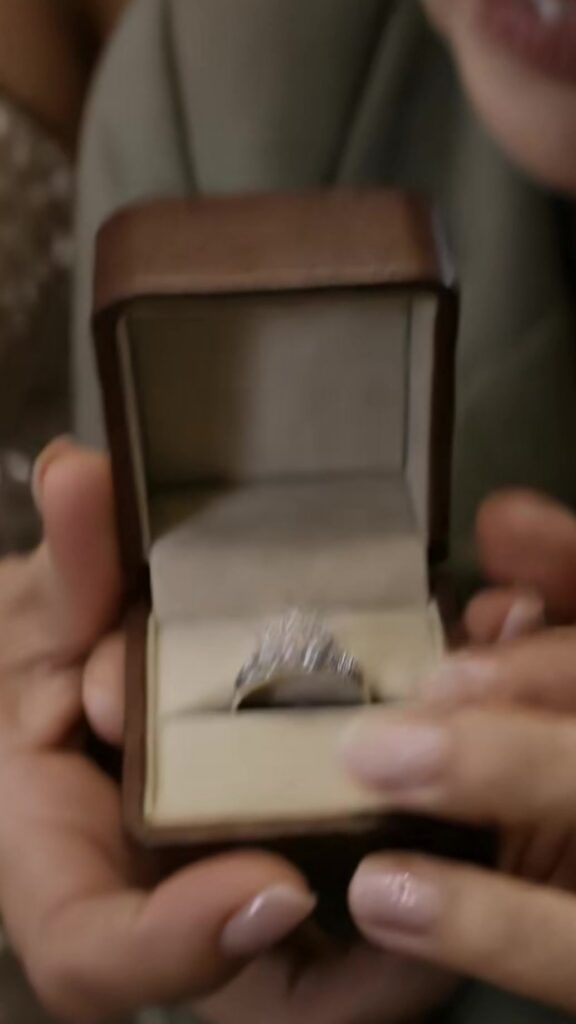
The grab came out of nowhere—hard, possessive, the kind of touch that didn’t ask permission. Mara’s wrist snapped back, pain jolting up her arm, and the small velvet box in her other hand skidded in her palm as if it, too, wanted to flee. For a breath she thought she might drop it, and the thought terrified her more than the bruise forming under the stranger’s manicured fingers.
“Security!” a woman’s voice rang out, bright as broken glass. “She’s been stalking my fiancé. She’s trying to extort him!”
The boutique had been all soft music and warm champagne-colored light a moment ago—mirrors, chandeliers, velvet chairs where brides sat like royalty while their friends sighed and applauded. Now that same light pooled on faces turning toward Mara, collecting shock, delight, outrage. Phones rose in a practiced reflex. The air tightened with the scent of perfume and judgment.
The woman who’d grabbed her looked as if she’d been born inside a magazine. Her hair was pinned into a flawless wave, her dress was white even though today wasn’t her wedding day, and the diamond on her left hand flared each time she moved. Beside her stood the man she’d claimed—Lucian Hale—tall, steady, handsome in an expensive, quiet way. His jaw was set as if he’d prepared for this moment, but his eyes betrayed him, flicking to the velvet box in Mara’s trembling hand.
Mara tried to pull her wrist free. “Please,” she managed. Her voice scraped, unused to rooms like this. “I only need him to look.”
“Show them what you brought,” the rich woman hissed, smiling as if she’d just offered a harmless party trick. “Go on. Show them your little prop.”
Mara swallowed. She could feel every gaze like fingertips. She could feel the old ache that had lived inside her since childhood, the ache of not being believed. The box was worn at the corners, the velvet rubbed thin from years of being opened and shut in secret. She lifted it higher, because hiding it now would only make the story they’d invented feel true.
With a careful thumb, she opened the lid.
An old ring lay inside, plain enough that it could have been overlooked in a drawer. No halo of diamonds, no glittering stones. Just a band of pale gold, slightly dulled, with a single small sapphire set flush as if it had been pressed into the metal by a thumb. It did not look like a weapon. But in Mara’s hands it weighed like a confession.
“That’s it?” someone scoffed, half-laughing. Another whisper: “Probably stolen.”
Mara drew in air, tasting bitterness. “This ring,” she said, and her throat wavered, “was buried with my mother.”
Silence didn’t arrive gently; it slammed down. Even the music seemed to retreat. Lucian’s posture changed in a way only someone watching closely would notice—his shoulders stiffening, the neat mask cracking at the edges. The woman beside him tightened her grip on Mara’s wrist until Mara’s fingers went numb.
A man emerged from behind the counter, older, in a dark suit that made him look like a priest in a house of vows. The owner, Mr. Sato, had the careful calm of someone used to tantrums and tears. “Miss,” he said, palms open, “may I?”
Mara hesitated, then placed the box into his hands. His fingers were steady until he lifted the ring out, turning it toward the light. He frowned, then leaned closer as if the metal had whispered something to him. The blood drained from his face so quickly it looked like someone had dimmed him.
“No,” he breathed. His voice barely carried, and yet it traveled through the room like a cold draft. “That can’t be.”
The rich woman’s smile faltered. “What is this?”
Mr. Sato’s eyes didn’t leave the ring. “I have been in this business forty years,” he said, and now his words were louder, weighted. “I remember rings. I remember hands that wore them. This belonged to a bride who never made it down the aisle.”
A collective intake of breath. Someone murmured a name—Sloane—like it was a ghost they’d heard about in the city’s long gossip. A young woman who’d vanished a decade ago, the story everyone knew in fragments: money, scandal, a sudden burial closed to strangers. People loved tragedies that came with a family crest.
Mara’s wrist was finally released. She flexed her fingers, then lifted her chin toward Lucian. Tears blurred her eyes, but they did not soften what she had come to do. “Then tell them,” she said, “why my mother kept your letters in the same box.”
Lucian’s face went taut. His mouth opened, closed. The rich woman turned toward him as if seeing him for the first time, her confidence wobbling. “Lucian?” she whispered, the word cracking at the edges. “What is she talking about?”
Mara reached into the box, her fingertips brushing paper that had absorbed years. She drew out a bundle of envelopes tied with a ribbon faded to the color of old roses. The edges were softened, handled too often. The handwriting on the top envelope was elegant and unmistakably masculine.
“Or,” Mara said, and her voice steadied the way a blade steadies in a hand that has finally stopped shaking, “should I read the one you wrote after they sealed her casket?”
Lucian took a step back. His breath came uneven, audible in the hush. The rich woman’s hand rose to her throat as if she couldn’t find air. The phones that had risen for spectacle now hovered for evidence.
Mr. Sato turned the ring over, as though compelled by something he feared. “There’s… there’s an engraving,” he said, and his hands trembled for the first time. “Not a name. A date.”
He angled it toward the nearest mirror so the light could catch, and the tiny letters flashed. It wasn’t the date a ring is usually marked with. It wasn’t an anniversary. It was a burial date—specific, brutal, undeniable.
Mara let out a sound that wasn’t quite a laugh and wasn’t quite a sob. “She didn’t vanish,” she said softly. “They made her disappear into the ground. And they made me disappear into a different family.”
Lucian’s knees looked suddenly uncertain, as if his body wanted to fold under the weight of years. “You don’t understand,” he started, palms lifting in a gesture of peace that arrived too late.
Mara stepped closer until she was in front of him, close enough that he could see the shape of her grief, close enough that everyone else could feel it. “Then say it,” she whispered. “Say what you did. Say what you knew.”
His lips quivered. His eyes darted to the rich woman beside him, to the cameras, to the exit as if there was a door that opened into another life. But the boutique had become a courtroom made of glass, and every reflection held him captive.
Mara untied the ribbon. The first letter slid free with a dry sigh, paper against paper. She raised it, her fingers steady now, and the room leaned in as if pulled by gravity. “To Sloane,” she read from the top, and her own mother’s buried name became sound again, alive in the air. “If you are reading this—”
Lucian made a strangled sound, half protest, half surrender. The rich woman’s eyes widened with dawning horror, the kind that rewrites a person’s whole history in an instant. Mr. Sato held the ring as if it might burn through his palm.
Mara looked up from the letter, meeting Lucian’s gaze with a calm that felt like the end of a long storm. “This isn’t blackmail,” she said. “It’s what you tried to bury. And I’ve already dug it up.”
Then she began to read.