She shouldn’t have been there.
Not at the Halberd Hotel, not under chandeliers that scattered light like shattered ice, not among gowns that whispered money and history with every step. The invitation had been clear—names engraved, seals pressed, security briefed. The annual Vesper Gala wasn’t a party so much as a ritual for people who believed the world could be negotiated over champagne.
Yet she stood in the foyer anyway, as if the marble had grown beneath her shoes by accident. Her dress was wrong: simple, too dark, the kind of fabric that didn’t catch the light so much as swallow it. Her hair had been pinned with steady hands, but it couldn’t disguise how young she was. Nineteen, maybe. The kind of age that still looked like it belonged to streets that hurried, not halls that waited.
Heads turned. A few curious, most offended. A security guard at the door took a step forward, ready to ask what name she’d stolen to get inside.
She didn’t flinch. She didn’t search for exits. She looked past the swelling music, past the clinking glasses, past the laughter rehearsed for cameras, and fixed her eyes on a table near the windows where the city spread out like a map of promises.
At that table sat Adrian Vale.
His suit was the kind that didn’t wrinkle, his hair the kind that never looked touched, his posture the sort men practiced when they wanted to appear harmless. He had a reputation for making problems vanish—companies, scandals, people. He smiled easily, but his eyes rarely did.
She walked straight to him.
Ignored the donors and the ministers and the wives with diamond throats. She moved as if she’d already measured the distance in a different life. A waiter tried to sidestep her. She made him adjust instead.
Adrian noticed at the last moment, turning from the man beside him with a polite question caught in his throat. His gaze slid over her dress, her bare hands, the absence of jewelry that would announce pedigree. His smile tightened.
“I think you’re at the wrong table,” he said, the tone gentle enough to make it sound like a kindness.
She stopped at his chair, close enough that he could smell rain in her hair—outside air, not the perfumed warmth of the ballroom. She leaned down slightly, not intimate, just certain.
“I’ve been looking for you,” she said quietly.
Across the table, someone chuckled, assuming it was a joke, some charity guest daring to flirt above her station. Adrian didn’t laugh. He watched her face, searching for a connection he could file away and neutralize.
“Do we know each other?” he asked.
“Not yet.”
He frowned. “Then—”
She lifted her hand.
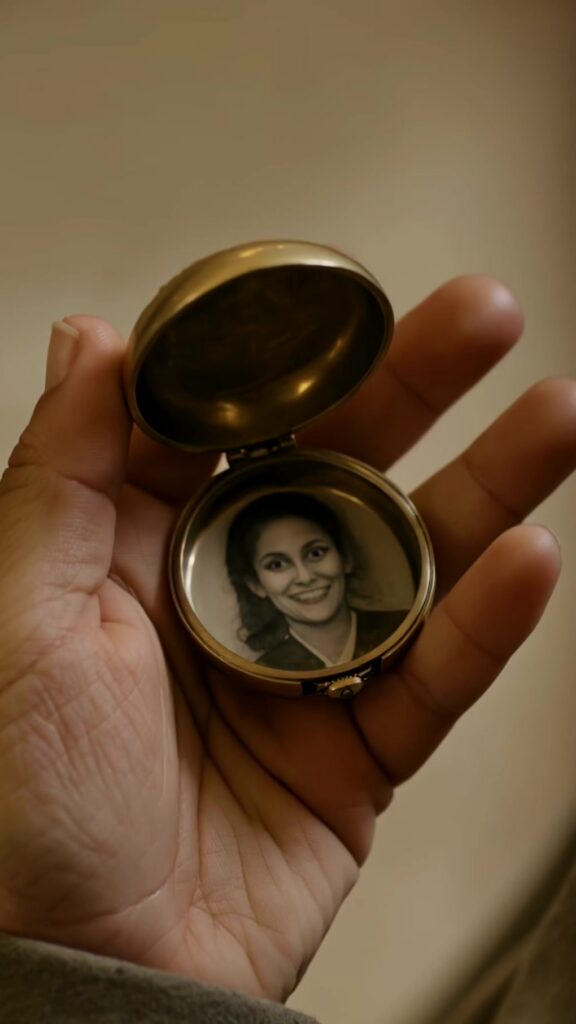
In her palm lay a locket.
It was oval, tarnished, its edge scorched as if it had survived a fire that wanted to finish the job. The hinge was warped, stubborn with age, but the clasp still held. It looked like something dragged from rubble, not worn around a neck in a room like this.
Adrian’s chair creaked as his weight shifted forward. For a fraction of a second, he forgot the gala, the watchers, the caution. His face changed the way a man’s does when a door he believed bricked shut swings open.
“Where did you get that?”
The table fell strangely quiet, as if the sound had been cut and only the music remained, distant and irrelevant.
She didn’t answer right away. She watched him watch it.
Adrian’s right hand moved without permission toward his jacket, fingers sliding along the inner seam. He stopped himself. The reflex had been too fast—muscle memory, not manners.
But she’d already seen.
“You have one,” she said. Not a question.
Adrian’s jaw tightened, the skin near his eye ticking. “No.”
“You do.” She breathed in once, steadying herself, as if she’d practiced this moment in mirrors where no one applauded. “My dad gave me this.”
Adrian’s gaze snapped up. “Your dad.”
She nodded, and there was a bruise at the base of her throat, yellowing at the edges, the sort of mark that came from a rough grip or a collision with something unyielding. He noticed it and hated that he noticed it.
“Name,” Adrian said, the word sharp, stripped of etiquette.
The security guard at the foyer took another step, sensing a shift, sensing danger where there had only been spectacle. A woman at a neighboring table whispered into her husband’s ear. Phones stayed down—for now—but curiosity rose like heat.
The girl leaned in, close enough that her voice wouldn’t carry. Adrian held still, though every nerve in him seemed to brace.
She whispered the name.
Adrian’s throat worked as he swallowed. The city lights beyond the windows looked suddenly too bright, too near, like the world might press its face against the glass to listen.
That name wasn’t supposed to exist anymore.
He’d watched it erased from documents, from records, from the mouths of people who wanted to keep breathing. He’d paid for the silence. He’d buried it under a decade of good deeds and public generosity and contracts signed with clean ink.
He’d buried it the way men buried bodies—deep, quick, without ceremony.
“That’s not possible,” he said, but his voice had lost its authority. It sounded like a plea.
She straightened slightly, and now her eyes were bright with something that wasn’t tears but could have been. “He told me to find you when I was old enough,” she said. “He said if anything happened, I’d know you by the twin.”
“Twin,” Adrian repeated, the syllable scraping.
She nodded toward his jacket. “Show them,” she said, and though her tone remained soft, it landed like a command.
Adrian’s fingers curled against his thigh, nails biting cloth. He imagined the room turning, the cameras, the headlines, the board members who would call him at dawn and ask what this girl meant, what he’d done, who he’d been. He imagined the old corridor that smelled of bleach and rust. The sound of a door locking. The taste of smoke.
He forced a smile for the watching faces, a mask that fit even when his skin tried to reject it. “This isn’t the place,” he murmured.
“It’s exactly the place,” she said. “You built your life on being untouchable. I wanted everyone to see you touched.”
He stared at her, and the terrible understanding arrived in pieces.
Not just that she had the locket. Not just that she knew the name. But that someone had kept the thread alive all these years, letting him believe the past was ash while it was only sleeping.
His own locket—hidden, never shown—had been his reminder and his insurance, both. Proof of the old vow. Proof that he hadn’t imagined it. Proof he could destroy if he ever needed to sever the last tie.
Now there were two.
And the second one sat in the open like a match over gasoline.
“What do you want?” he asked, voice low.
“The truth,” she said. “And the rest of it.”
“The rest of what?”
She turned the burned locket over. On its back, faint under soot, were initials—two letters once cut clean, now scarred. She traced them with her thumb. “You know,” she said. “You promised him.”
Adrian’s mouth went dry.
He remembered a boy with blood on his knuckles, grinning even while the building shook. He remembered two lockets snapped from the same chain, pressed into two palms like an oath that would outlive fear. He remembered saying, I’ll get you out. I swear it. I swear it on this.
And then he remembered walking away.
Not because he couldn’t help, but because he chose not to. Because leaving one man behind had been cheaper than losing everything. Because a sealed door and a fire were convenient erasures.
The girl watched his face, reading the confession he couldn’t keep hidden now that she’d opened the wound in front of witnesses.
“He didn’t die in that fire,” she said. “Not right away.”
Adrian’s breath stuttered. “You’re lying.”
“I’m not,” she said. “He lived long enough to tell me who you were. Long enough to burn this locket’s edge in the candle and say, ‘If he still has his, he’ll know you’re mine.’” She lifted her chin. “He told me you’d pretend not to remember.”
Adrian looked around the ballroom as if the walls had shifted. The gala’s music swelled, a bright, oblivious song. Across the room, the security guard finally moved, hand near his earpiece. A man in a navy suit watched Adrian too closely, not a guest—someone working, someone listening.
The girl’s voice dropped to a whisper only he could hear. “You buried him,” she said. “But he planted me.”
Adrian’s hand slid into his jacket, deliberate now, no longer able to stop himself. His fingers closed around cold metal, the second locket hidden against his heart like a secret tooth.
He didn’t pull it out. Not yet.
Because he understood what would happen the moment he did: the room would learn there had always been a lock to his past, and she had brought the key.
He met her eyes, and for the first time that evening he saw what didn’t match and what did.
She didn’t belong in the light. He did.
But they belonged to the same darkness.
“Who sent you?” he asked, the question raw.
She smiled without warmth. “No one,” she said. “I came because you’re the only man in this room who can finish what he started.”
The security guard reached their table. Adrian’s associates leaned back, confused, alarmed, suddenly aware that the girl’s presence wasn’t a stunt but a reckoning.
Adrian stood slowly, careful not to draw attention with haste. He looked down at the locket in her hand, at the burned edge that had survived flame, at the proof that the past had teeth.
Then he looked at her, and something in him—something he thought he’d sold—twitched like it remembered how to hurt.
“Come with me,” he said.
She didn’t move until he did.
As they walked away from the table, through the lights and the dresses and the watching eyes, Adrian felt the terrible certainty settle in his bones:
Whatever he’d buried hadn’t stayed underground.
It had grown.
And now it was standing beside him, holding a locket like a verdict.