At first, it felt like nothing—just the soft drag of a card through a reader, the electronic chirp of approval, the tired rhythm of a Tuesday evening that refused to become a story. The fluorescent lights in the grocery store were too bright for the hour, bleaching everything into sameness: pale tiles, pale faces, pale paper receipts curling like dry leaves.
Jonah kept his movements small. He’d learned to, over the years. Small movements meant no one noticed the way his left hand sometimes shook when he got tired, or the way his gaze flinched whenever a child dropped a jar hard enough to sound like breaking. Small movements meant you could be nobody in a line of nobodies. A safe person. A forgettable person.
He was halfway through bagging his items—bread, canned soup, a bundle of bananas he’d let brown in peace because he hated the idea of waste—when the girl in the next lane spoke.
“He had that too.”
It wasn’t loud. It wasn’t a demand. It landed in the air like a penny dropped into a well: small, precise, and followed by a deepening silence.
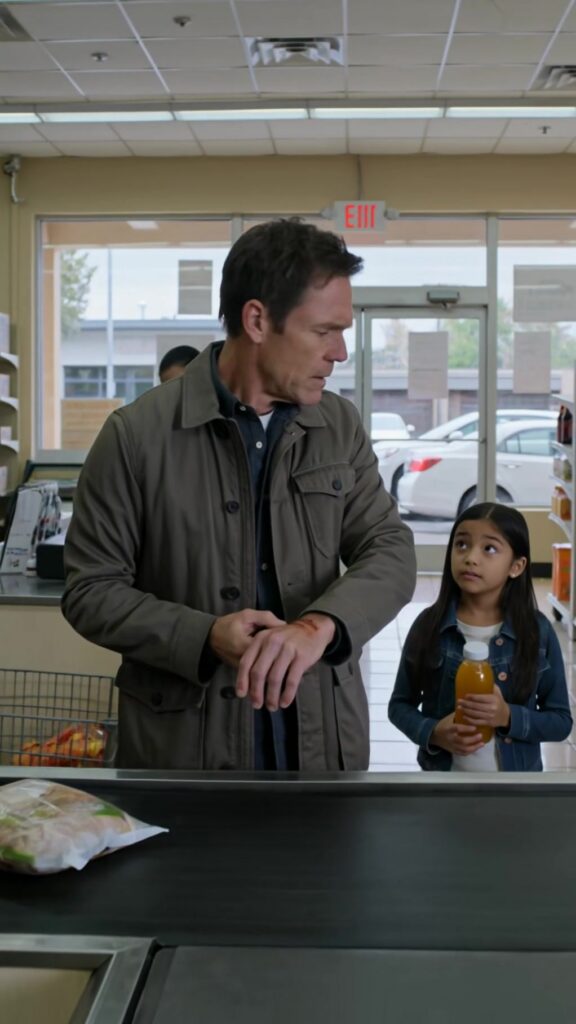
Jonah didn’t respond right away. He kept his eyes on the conveyor belt, as if ignoring a sentence could unmake it. His right wrist brushed the edge of the counter, and the old scar there—an uneven stripe of mottled skin that never took the sun the same way—caught the cold light.
He felt, rather than saw, the girl’s stare. She wasn’t a little kid. Maybe twelve. Maybe thirteen. A narrow face, dark hair pulled back, an expression too steady for someone her age. Like she had practiced holding secrets in her mouth until they tasted ordinary.
“What are you talking about?” Jonah asked. His voice came out carefully assembled, each word placed down like glass.
The girl’s head tilted, just a fraction. “He said it happened when everything caught fire.”
The breath Jonah had been holding slipped and turned sharp. The store noise—scanner beeps, the murmur of other shoppers, the distant automatic doors—fell away as if someone had cupped his ears.
Nobody talked about that night. Nobody talked about the way the ceiling had collapsed in sheets of burning paper, or the way the air itself had turned into something you could choke on. Nobody talked about the names that had stopped being spoken because the people attached to them were gone.
“Who said that?” he asked.
“My father.” The girl said it like she was naming the weather.
Jonah’s fingers tightened around the handle of a plastic bag until the thin material creaked. “Name,” he said, and the word came out harsher than he intended, like a reflex snapped from a trap.
She didn’t hesitate. “Michael Reeves.”
The world didn’t tilt. It didn’t spin. It simply stopped agreeing with itself. Jonah’s knees threatened to fold, and he caught himself on the edge of the counter, the burn scar flaring with phantom heat.
Michael Reeves was a name that belonged to another life—a life with a station badge and a locker that smelled like smoke even after it had been scrubbed. A life where the future was made of plans instead of empty evenings and canned soup. Michael Reeves was supposed to be dead.
Ten years ago, the official report had said “casualty.” The unofficial whispers had said “hero.” Jonah had carried the weight of both words like a second skeleton.
The girl stepped closer to Jonah’s lane while the cashier kept scanning, oblivious or pretending to be. She slid something onto the counter between them: a small object wrapped in brown paper and secured with twine. It looked like a gift someone had been forced to give.
“Take it,” she said.
Jonah stared at the bundle as if it might bite. “I don’t—”
“You do,” she interrupted, not unkindly. Her eyes never left his wrist. “He told me to find you. He said you’d try to disappear.”
Jonah’s throat tightened. He hadn’t told anyone his last name when he moved to this town. He’d paid cash for the apartment deposit. He’d taken a job where his uniform had no badge and his mistakes were swept up with a broom instead of written in reports.
He reached out. His hands hesitated, then moved anyway, drawn by a need that had lived in him like a hunger he couldn’t name. He untied the twine with clumsy fingers and unfolded the paper.
Inside was a metal token: a firefighter’s challenge coin, worn smooth along the edges. The emblem stamped into its face was familiar enough to make Jonah’s stomach lurch—Engine 9’s old crest, the one they’d stopped using after the fire. On the back, scratched into the metal in uneven lines, was a date and a name.
Not Michael’s. Jonah’s.
JONAH LANE — 03/17
That date was a dead end in Jonah’s mind, a doorway bricked up with grief. He knew it without thinking: the night the warehouse on Mercer went up like a funeral pyre. The night Michael had disappeared in the smoke. The night Jonah had burned his wrist trying to pull a door open that wouldn’t yield.
Jonah’s lungs forgot their job. He stared at the coin until the edges of the world blurred. There was no way this could exist. No way it could have left the station. No way it could have crossed ten years and ended up on a grocery store counter under fluorescent lights.
Unless the story he’d been living in was missing pages.
“Where did you get this?” Jonah managed.
“From him,” the girl said. “He keeps it in a box with other things. Things he says he can’t show anyone. He told me if anything happened—if he didn’t come back one day—I should bring it to you.”
Jonah’s fingers closed around the coin. The metal was cold, but his skin tingled as if it were still warm from a palm that shouldn’t exist. “Where is he?”
The girl swallowed. For the first time, her steadiness faltered. “He’s not… he’s not okay,” she said, and then, as if honesty required precision, “He’s been getting worse. He has these nights where he wakes up and thinks he’s still there. He says your name like it’s a rope.”
Jonah’s chest tightened painfully. He remembered waking up on his own kitchen floor after nightmares, his hands clawed into fists, his mind trapped in a loop of smoke and screaming metal. He remembered thinking, more than once, that survival had been an accident.
“He told you to find me,” Jonah said, trying to make it sound like a statement instead of a plea.
She nodded. “He didn’t know where you were. But he remembered you loved the old river trail. He said you’d choose a town with water because you can’t stand the smell of dust.” She looked at Jonah with a sharp, almost adult sadness. “He was right.”
Jonah’s mouth opened, then closed. Too many questions crowded him, pushing and shoving: How? Why now? What had really happened in that warehouse? And why would Michael send a child instead of coming himself?
“What’s your name?” Jonah asked quietly.
“Ava,” she said. “Ava Reeves.”
The cashier finally looked up, catching the tension like a draft. “Everything okay?” she asked, voice polite, eyes wary.
Jonah forced air into his lungs. He pressed the coin into his palm until it hurt. “Yeah,” he said, though it wasn’t true. “Just—yeah.”
He finished paying like a man underwater, every motion slowed and distorted. The receipt printed, long and pale as a confession. He gathered his bags, the ordinary weight of groceries suddenly obscene against the gravity pulling him backward in time.
Outside, the evening air was damp, smelling of rain and exhaust. Ava walked with him to the edge of the parking lot where an older sedan waited, its engine idling. She didn’t open the door yet. She stood facing him, shoulders squared as if bracing for impact.
“He’s at St. Brigid’s,” she said. “The rehab place by the highway. But it’s not… it’s not like the commercials. They keep telling him he needs to let it go, like it’s something you set down.” She frowned. “He told me you’d understand.”
Jonah stared at her, at the fierce smallness of her. A child carrying a message too heavy for her arms. He remembered Michael laughing in the station kitchen, tossing a towel at Jonah’s head and calling him “kid” even though Jonah had been twenty-seven and full of stubborn pride. He remembered Michael’s hand on his shoulder at the warehouse entrance, voice steady in the chaos: Stick with me.
Jonah looked down at his scar. For ten years, he’d treated it like a sentence—proof that the story ended in fire, proof that he’d failed, proof that he didn’t deserve to move on. But in his palm, the coin insisted on another possibility: that something had survived besides him.
“I’ll come,” Jonah said, and the words felt like stepping onto a bridge he couldn’t see the other side of. “Tonight.”
Ava’s eyes shone, but she didn’t cry. She only nodded, once, like sealing a contract. Then she opened the car door and slid inside.
Jonah stood alone for a moment, the grocery bags biting into his fingers. The parking lot lights flickered on, haloing the wet asphalt. Somewhere nearby, a shopping cart rattled in the wind, a thin metallic echo like distant chains.
At first, it had felt like nothing. A quiet checkout. An ordinary day. But now the coin burned cold in his hand, and Jonah understood: the past had not stayed buried. It had been waiting—patient as smoke trapped in walls—for the slightest crack.
He climbed into his own car and started the engine. The headlights carved two pale tunnels through the dusk, and Jonah drove toward the highway, toward St. Brigid’s, toward whatever truth had been hidden behind ten years of ash.
Behind his ribs, something long numb began to stir, fragile and furious as a spark.