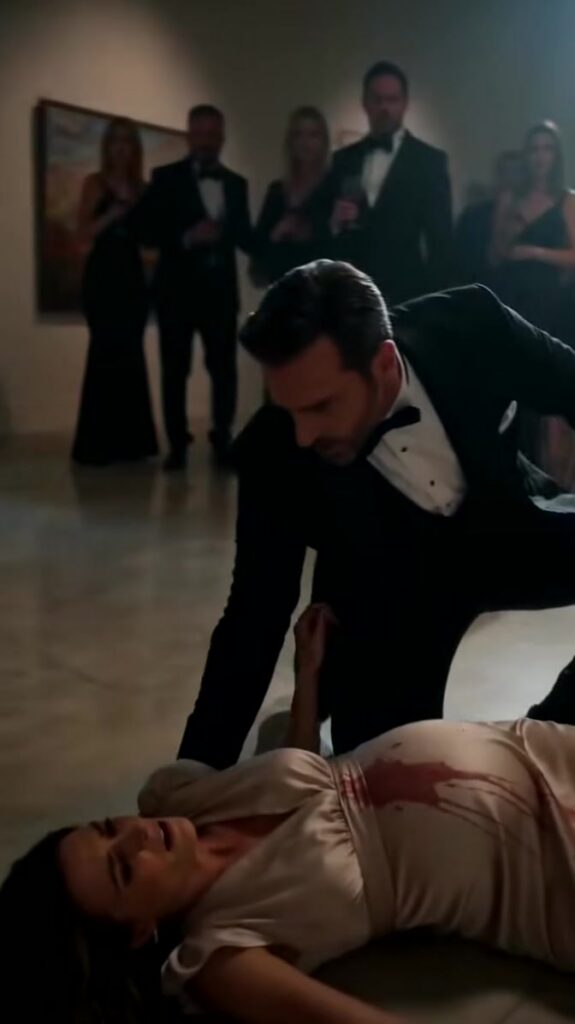
The humiliation happened in one motion—an elegant flick of the wrist that looked, from a distance, like an accident rehearsed until it could pass for fate. Mira saw it coming anyway. She’d been watching Sabine Arkwright all evening, watching the way she drifted through the gallery like she owned the air between the paintings, the way she could laugh without warming her eyes.
Mira shouldn’t have come. She’d told herself that on the drive over, with her palms sweating on the steering wheel and her stomach turning, not from nerves but from the life inside her. She’d told herself again in the foyer, where the marble floors gleamed like water and the guests wore their money the way some people wore perfume—subtle, suffocating, impossible to ignore.
But the invitation had arrived with her name printed in thick black ink, no return address, no explanation. And on the back, in smaller letters, a single sentence: Tonight, the truth will hang on the wall. Mira had come because she had learned, the hard way, that truth didn’t appear unless you stood in the room and forced it to.
The gallery was a cathedral of white walls and restrained lighting, each canvas spotlit like a relic. Mira’s own work—her first piece shown in a space like this—hung at the far end of the main room: a large oil painting of a storm over a harbor, the water roiling under a sliver of dawn. She’d painted it in the smallest room of her apartment, the windows painted shut, the smell of turpentine clinging to her hair for days. She’d painted it while counting down the weeks until her body would no longer be hers alone.
Sabine approached as if she were strolling toward a display she intended to purchase. She wore a pale silk dress that refused to wrinkle and a necklace that looked like it had been cut from a chandelier. Behind her, a small orbit of admirers followed—people with smooth faces and expensive smiles, people who had learned to laugh on cue.
“Mira Lennox,” Sabine said, tasting the name. “I wondered if you’d actually show.” Her gaze dipped to Mira’s midsection, not quite a glance, more like a blade drawn and re-sheathed. “I didn’t think you’d be… comfortable in a room like this.”
Mira held her glass of sparkling water with both hands. She could feel the baby’s weight shifting, a gentle insistence beneath her ribs. “This is a public exhibit,” she said. “Everyone belongs.”
Sabine’s smile sharpened. “No,” she murmured, leaning close enough that only Mira could hear. “Some people are allowed to stand in the light. Others are meant to be grateful they were invited to watch.”
Then, louder, for the circle around them: “Your painting is moving. Truly. It must be thrilling to have your… little moment.” She lifted her own glass of red wine. The color looked almost black under the lights. “Let’s toast to it.”
Mira had a single, absurd thought: Don’t ruin my dress. She’d bought it secondhand and altered it herself, stitching a new seam to accommodate her swelling waist. She’d chosen it because it made her feel like she belonged here, if only for an hour.
Sabine’s wrist turned. The wine leapt out in a smooth arc, as if obeying a command. It struck Mira’s dress across the front, blooming crimson over pale fabric. A gasp ran through the room like wind through dry leaves. For a second, the gallery froze—glasses hovering, conversations choking off mid-syllable, eyes snapping toward Mira with the quick hunger of scandal.
Sabine’s voice carried, sweet as sugar. “Oh dear. How clumsy of me.”
Mira’s throat tightened. Heat rushed to her face, not from shame at the stain, but from the ease with which Sabine had manufactured it. “Why would you—?” Mira began, and her voice betrayed her, cracking on the last word.
She took a step back, instinctively, to escape the circle of staring faces. Her heel met the marble, slick under the wine that had splattered down. The floor offered no mercy. Mira’s foot slid. The world tilted. Her arms flailed for something to hold—air, a stranger’s sleeve, the wall itself—but there was nothing close enough.
She fell hard, the impact echoing off the clean surfaces as if the building wanted everyone to hear. Pain shot up her spine. The breath left her in a sharp, humiliating sound. Her hand flew to her stomach before she could think, as if her body knew where the real danger lived.
“…my baby,” she whispered, and it wasn’t loud, but it was the kind of word that turns a room into stone.
No one moved. No one spoke. Even the music—some quiet string quartet recording—seemed to thin out, as if the speakers were embarrassed to keep playing.
Sabine stood above her, perfectly still. Her expression wavered for the first time, a crack in porcelain. Then she recovered and looked away, as though Mira’s pain were a stain she didn’t want on her conscience. “Someone should help,” she said, but she didn’t bend, didn’t reach, didn’t do anything that would risk ruining her own dress.
Then—BANG. The doors at the gallery’s entrance slammed open with a sound that made several guests flinch. Footsteps struck the floor fast and purposeful, cutting through the stunned quiet like a blade.
A man pushed through the crowd. He wore a dark coat, unbuttoned, as if he’d thrown it on mid-run. His hair was wind-tossed, and his face—too controlled to be calm—searched the room until it locked on Mira. He dropped to his knees beside her with a precision that suggested practice, the kind of practice you never want someone to have.
“Mira,” he said, and his voice was low, urgent. He looked at her stained dress, at the way she cradled her belly, and something dangerous surfaced beneath his composure. “Talk to me. Are you bleeding?”
She tried to speak but only managed a small shake of her head. Her fingers trembled against her stomach. Fear, bright and hot, rushed through her in waves that had nothing to do with the fall and everything to do with the fragile life inside.
He drew in a slow breath, then lifted his gaze to the room. The temperature seemed to drop with it. “Who did this?” he asked, not loudly, but with a weight that made the words feel like they had edges.
The guests shifted, suddenly fascinated by the paintings, by their own shoes, by anything that wasn’t accountability. Sabine held her wineglass in a way that made her knuckles pale, as if she could squeeze innocence out of it.
Mira’s arm felt impossibly heavy, but she raised it. Her finger extended, a small, decisive gesture toward Sabine Arkwright. It was barely more than a point, barely more than a weak accusation, yet it was enough. The air changed. The circle around Sabine loosened, then parted, bodies moving out of the way as if they’d been commanded.
The man rose slowly. He was tall, broad-shouldered, and in the gallery’s clean light his face looked carved rather than soft. He turned toward Sabine with the kind of stillness that made people step back without understanding why.
Sabine’s smile returned in a brittle attempt. “This is absurd,” she said. “She slipped. It’s a terrible misunderstanding.”
He walked closer. One step, then another, until there was no polite distance left. His voice did not rise. It didn’t need to. “You told her she didn’t belong here,” he said, and several heads snapped up, startled that their private cruelty had been heard. “Then you tried to make the room agree with you.”
Sabine’s eyes flickered. “I didn’t—”
“You made a mistake,” he interrupted, and the word mistake sounded like a verdict. He reached into the inside pocket of his coat and drew out a folded document, then another—letters, contracts, things with seals. “You assumed this was your gallery,” he went on, each word measured. “You assumed the board would always take your calls. You assumed no one would challenge you in public.”
He held up the papers. “Tonight’s exhibit is funded by my foundation,” he said, and the ripple that moved through the guests was not a gasp now but a realization, a recalculation. “And this—” He tilted the top sheet so Sabine could read it. “—is the order removing you from the committee effective immediately. For misconduct. For harassment. For assault.”
Sabine’s face drained of color so quickly it looked like the lights had dimmed. “That’s not possible,” she breathed, but the confidence had already left her, leaking out in the silence.
Behind him, Mira heard someone finally call for an ambulance. Another person crouched beside her, hands hovering uncertainly as if afraid to touch her without permission. Mira’s vision blurred at the edges, not from weakness but from the surreal shift—how fast a room could turn when the right person spoke.
The man stepped closer to Sabine, the distance between them narrowing to nothing. His voice dropped even lower, meant only for her, but the room leaned in anyway. “You wanted her to fall in front of everyone,” he said. “So now you will.”
He reached out—one hand lifting as if to take Sabine’s wineglass, as if to tilt it back toward her, as if the next second would decide whether this was justice or something darker.
And then the moment snapped—the sound of sirens rising outside, the gallery’s breath caught in its throat, Mira’s fingers tightening around the baby beneath her palm—before anyone could see what he would do next.