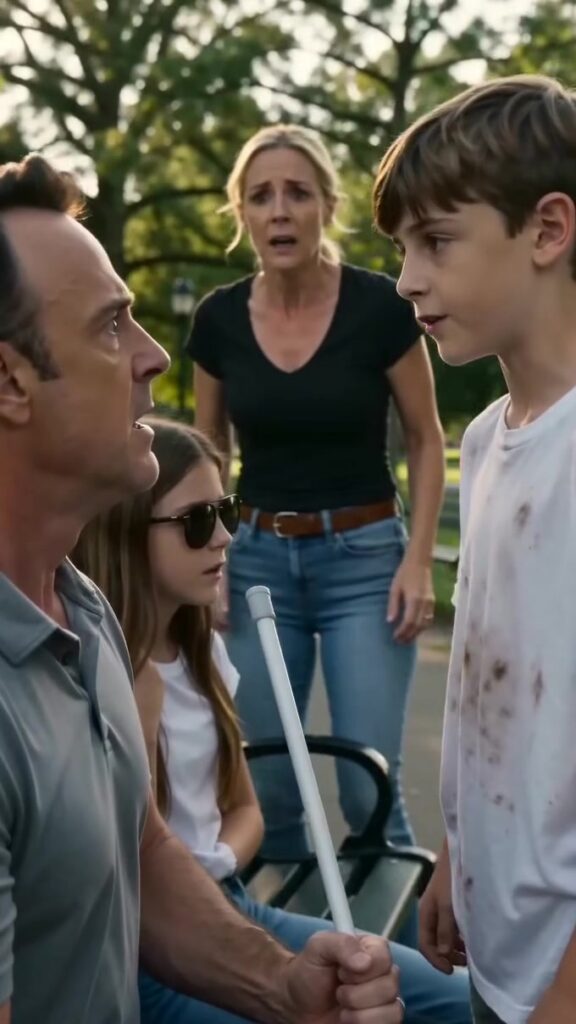
The first warm Saturday of April made the city look honest. Sunlight rinsed the playground, glossed the duck pond, and turned the cracked paint on the benches into something almost charming. Marcus Hale chose a bench facing the fountain because the sound of running water steadied his breathing. It had been his ritual since the diagnosis—come early, sit still, pretend time could be trained like a dog.
Beside him, Ellie sat straight-backed in a pale cardigan, her dark glasses too large for her small face. Her cane lay across her knees, her fingers folded over it as if she were holding a promise. People tried not to stare; they always failed. Marcus had learned the choreography: the quick glance, the softening expression, the whisper to a companion. He hated all of it, but he hated the pity most when it landed on Ellie like dust.
He was adjusting the strap of her bag when a shadow fell over the bench—thin, steady, unhurried. A boy, maybe fourteen, stood in front of them with dirt under his nails and an expression that didn’t match the park. His sweatshirt was too big, his shoes scuffed white at the toes. The thing Marcus noticed, absurdly, was the boy’s stillness. Children in parks moved. This one waited like a witness.
“Sir,” the boy said, voice level, “your daughter can see.” The sentence didn’t arrive gently. It struck like a stone through glass, and the sound of it felt louder than the fountain. Marcus looked up so fast his neck burned. His mind produced a dozen answers at once—anger, disbelief, a sick flare of hope he’d trained himself to strangle. “What did you say?” he demanded, and heard the edge in his own voice.
The boy didn’t blink. “She isn’t blind,” he repeated, as if reciting a fact from a textbook. “Not the way you’ve been told.” He nodded toward Ellie with a kind of careful respect that unsettled Marcus more than the accusation. “She’s been kept in the dark. Literally and otherwise.” Ellie remained motionless, but Marcus noticed her grip tighten on the cane, knuckles whitening under the spring sun.
Marcus leaned forward. “Who are you?” he asked, and instantly hated how small the question sounded. The boy’s eyes flicked once to Ellie’s sunglasses, then back to Marcus. “Does it matter? I’m the one who watched her practice,” he said quietly. “At the clinic. In the hallway. She thinks no one notices when she counts steps. When she turns her head away to avoid looking like she’s looking.” He swallowed, and for the first time something like anger cracked through his calm. “She’s not sick. Someone is making sure you believe she is.”
Air shifted around them. The park noise—laughter, skateboard wheels, dog tags—seemed to move farther away, like a tide pulling out. Marcus’s hands curled around the bench slat until the wood bit his palms. He tried to speak, but his thoughts ran into each other. Ellie had been examined, scanned, tested; there were thick folders and doctor’s signatures, charitable foundations and training sessions. Marcus had rebuilt his life around those papers. The boy’s claim was a match held to a house made of receipts.
“Marcus!” The shout sliced through the space between them. Nadia’s voice. Nadia running. Marcus turned his head and saw his wife crossing the grass fast enough to jolt the parents near the swings into looking up. Her hair had come loose from its clip. One hand clutched her phone like a weapon. Panic made her face sharp and strange, as if someone had changed it while Marcus wasn’t watching. “Don’t listen to him,” she called, breathless, too loud for a park. “Who even is this? Get away from my family!”
The boy stepped a half pace closer, not to Nadia but to Marcus, as though proximity could make truth harder to dodge. “It’s her,” he said, and the words were so blunt they seemed to scrape the air. Marcus’s eyes snapped back to Nadia. She had stopped mid-stride, chest rising and falling. For an instant she looked like a runner who’d realized the finish line was a cliff.
Nadia lifted her chin. “Marcus, please.” The plea was familiar—she had used it during sleepless nights, during bills, during the day Ellie’s cane arrived in the mail. Marcus had always heard devotion in it. Now he heard something else: urgency that wasn’t love. “We can talk at home,” she said, trying to smile. “Ellie’s tired. This boy—he’s sick.”
Ellie moved. It was a small movement, the kind parents learn to measure like weather. Her head turned slowly, not toward her mother’s voice, but toward the boy’s. Her lips parted. Marcus’s breath stopped so hard his ribs ached. Ellie never oriented like that. She didn’t turn to sound; she waited for touch. Now she turned as though she knew exactly where the boy stood.
“Daddy,” Ellie whispered, and the sound of the word peeled him open. Her fingers slid off the cane. Her chin lifted a fraction, as if searching. “There’s… brightness,” she said, voice trembling with uncertainty, like someone describing a dream they weren’t sure they were allowed to have. “I can tell where the sun is.” The sunglasses hid her eyes, but Marcus could see the tiny tension at the corners of her mouth—fear and hope fighting for space.
Nadia made a sound that was almost a laugh and almost a sob. “Ellie, stop,” she said sharply, and in that sharpness Marcus heard a command, not a comfort. The boy’s calm returned, colder now. “She started seeing shapes months ago,” he told Marcus. “She told her mother. Her mother told her it was dangerous to mention. ‘Your father will fall apart,’ she said. ‘Your father needs you to be safe.’” The boy’s gaze didn’t leave Marcus. “She medicated her. Not enough to hurt her body. Enough to blur her world and keep you grateful.”
Marcus’s mind reached for denial the way a drowning man reaches for air, but it couldn’t find any. There were moments—Ellie flinching from light when she’d supposedly never noticed it, Ellie pausing at the top of the stairs as if gauging distance, Ellie whispering in her sleep, “I saw it.” Marcus had filed each moment away under grief, under wishful thinking. Now they returned like evidence.
He stood, slowly, because if he stood quickly he might explode. Nadia stepped back without meaning to. In that backward step, truth flickered: she had been afraid of his hands, of his questions, of what he might do with certainty. Marcus’s voice came out rough. “Why?” he asked, and the single syllable carried every year of hospital corridors and borrowed courage.
Nadia’s mouth opened. No answer arrived. Her eyes darted toward Ellie, then toward the people beginning to notice the stillness on their bench, the way silence had gathered there. “Marcus,” she said again, but it sounded smaller now, like a key that no longer fit a lock.
Behind Marcus, the boy exhaled. “You’re late,” he murmured, not with cruelty but with the resignation of someone who’d watched a fire spread while others argued about smoke. Marcus looked down at Ellie. She was trembling. Her hand found his sleeve, not searching blindly but reaching straight to him, and that directness broke something in him that had been held together by lies.
He lifted a hand toward Nadia, palm open, not yet accusation—an invitation to speak before the world hardened. The park seemed to hold its breath with him. And in that stretched second, right before Nadia could answer the question that would rearrange their lives, Ellie’s sunglasses slipped a millimeter down her nose, revealing eyes that blinked against the sun as if they had been waiting for permission all along.
The words had hit before anyone could think. Now there was nothing left to do but think anyway—and pay whatever thinking would cost.