The night Mara found the box of whitening strips, the cardboard was already soft at the corners, as if it had been held too long in anxious hands. It sat on the bathroom counter like a dare—white packaging, promising a bright new version of her in fourteen days. She stared at the mirror above it, at the reflection that never smiled first. The overhead light made every small flaw louder. Her teeth weren’t bad. They weren’t even yellow. But in the world she lived in—fluorescent offices, camera phones, quarterly meetings that felt like courtrooms—“not bad” was another word for “not enough.”
She peeled open the box with careful fingers and read the warnings again. Gum irritation. Tooth sensitivity. Do not use more than directed. Mara had already used more than directed with everything else in her life: longer hours, fewer meals, the kind of laughter that pretended to be effortless. The strips were her latest gamble, her quiet confession that she believed the smallest thing could undo her.
The first strip clung to her teeth like a clingy secret. She sat on the edge of the tub and waited, mouth slightly open, breathing through her nose as the gel bit at her enamel. Fifteen minutes later, her gums felt raw, like she’d scraped them with a wire brush. When she pulled the strip away, saliva thread shimmered between her lips and the plastic like a thin, humiliating string.
The next morning, in the elevator at work, she tried a cautious smile at her own reflection in the mirrored wall. A man in a gray suit glanced at her and looked away. Mara’s teeth felt tender, as if they had nerves exposed to air. At her desk, she flinched when hot coffee touched her tongue. She swallowed pain like she swallowed everything—quietly, politely, and alone.
By noon she had decided: no more strips. She tossed the box in her drawer beside the stack of rejection letters she hadn’t thrown away either. Her phone buzzed. A message from her younger sister, Lina, arrived like a door slamming open in a stale room: “Don’t laugh. Aunt Sal says you can whiten teeth from your kitchen.”
Mara almost did laugh—sharp, tired, dismissive. Then Lina sent a second message: “She used to do it when money was tight. She swears it’s safer if you don’t go crazy. Want me to call?”
Mara stared at the words. When money was tight. Mara knew that feeling like a scar you touch when you’re not thinking. She typed, “Call me,” and watched the dots appear and disappear, as if Lina were searching for the right way to say something old and delicate.
That evening, Mara drove to the small apartment where their aunt lived, above a bakery that smelled of yeast and sugar. The stairwell was narrow, and the light flickered like an anxious heartbeat. Aunt Sal opened the door before Mara could knock, as if she’d been listening for her footsteps. She was wearing a flour-dusted apron and a look that said she’d already forgiven Mara for staying away too long.
“Sit,” Aunt Sal said, steering her to the kitchen table. The kitchen itself looked like it had been built out of necessity and memory: a chipped kettle, mismatched mugs, a calendar stuck on last month. On the counter sat an open jar of coconut oil, a small bowl of baking soda, and a bundle of mint tied with twine like a charm.
“You came for the teeth,” Aunt Sal said, not unkindly. “But it’s never just the teeth.”
Mara’s throat tightened. “I’m tired of… chasing it,” she admitted, unsure what “it” even was. Beauty? Approval? The brief illusion of control?
Aunt Sal poured warm water into a mug and slid it toward her. “People sell you a promise,” she said. “They make you pay for the right to feel okay. But your body is not a bill you owe.” She tapped the jar of coconut oil. “We can help the surface. But you also have to stop scraping at yourself.”
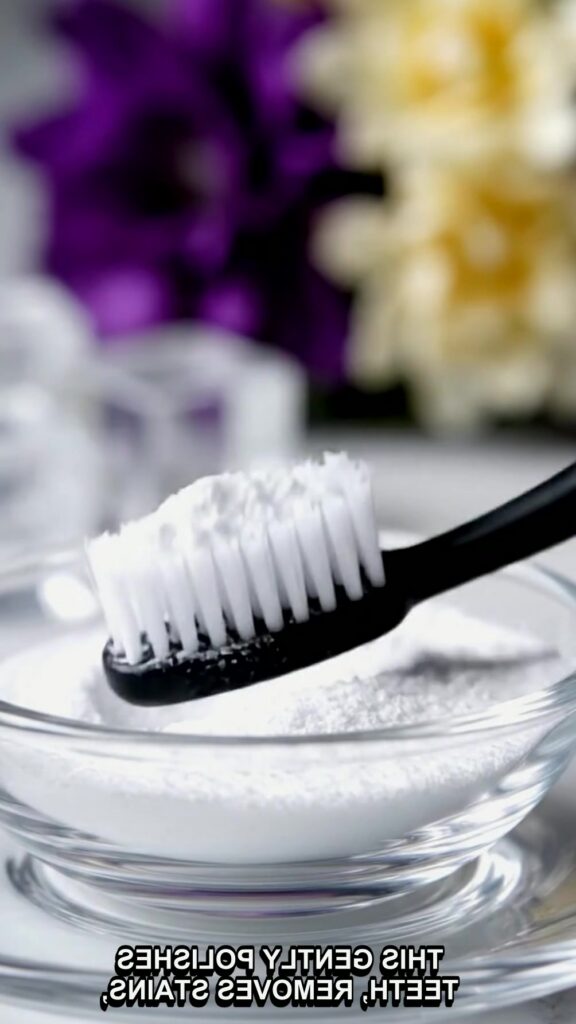
It wasn’t magic, Aunt Sal explained. It was habit, patience, and restraint—the opposite of what the shiny box had offered. She showed Mara how to take the smallest amount of coconut oil, how to swish gently for a few minutes before brushing, not as punishment but as care. She warned her about abrasives, about overdoing baking soda the way people overdid everything when desperate. “A pinch, once in a while,” she said, “like salt in soup. Not like sand in your mouth.”
Mara listened as if the instructions were a spell. The seriousness in Aunt Sal’s voice made her understand: this wasn’t a hack. It was a choice to be slow.
They stood together at the sink. Mara scooped a small spoonful of coconut oil, surprised by its silky stubbornness, and let it melt against her tongue. She swished cautiously, feeling faintly ridiculous, then oddly comforted by the simple act—no sting, no chemical burn, no race against a timer. The kitchen smelled faintly of coconut and mint and bread rising downstairs, as if the world was capable of being gentle.
When she spat into the trash and rinsed, she looked up. Under Aunt Sal’s flickering bulb, her smile did not suddenly blaze like an advertisement. But it looked… like hers. Unforced. Unwounded.
“That’s it?” she asked, almost offended by how ordinary it was.
Aunt Sal leaned back against the counter. “That’s the start,” she said. “But listen to me, Mara. If you use it to punish yourself, you’ll find a way to turn even this into a weapon.” She pointed toward Mara’s face with two flour-streaked fingers. “You don’t need to erase your life from your mouth.”
Mara thought of the meetings where she stayed quiet, the photos she avoided, the way she’d practiced smiling in the mirror until it looked like a lie. She thought of her father, who used to grin wide after coming home from a double shift, teeth imperfect but bright with relief. She thought of Lina’s laugh, loud and fearless, filling rooms without asking permission.
On the walk back to her car, Mara realized she’d been clenching her jaw for years. She loosened it, felt the strange ache of letting go. In her apartment, she threw the whitening strips away—not into the drawer, not into the trash can where she might retrieve them later, but into the bin outside, under the indifferent night sky.
The next morning she woke early and made tea. She stood by her window while the city yawned awake, and for the first time in weeks she did not immediately scan her reflection for defects. She swished oil, brushed gently, and rinsed until her mouth felt clean in a way that didn’t hurt. It wasn’t a transformation you could sell in a before-and-after photo. It was a quiet return to herself.
At work, when her manager called her into the conference room and asked her to present on the spot, Mara felt the familiar surge of panic. Her tongue wanted to hide. Her lips wanted to stay closed. Instead, she breathed, opened her mouth, and spoke. Her voice trembled, then steadied. When she finished, she looked around the table.
No one was judging her teeth. They were watching her. Listening.
Later, in the restroom, she caught her reflection again. She smiled—small at first, then wider. Not because she was suddenly perfect, but because she was no longer bargaining for permission to be seen. The mirror did not smile back. It simply held her there, honest and whole, as if to say: you were never a product. You were never a problem to solve.
Outside, the day went on without fanfare. But Mara carried something new with her, something stronger than white strips and fragile promises: the knowledge that care could come from her own hands, from a kitchen that smelled like bread, from a family that told the truth. And if her smile grew brighter over time, it would not be from bleaching herself into someone else. It would be from finally choosing not to disappear.