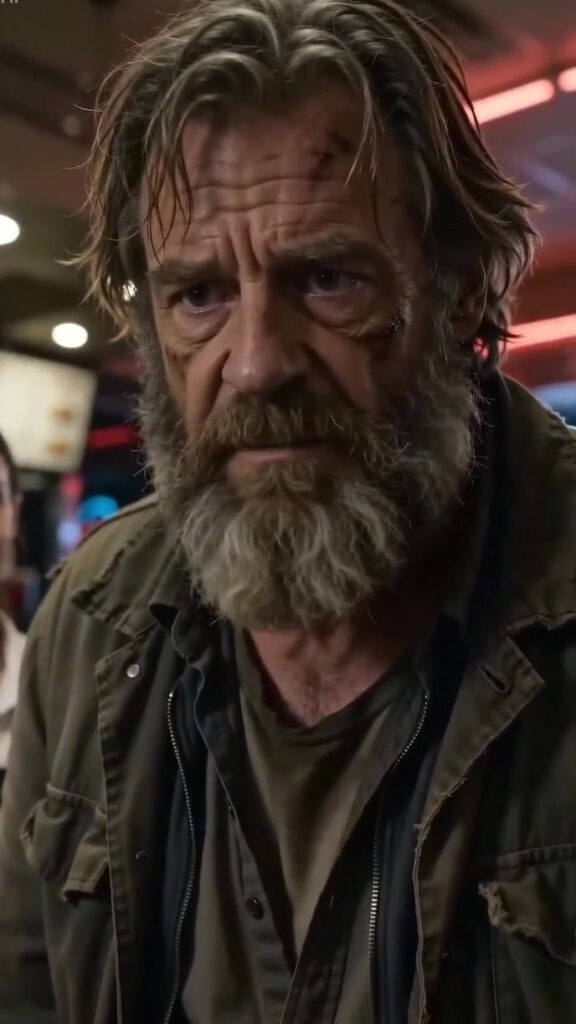
The diner was warm, glowing under soft neon lights, but the corner booth felt cold.
It wasn’t just the draft sneaking in whenever the door chimed and swung open. It was the way the booth sat slightly apart from the others, backed into shadow beneath a flickering sign that promised COFFEE HOT all night and couldn’t quite keep its promise. It was the way conversations skirted around it as if the vinyl seat carried a stain no sanitizer could erase. And it was the man himself—hunched in a dirty jacket that had once been black, hair matted in uneven clumps, hands trembling over a laminated menu he didn’t read.
Hunger did that. Not the romantic hunger of missed dinners and dramatic stomach growls, but the kind that thinned your patience and sharpened your shame until they cut you from the inside. His fingers shook not from fear, because fear took energy, and he was beyond spending it. He stared at the tabletop, at old knife marks and tiny burns, as though they were maps to a place he could still reach.
People noticed him, the way people always did—quickly, unwillingly. A couple at the counter fell quiet when they saw his jacket. A man in a work vest glanced, then returned to his pancakes with sudden devotion. A teenager with earbuds raised her eyes, took in his face, and looked away so fast her neck seemed to snap. The room kept moving, kept chewing and pouring and laughing too loud, but the corner booth remained a pocket of winter.
All except her.
Her name tag read MAYA in uneven marker, and the letters were smudged where her thumb kept worrying the plastic. She moved through the aisle with a practiced rhythm, balancing plates, refilling cups, taking orders. She also watched. Not with pity, the kind that made you smaller, but with a careful attention that treated him like a person who might speak.
When the lunch rush softened and the bell over the door fell silent for a stretch, Maya stepped into the kitchen and came back out carrying a simple plate. A hot dog, split down the middle and dressed with mustard. Fries beside it, steam rising like a small prayer. It wasn’t fancy. It was the kind of meal a diner gave without thinking to anyone with eight dollars and an appetite.
But the way she held it made it look rare.
She approached the corner booth slowly, as if sudden motion might spook the fragile hope she carried. Then she set the plate down in front of him with a gentleness that didn’t belong to a place where orders were shouted and plates clattered.
“Here you go, sir,” she said, voice low. “I hope you enjoy it.”
The man blinked. He stared at the food as if it might vanish if he acknowledged it. Then he raised his eyes. They were tired eyes, the kind that had watched too many mornings turn into nights without relief. But behind the fatigue something stirred—an old instinct, alert and wary, like a dog hearing a distant whistle.
“Thank you,” he whispered. The words came out rough, like they hadn’t been used in years and had to push through rust.
Maya smiled, small and fast, and started to turn away.
The slap that followed didn’t come from a hand against skin. It came from authority striking kindness.
A manager’s palm hit the edge of the table hard enough to make the ketchup bottle jump. Then his arm swept, violent and casual, and the plate flew.
Ceramic shattered on the tile. Fries scattered like spilled matches. The hot dog rolled, leaving a streak of mustard across the floor. A drinking glass—no one remembered whose—tipped and joined the wreckage, exploding into glittering fragments.
“This trash doesn’t deserve to eat here!” the manager barked.
His name tag read LENNY, but the way he carried himself said he didn’t believe in names. He believed in rules. In control. In making sure the wrong kind of person didn’t get comfortable.
The diner froze as if the neon itself had stopped humming. Forks hovered midair. A radio somewhere behind the counter kept playing a cheerful old song that suddenly felt obscene.
Maya stared at the mess. Her mouth opened, but no sound came at first. Then, “I—I was just trying to help,” she managed. Her eyes shone, and she blinked hard as if she could keep the tears from happening by refusing them.
“Not with my food, you’re not!” Lenny snapped. “You want to play hero, do it on your own time. We don’t feed drifters. We don’t encourage them.”
He turned his glare toward the man in the booth, expecting flinching, expecting the shrink of shoulders and the fast retreat that always followed humiliation. Everyone watched for it. That was the unspoken contract of places like this: the weak would be quiet so the comfortable could stay comfortable.
Silence stretched until it became heavy. Even the grill hissed softly, as if trying not to interrupt.
Then the man moved.
Slowly he slid out of the booth. For a moment he seemed to struggle, as though his joints had forgotten what standing was. Then his spine straightened, vertebra by vertebra, until he was taller than he’d looked. His shoulders rolled back. The trembling hands—those desperate hands—went still at his sides.
The weakness didn’t merely fade. It dropped away, like a coat he no longer needed.
Lenny’s mouth tightened. “What, you got something to say?”
The man looked directly at him. Up close, the grime on his jacket was real, the frayed cuffs, the stale smell of rain-soaked fabric. But his eyes—his eyes held something sharper than hunger. Something that had once been trained.
His voice came out calm. Too calm. “You just made a mistake,” he said.
A chill moved through the diner, raising gooseflesh on arms and tightening throats. It was absurd—he was a man with no money, no meal, no allies. Yet the room felt as though a line had been crossed, as though someone had opened a door to a darker hallway.
Lenny barked a laugh, but it sounded thin. “Yeah? And what are you gonna do, tough guy? Call your friends under the bridge?”
The man didn’t answer right away. He glanced down at the shattered plate, at the fries scattered across the floor. He watched Maya kneel to start picking up pieces of glass with bare fingers, because she hadn’t thought to fetch a broom. That, more than the insult, seemed to harden something in him.
“Don’t,” he told her gently.
Maya looked up, confused, a bead of blood already forming on her fingertip.
The man stepped forward, careful not to tread on the shards, and reached into the inside pocket of his dirty jacket. A murmur rose—a ripple of fear that he might pull a weapon, that the night might turn into the kind of headline people read with relief because it happened to someone else.
Instead, he drew out a wallet.
It looked out of place against the ragged fabric—dark leather, worn but cared for, corners smooth from years of use. He opened it and slid a card out, then placed it on the counter where everyone could see. Not tossed. Not flaunted. Placed, like a final piece in a game that had been playing since the moment Maya set down the plate.
Even from the booths, people leaned, squinting. A couple of letters were visible. An emblem. The kind of emblem you recognized even if you didn’t know why.
Lenny’s face changed first. His eyes darted to the card, then back to the man. Color drained from his cheeks in a quick, ugly wash.
“You… you’re—” Lenny began, but the rest stuck in his throat.
The man’s calm didn’t shift. “I don’t want your apology,” he said. “I want you to look at her.”
Lenny swallowed. His throat bobbed. His bravado collapsed as if someone had cut a string.
“Look at her,” the man repeated, and the room felt the weight of the words. They were not a request.
Lenny’s eyes flicked toward Maya, and for the first time he seemed to actually see her: the exhausted young woman on her knees, her hand bleeding because she’d tried to do something decent in a place that punished decency when it didn’t turn a profit.
“Now,” the man said, “tell her why you did it.”
The diner held its breath. Outside, a car passed, headlights painting the windows and then leaving them in neon again. Somewhere in the back, a cook whispered, “Oh my God.”
Maya stood slowly, wiping her finger on a napkin. Her eyes were still wet, but her chin lifted as if she’d been lent strength.
Lenny’s mouth opened. Closed. Opened again. Whatever he’d been about to say—whatever lie, whatever threat—died under the man’s steady gaze.
The man leaned in just enough that Lenny could hear him without anyone else catching the words. But the hush made everyone feel them anyway.
“You kicked a starving man to remind a room you had power,” he said softly. “And you broke her kindness to make sure no one followed her example.”
Lenny’s eyes darted around, searching for support, finding none. Every patron who had looked away earlier now watched as if they were being asked to account for their own silence.
The man straightened, picked up the fallen napkin dispenser from the counter, and set it back in place—another quiet gesture that felt like judgment.
“Bring her a first-aid kit,” he told Lenny. “Bring me nothing. And call your owner. Tell him the man from last winter is here.”
At the mention of last winter, Lenny’s hands began to shake—not from hunger, but from fear.
Maya stared at the man, trying to fit the pieces together: the dirt, the hunger, the wallet that didn’t belong, the way the air had changed around him. “Who are you?” she asked, barely audible.
He looked at her then, and the hardness in his expression softened, just a fraction. “Someone who owes this town a debt,” he said. “And someone who doesn’t like watching good people learn to be cruel.”
He glanced down at the scattered food and then back to Maya. “I’m sorry about the meal.”
Maya shook her head, tears finally spilling. “It’s not the meal,” she whispered.
The neon buzzed overhead, warm and steady, pretending the world was simple. But the corner booth—once cold with neglect—now felt like the center of a storm that was about to break. And in the stillness before it, the man in the dirty jacket stood perfectly upright, as if hunger had never owned him at all.