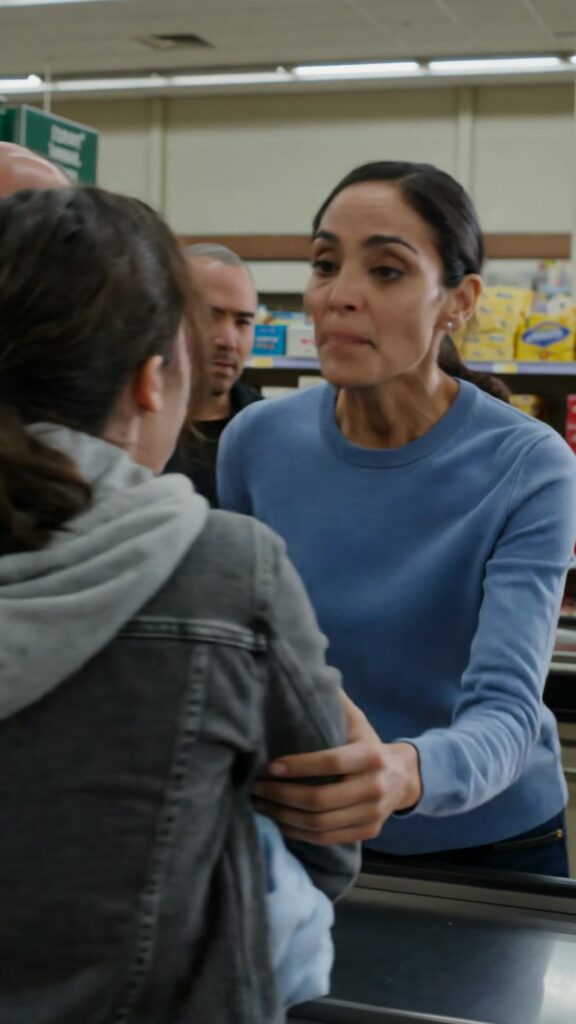
The line at Lane Four had been ordinary until it wasn’t. A toddler had been whining for a candy bar, a man in a suit had been tapping his card with impatient rhythm, and the cashier—barely out of high school—had been apologizing for the register’s stubborn delay. Then, in the space of a breath, the noise drained away as if the store itself had learned to hold its tongue.
The silence wasn’t gentle. It had weight. It pressed against ribs and made mouths forget their easy words.
Marin stood in it like someone caught in sudden snow. She hadn’t meant to reach out, hadn’t planned the small kindness. The young mother ahead of her had shifted awkwardly, balancing a squirming newborn against her shoulder while fumbling for a wallet. Marin’s hand had risen on instinct and touched the woman’s arm—just to steady her, just to say, you’ve got this without making a scene.
Then the baby’s fist flailed free of the blanket. A tiny wrist flashed under the harsh grocery lights, and Marin’s vision narrowed as if the aisle had become a tunnel.
A bracelet. Silver, older than anything that should have been on a newborn. Not new-store shiny, but lived-in: faint scratches, softened edges, the kind of wear that came from years of being taken off and put back on, from being carried in pockets, from surviving.
And on it—letters cut deep enough to outlast almost anything.
Marin whispered without meaning to. The name slipped out of her mouth as if it had been waiting behind her teeth for years.
“Ethan…”
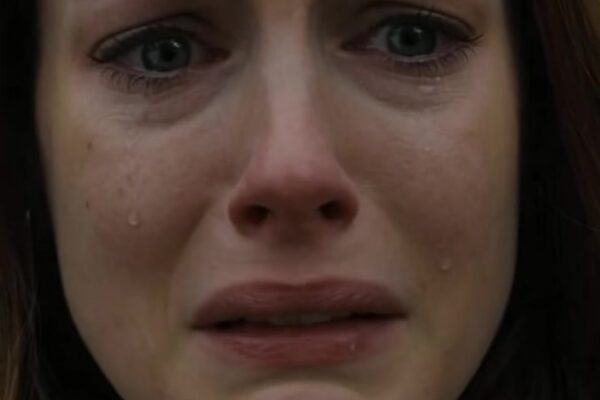
The young mother froze mid-motion. Her lashes fluttered, wet with exhaustion. “What?”
Marin realized she was still touching her, realized her fingertips were trembling as if the air had turned to cold water. She withdrew her hand, but it felt too late; the moment had already been marked.
“I—” Marin’s voice came out thin. She stared at the bracelet again, hoping the name would change when she blinked. It didn’t. The engraving was blunt and certain: ETHAN.
“Is that his name?” Marin asked, and hated the tightness in her own question, hated that she sounded like she needed the answer to breathe.
The young mother’s protective instincts sparked. She shifted the baby higher, turning the wrist inward as though Marin’s eyes were hands. “Yes,” she said carefully. “Why?”
Behind them, the cashier had stopped scanning. The man with the tapping card had forgotten his impatience. Someone’s cart squeaked once, then went still. In the fluorescent glare, Marin felt exposed, the way she had felt in hospital corridors with too-clean floors and too many doors she wasn’t allowed behind.
Her mind was already running down old tracks. The name. The year. The phone calls that had ended in static excuses. The lullaby she couldn’t remember fully anymore because grief had a way of stealing even your own memories.
“I’m sorry,” Marin managed, and that apology carried too much. She swallowed hard, tasting something metallic. “It’s just… I haven’t heard it said aloud in a long time.”
The young mother’s eyebrows drew together. She didn’t look like she wanted sympathy; she looked like she wanted the nearest exit. “Do I know you?”
Marin shook her head. She could feel her pulse in her throat. Her coat pocket suddenly seemed heavier than it had been when she’d walked in. The old habit—carrying proof, carrying the past like a charm or a punishment—rose up without permission.
She reached into her pocket with fingers that didn’t feel like her own and pulled out a photograph.
It was creased, the corners rounded from being handled too many times. The colors had faded toward sepia, but the boy’s face remained unmistakably bright. Five years old, maybe, with a gap between his teeth and the reckless grin of a child who believed the world was meant to be kind.
Marin held it out, then hesitated, then held it closer to her chest as if she couldn’t stand the thought of letting go. “This is Ethan,” she said.
The young mother stared at the picture, and Marin saw her suspicion sharpen into fear. She stepped backward, almost bumping into the candy display. The baby, startled by the movement, let out a thin cry that cut through the quiet like a thread being snapped.
“Why do you have that?” the young mother asked. Her voice rose just enough to make a few heads turn from the next aisle. “Why do you have his name?”
Marin’s gaze flicked down to the back of the photo, though she knew exactly what was there. Ink, slightly smudged from an old tear.
Ethan — 2019.
She hadn’t written it for nostalgia. She’d written it in a waiting room, while a nurse with kind eyes had offered her a pen as if it were a lifeline. She’d written it because she was terrified that time would steal details first, then steal the whole boy. Dates were anchors. Names were ropes.
Marin lifted her eyes again. The young mother’s grip on the newborn tightened, her knuckles pale. The bracelet glinted between blanket folds like a secret trying to escape.
“Because,” Marin said, and her voice cracked on the last syllable, “that’s my son’s name.”
The words dropped into the aisle like something heavy. In their wake, every small sound—the hum of the refrigerator units, the distant beep of another register—seemed to drift away, leaving only that name suspended between them.
The young mother shook her head once, fast. “No,” she whispered, though she didn’t know what she was denying yet. “No, that’s not—”
Marin didn’t move closer. She didn’t want to be the kind of stranger that made mothers clutch their babies. She stood rooted beside the credit card reader, her hands open at her sides as if showing she carried nothing dangerous besides memory.
“I’m not saying anything about your baby,” Marin said, careful now, each word placed like stepping stones over a river. “I’m not accusing you. I’m… I’m asking.”
The young mother’s breath came shallow. “Asking what?”
Marin nodded toward the bracelet. Her throat burned. “Where did you get that?”
The young mother’s eyes darted, as if searching for help in the faces of strangers pretending not to listen. Then she looked back at Marin, and something in her expression softened—not into trust, but into the raw confusion of someone who had been certain of her own story until this instant.
“It was in a box,” she said quietly. “With his things. The hospital gave it to me.”
Marin’s stomach lurched. “Which hospital?”
“Mercy Hill,” the woman answered, then flinched as if the words themselves had struck her. “But—listen, I don’t understand. His name is Ethan because… because it just is. I liked it. It felt right.”
Mercy Hill. Marin had dreamed that name more times than she could count. She’d stood in its lobby with a clipboard and a shaking signature, hearing her own heartbeat in the quiet after the doctor said words he should never have had to say. She’d walked out with her arms empty and the world still insisting on turning.
Her tongue stuck to the roof of her mouth. “How old is he?”
“Three weeks,” the young mother said, defensive again, then immediately uncertain. “What does that have to do—”
Marin’s mind tried to fit the pieces together and found only jagged edges. A bracelet that had survived years. A newborn wearing a name engraved too deep to be new. A hospital Marin knew like an old scar.
“I’m sorry,” Marin said again, because she had nothing else that wasn’t a scream. “I’m sorry. This is… I didn’t come here for this. I came for bread and diapers for my sister. I didn’t come to—” She gestured weakly, unable to name the moment that had taken hold of them both.
The young mother’s eyes fell to the photograph again, and for the first time she really looked at the boy’s face. Marin watched her mouth part, watched her brow crease. Not recognition—something closer to a question forming without words.
The baby whimpered, then cried, soft and insistent, a sound that should have made everything else trivial. Instead it made Marin’s heart clench with a pain so familiar it felt like returning home to a ruined house.
“What’s your name?” the young mother asked, voice shaking now with something that wasn’t only fear.
Marin hesitated. Names had power. Names could start avalanches. “Marin Caldwell,” she said at last.
The young mother repeated it under her breath, as if testing whether it belonged in her world. Her gaze went to the bracelet again, and then—slowly, reluctantly—she pulled the baby’s blanket back just enough for the silver band to catch the light.
“There’s more,” she admitted, almost inaudible. “On the inside.”
Marin’s lungs forgot how to work. “May I…?”
The young mother didn’t offer the baby. She didn’t have to. She simply turned the tiny wrist, revealing the hidden engraving tucked against newborn skin, protected from casual eyes.
Marin leaned forward, not breathing, not blinking.
Two small letters. A symbol that looked like a star. Then numbers.
Something Marin recognized as intimately as her own pulse—because she had chosen it, once, with shaking hands and a desperate hope that marking something would keep it from being lost.
The checkout lane remained silent, but the silence was no longer shock alone.
It was the sound of a past breaking open.
Marin lifted her head, eyes wet and wide, and met the young mother’s stare.
“That bracelet,” Marin whispered, “was never supposed to leave my son.”
Outside, through the automatic doors, evening light bled across the parking lot like a warning. Inside, under fluorescent glare, two women stood trapped between the ordinary and the impossible, with a newborn’s cry threading through them like fate calling for attention.
And the name—Ethan—hung in the air, refusing to fade.