The street looked like something out of a dream—too vivid to be trusted, too tender to belong to a city that usually hurried past itself. Spring had climbed the walls and draped them in color. Blossoms spilled from iron balconies like soft confessions, and petals wandered through the air as if they had forgotten where they meant to land. The cobblestones held the last warmth of the day, glowing beneath a sky that was turning copper at the edges.
No one could later agree on why they had stopped there. Some said it was the light. Some said it was the smell of flowering trees and fresh bread drifting from a corner café. But as the street filled, shoulder by shoulder, the truth became simpler: they had been pulled by a sound that felt like a hand reaching through a crowd, asking—without words—to be taken.
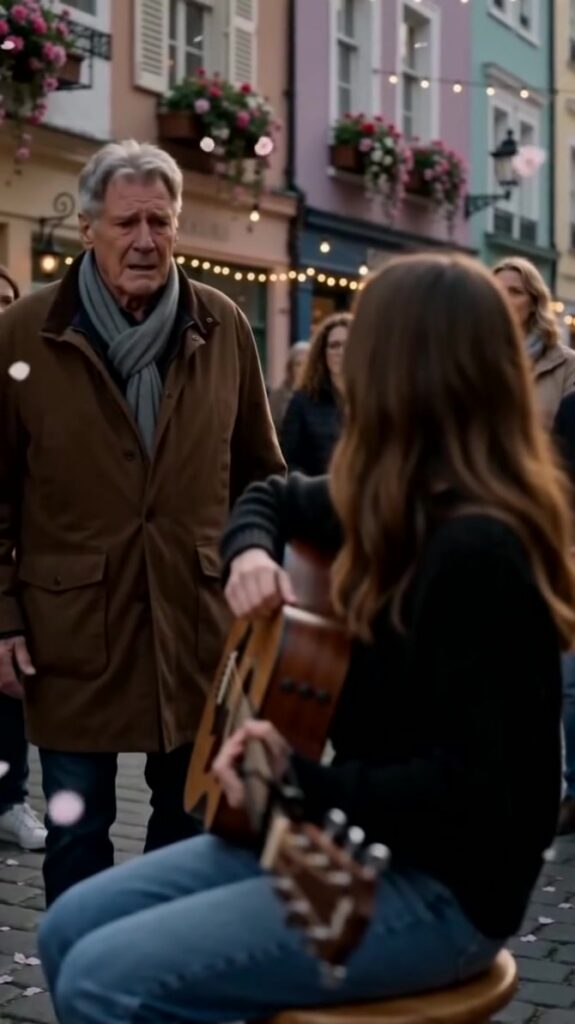
At the center of the gathering sat a young woman on a worn wooden stool, as if she’d always been part of the street and the street had simply decided to notice her today. She wore an oversized black sweater that made her look smaller than she was, sleeves hiding her wrists, the fabric heavy with a kind of private weather. An acoustic guitar rested against her like something fragile. Her eyes were closed as she played, but not in the theatrical way performers sometimes do; it was as if she needed the darkness behind her eyelids to find the place the song came from.
The melody moved slowly, like a story spoken at night. It wasn’t virtuosic. It didn’t need to be. It carried the rawness of a lullaby remembered by someone who had once been afraid to sleep. Even people who had been mid-argument or mid-text fell silent. A dog stopped pulling at its leash. A cyclist forgot to ring a bell and simply coasted to a halt, balancing with a foot on the stone.
When the song reached its end, her voice thinned until it was almost a thread, trembling between the buildings. The final phrase came out like a promise made in a room where no one answered back. It hung there, unwilling to disappear, as if the street itself was keeping it from dissolving.
Applause started hesitantly. A few palms met softly, not wanting to break the spell. Others joined, grateful for permission to exhale. The young woman opened her eyes slowly, blinking as though she’d been somewhere far away and the journey back took effort. She offered the smallest smile—tired, kind, strangely older than her face—and leaned toward the microphone.
“Thank you,” she said, barely louder than her song.
Then she froze.
At the edge of the crowd stood a man who looked as if he had been planted there. He wore a brown coat that had seen too many winters and a grey scarf wrapped with care, as if someone once insisted he protect his throat. His hair was touched with silver, not elegantly but honestly, and his hands hung at his sides without movement. He wasn’t clapping. He wasn’t smiling. His gaze was fixed on her with the intensity of a person reading a letter they never thought would arrive.
He took a step forward.
The crowd parted without being asked. Something in his expression demanded it—not authority, not anger, but weight. People turned their faces away as he passed, the way you look away from grief out of instinctive respect. The street seemed to grow quieter, the breeze gentler, as though everything understood that this was not a performance anymore.
He stopped directly in front of her, close enough that she could see the fine tremor in his jaw. For a long moment, neither spoke. The young woman’s fingers hovered over the strings as if she didn’t dare let them fall. The man’s eyes shone, unshed tears caught in the late sun.
When he finally spoke, it was in a voice that sounded scraped raw by years of silence. “I’m sorry,” he whispered, and the words were so heavy they seemed to drop between them. “That song… where did you learn it?”
Her breath caught. The question was simple, but the way he asked it made it feel dangerous, like opening a door you’d nailed shut for a reason. She swallowed. “My mother,” she said. “She used to hum it when she thought I was asleep.”
His face tightened, the way a wound closes just before it splits. “What was her name?” he asked, barely holding the syllables together.
The entire street felt suspended. The young woman’s grip on her guitar strengthened until her knuckles paled. “Her name was Eliana,” she said, voice trembling. “Everyone called her Lia.”
Something in the man collapsed. He flinched as if struck, then brought a hand to his mouth. He nodded once—no, not a nod. A surrender. “Lia,” he repeated, and it sounded like a prayer he’d forgotten how to speak.
The young woman stared at him, heart hammering, a sudden heat behind her eyes. “Do you know her?” she demanded, and her attempt at steadiness failed. “Because if you do—if you did—then you tell me why she never said where she came from. Why she never told me anything about before.”
The man’s throat worked. He looked at the guitar, at the worn wood, at the strap frayed near the pin. “She left with that instrument,” he said. “Not that one exactly. But one like it. She told me she needed air.” His gaze lifted to her face, and in his eyes was a panic so old it had become part of him. “She said she would be gone a week.”
The young woman’s mind flashed with images: her mother at the stove, her mother pressing fingers to her own temple when headaches came, her mother refusing photographs. The empty spaces around those memories suddenly formed a shape. “Who are you?” she asked, quieter now.
He tried to answer, but the first attempt broke. He inhaled, and the breath shuddered. “My name is Jonas,” he said. “I was… I was supposed to be her husband.”
The word husband landed like a stone in water. Ripples spread through the crowd—whispers, soft gasps quickly swallowed. The young woman’s stomach turned. “No,” she said. “She never—she couldn’t—”
“I know,” he said, urgently. “I know what you’re thinking. That I’m a stranger trying to borrow your grief.” He reached into his coat with slow, careful movements, as if he feared sudden gestures might shatter her. He drew out an envelope, worn at the edges, sealed and resealed so many times the paper had gone soft. “I came here every spring,” he said. “Every year on the same evening. This was where she promised to meet me. I thought if I kept showing up, the city might eventually return her.”
He held the envelope out. His hand trembled. “She wrote this the night she left,” he said. “She gave it to me and told me not to open it unless she didn’t come back.”
The young woman stared at it, afraid it might burn her. “Did you open it?” she asked.
He shook his head, and his eyes filled fully now. “I couldn’t,” he admitted. “If I didn’t read it, I could pretend she was still on her way.”
The young woman took the envelope. The paper was warm from his hand. She felt, absurdly, as if she were holding a beating heart. “Why are you here now?” she asked, voice low. “Why today?”
Jonas’ gaze flicked to her, then to the street, the petals drifting, the light turning everything unreal. “Because I heard her,” he said simply. “In you. In that last line—like the song was calling someone back. I didn’t know I was the one being called until I was already walking.”
Her eyes burned. “She’s gone,” she said. “I buried her three years ago.” The words cracked. “And I still don’t know who she was. I only know what she refused to tell me.”
Jonas nodded, as if he’d already mourned that fact a thousand times and was now being asked to mourn it again. “Then we read it,” he said. “Together. If you want.”
The street seemed to lean in. The young woman looked at the crowd—strangers who had become witnesses, faces softened by the quiet force of what was unfolding. She looked back at Jonas, at the grief carved into him, and then at the envelope in her hands.
She slid a finger beneath the flap and opened it. The paper inside was folded neatly, like someone had tried to make sorrow orderly. Her hands shook as she unfolded it. The first line was written in a familiar slant, and suddenly she could see her mother’s hand moving, could smell the tea she used to drink at night, could hear the way she used to sigh before telling a story that wasn’t the whole truth.
She read aloud, voice catching. The letter wasn’t long. It was an apology, a confession, a map made of words. Lia wrote that she was afraid—afraid of the life she’d built, afraid of the life she’d left, afraid of hurting everyone no matter what she chose. She wrote that she was leaving because she believed she carried ruin like a perfume, that anyone who loved her would eventually breathe it in. She wrote that if a child ever came to her, that child should never grow up thinking love was something that vanished without explanation.
The young woman’s throat tightened, and she had to pause. Jonas’ eyes were closed now, tears slipping down without shame. When she reached the last lines, her voice thinned to the same fragile thread as her song.
Lia had written: If you hear this melody again, it means I found a way to send myself back. Not in body. In a reminder. In a thread of sound. Forgive me for leaving you with echoes. I did it because I wanted you to survive me.
The young woman lowered the letter, shaking. The street felt different—less like a dream now, more like a place where dreams and truth had collided. She looked at Jonas. “She left a song,” she whispered. “That was all she could carry.”
Jonas opened his eyes, and in them was the same stunned tenderness she had seen in her mother when she thought no one was watching. “And you carried it,” he said. “All this time.”
The young woman pulled the guitar closer, as if it could anchor her. “I thought I was singing to someone who would never hear me,” she said. “But you did.”
Jonas nodded, swallowing hard. “I did,” he said. “And I’m here.”
For a moment, neither moved. The petals continued to fall, slow and indifferent, as if they had always been meant to witness this. The crowd remained silent, not out of discomfort, but out of reverence—understanding, somehow, that the smallest sounds could change a life.
The young woman gestured to the empty space beside her stool. “Sit,” she said, voice trembling with a courage she hadn’t known she possessed. “Tell me about her. Tell me who she was before she became my mother.”
Jonas hesitated, then sat carefully on the curb, like a man afraid the ground might not hold him. He looked up at her as the sky deepened into evening, and for the first time his expression wasn’t only grief. There was also relief—painful, startled relief, like someone finding a door in the dark.
The street no longer looked like something out of a dream because it was beautiful. It looked like a dream because it was impossible and still happening: a song turning into a reunion, a secret opening like a letter finally read, two lives stitched together by a melody that refused to end.
And when the young woman began to play again—softly, almost shy—people didn’t clap, didn’t speak, didn’t move. They only listened as the night arrived, and the song, at last, found somewhere to come home.