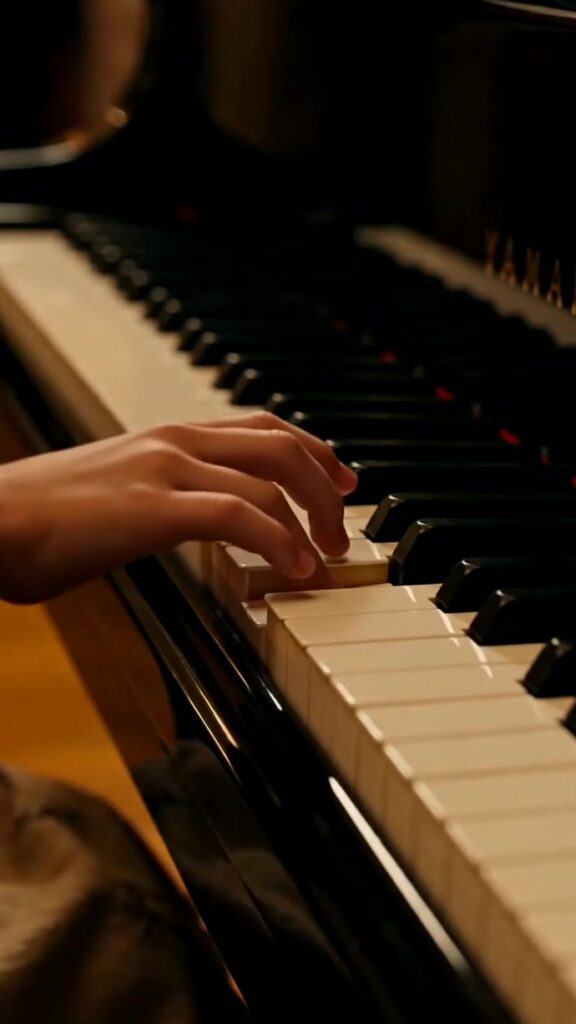
The ballroom was still frozen in that impossible silence, the kind that doesn’t happen naturally. It had been manufactured—by money, by manners, by the unspoken agreement of people who believed they could purchase the shape of an evening. Yet now, as the last piano chord thinned into the high air and died somewhere among the chandeliers, the quiet held like ice.
Hundreds of faces watched the grand piano as if it had opened its lid and shown them something inside: a heart, a blade, a confession. The glossy black instrument sat on its raised platform like a priest’s altar. The man in the tuxedo stood close enough that his cuff brushed the rim. He had been smiling through most of her performance, the practiced smile of a patron who liked to be seen appreciating talent. Now his mouth had forgotten its role.
He stared at the pianist—the girl in the wheelchair—like he was trying to recognize a portrait after someone had burned the nameplate off the frame. Her hair was pinned neatly, her dress simple compared to the sequined gowns circling the room. The chair’s chrome shone beneath the stage lights, unforgiving and bright. Her hands hovered above the keys, not in readiness but in suspension, as if the air itself had asked her to stop.
People had come to the Winter Jubilee for the usual reasons: to give money with one hand and collect power with the other, to sip champagne and feel charitable. The foundation banners bore the host’s name in gold thread—Aldrich Hartwell, benefactor, investor, philanthropist. His family had built hospitals with their surname carved into stone. Tonight they were raising funds for a rehabilitation wing. The irony should have been invisible. It wasn’t.
Aldrich’s fingers tightened around the piano’s edge. A tremor traveled from his knuckles up his wrist, small enough that only those close to the stage might have noticed. But everyone noticed. Silence has a way of enlarging tiny movements into omens.
He spoke, and his voice came out brittle, as though it had been stored too long in a locked drawer. “What is your mother’s name?”
A sound passed through the crowd—not words, not even a gasp, but the collective intake of people suddenly afraid they were sitting too close to something personal. Waiters stopped moving. An orchestra member lowered a bow as if caught stealing. A woman in pearls raised a hand to her throat and held it there, like she was checking whether her pulse had changed.
The girl lowered her hands to her lap. When she looked up, it wasn’t with the pleading anxiety Aldrich seemed to expect. Her eyes were calm. Not soft. Calm in the way deep water can be calm while it hides a current strong enough to pull a person under.
“My mother’s name was Mara,” she said. “And she did not keep your name on her tongue.”
The sentence should have been harmless. It landed like a dropped glass.
Aldrich’s shoulders jolted, a flinch he couldn’t disguise. He had invited this pianist himself—his assistant had placed the call to the conservatory after hearing about a young prodigy playing in a community hall. He’d insisted on a “moving” performance, something that would make the donors feel they’d helped create miracles. He’d seen her in rehearsal, nodded approvingly, offered a smile he assumed could purchase gratitude. He had not asked her name. She had not offered it.
Now he searched her face for a clue he was terrified to find. “Mara,” he repeated, and the syllables seemed to scrape his throat. “Mara… what?”
“Ashford,” she answered.
The name traveled through the room like a spark. Not everyone recognized it. Some did—older board members, lawyers, those who had been near the foundation decades ago. A man near the back shifted, the color draining beneath his tan. A woman on the dais, seated beside Aldrich’s wife, turned her head sharply as if a draft had touched her neck.
Aldrich’s hand fell from the piano. “She’s dead,” he said, and it sounded less like a fact than a desperate spell. “Mara Ashford is dead.”
“She is,” the girl agreed. “She died in a place that has your family’s name above the entrance.”
The temperature seemed to drop. The chandeliers still glittered, but the light had changed—too clean, too exposed. The ballroom’s mirrors caught and multiplied expressions that were no longer polished. Doubt spread in elegant clothing.
Aldrich’s wife rose halfway from her chair. “Aldrich?” she whispered, and her question contained a whole marriage of assumptions: that he would always explain, that whatever happened would never spill onto the white tablecloth.
Aldrich did not look at her. His attention stayed pinned to the girl like a condemned man watching the executioner’s hands. “Who are you?” he asked, and this time his voice was not for the crowd. It was for himself. “Who are you to say that name?”
The girl’s fingers touched the arms of her wheelchair. Not to steady herself, but as if she wanted to remind the room of the metal and the reality beneath her gown. “My name is Elise,” she said. “Elise Ashford. She was my mother.”
The murmurs began to rise, a nervous animal finding its feet. A few heads turned toward the exits as if donors could flee consequences by leaving early. A board member stood too quickly and nearly knocked over his chair. Someone dropped a dessert spoon; it rang too loud against the floor.
Elise continued, carefully, like someone stepping across thin ice while carrying something precious. “You asked about her name as if it was the key to this moment,” she said. “So I will give you the rest. She worked in your family’s hospital when she was nineteen. She told me she wanted to become a nurse. She thought the world could be made decent with enough hands and enough care.”
Aldrich’s jaw clenched. “Stop.”
Elise did not stop. “She told me about the night she got hurt,” she said. “The accident that was labeled unavoidable. The paperwork that was stamped before the blood had dried. The security footage that vanished. She lived long enough afterward to teach me what to listen for in people who smile too easily.”
“This is not the place,” Aldrich said, louder now, trying to muscle the room back into obedience. “This is a fundraiser.”
Elise’s gaze slid past him to the banners with his name and the glowing promise of charity. “That’s why I came,” she said. “Because you love places where people clap on command. I thought it would be fitting to speak in a room where you’re used to applause.”
Aldrich’s face had lost its color. In his eyes was something that did not belong to a man accustomed to control: naked calculation, and beneath it, fear. “What do you want?” he demanded.
Elise turned slightly, acknowledging the audience at last. Every donor, every journalist, every staff member became part of her line of sight. “I want you to hear what you have trained yourself not to hear,” she said. “I want you to answer a question you have avoided since before I was born. I want you to say it in front of witnesses.”
She faced him again. “Tell them,” she said, each word placed with the precision of a note. “Tell them why my mother’s file was sealed. Tell them why her settlement required silence. Tell them why the hospital’s rehabilitation program has your family’s name, when the first patient it failed was the woman who gave birth to me.”
The crowd’s hush returned, but now it was a different quiet—alive, watching, hungry. Somewhere a camera shutter clicked, then another. Aldrich glanced toward the foundation’s attorney, a sharp man with kind eyes that were currently doing nothing kind. The attorney’s expression said: not here, not now, not in public. But the room had already shifted. The evening had stepped out of its script.
Elise placed her hands back on the keys. “I didn’t come to beg,” she said. “I came to remind you that music is memory. And memory has teeth.”
Then she began to play again—not the planned piece, not the bright melody that had made donors smile earlier, but something spare and relentless, a sequence of notes that rose like questions and refused to be answered. The sound filled the ballroom and made the chandeliers tremble slightly, as if even crystal understood it was no longer decoration but witness.
Aldrich stood at the edge of the piano, trapped between the instrument and the eyes of everyone he had ever tried to impress. His lips parted. No apology came out. No denial held shape.
In the frozen space between Elise’s notes, the truth waited—impatient, inevitable, ready to be heard.