The ballroom glittered like a place where nothing ugly could exist. Gold washed the walls, poured down the columns, and clung to every shoulder in a way that made the human body look expensive. Crystal chandeliers hung like captured constellations, scattering light into a hundred fragments so no single shadow could grow bold enough to be noticed. Even the air seemed filtered—cool, scented, and obedient.
A live orchestra played as if the instruments were being stroked rather than bowed. Laughter traveled in delicate waves, never too loud, always timed to land neatly. Men in velvet and women in glassy silk tilted their heads in practiced angles, and their jewelry answered with quiet sparks. At the center of it all, placed with the arrogance of a monument, stood a gold-plated vault taller than any of the guests—its polished face reflecting the ballroom back at itself.
It wasn’t merely a safe. It was theater: a promise that the people here owned not only money, but mystery. Around it clustered phones and champagne flutes, as if the vault could be fed by attention. A host in a wine-dark tuxedo paced near it, his smile bright enough to hurt. He raised his hands in a gesture of benevolence, the kind that asked for applause while pretending to offer it.
“Ten thousand,” he announced, letting the words unfurl over the music, “if anyone can open it.”
The orchestra softened. The crowd tightened. The offer was not a gift; it was bait. Every guest understood the rules of such games: the reward was never the money, but the spectacle of failure. A few bold hands reached out, touched the wheel, tugged, turned, laughed at themselves, and stepped away before embarrassment could take root. The host’s grin widened each time, pleased by the small humiliations he could purchase for the price of a punchline.
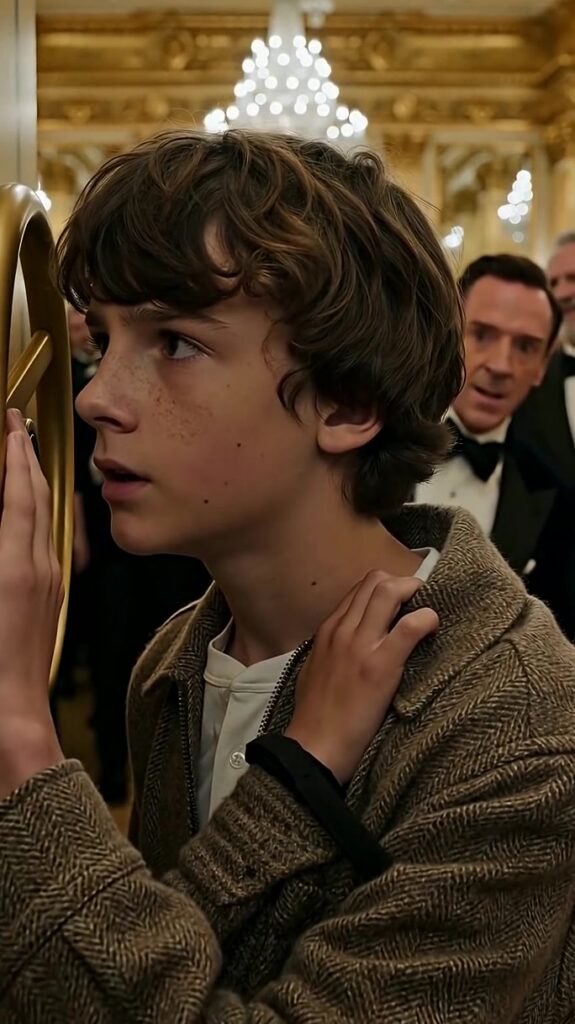
Then a boy in a brown tweed jacket moved forward from the edge of the room.
He did not belong to the glitter. His shoes had been polished carefully, but they were old. His jacket fit him like a borrowed thought. The guests turned, intrigued; their eyes sharpened in the way they did when they found someone safe to judge. Someone they could turn into a story to tell tomorrow.
What made them uneasy was his stillness. He didn’t look dazzled. He didn’t look hungry. He looked as if he had arrived late to something he’d once attended a long time ago.
“Go on,” the host called, voice cordial and pointed. “Let’s see what you can do.”
The boy approached the vault. Each step struck the floor with an echo that seemed too honest for the room. When he reached the gold surface, he laid his fingers flat on it, not with curiosity but with recognition. The metal was cold, though it gleamed as if it had just been kissed by fire.
He leaned in and pressed his ear to the lock.
The ballroom’s conversation thinned, then vanished entirely. Even the orchestra faltered, as if the violins had been asked to hold their breath. Somewhere a glass clinked, tiny and loud, and then the sound was swallowed by a silence that didn’t feel empty—it felt occupied.
The boy’s hand wrapped around the wheel. Before he turned it, he looked over his shoulder, not at the crowd, but straight at the host, as if the host were the only person in the room who mattered.
“Are you sure?” he asked.
The words landed wrong, like a footstep on rotten wood. A few guests laughed out of reflex, but the laughter came out thin and died quickly. The host’s smile remained, yet its edges trembled.
“Of course,” he said, too quickly. “Go on.”
The boy turned the wheel.
A click rolled through the room—deep, not merely mechanical, but decisive. The sound belonged less to gears than to the closing of a verdict. The host’s gaze tightened.
“Who taught you that?” he asked, stepping closer now, his voice lowering as if a secret had been spoken in public.
The boy didn’t stop turning. “My father built this vault,” he replied, as if naming the weather.
For the first time, the host’s grin failed completely. His face went blank in the way of someone watching a door open that he had sworn was bricked shut. The guests, sensing the shift, began to drift backward without knowing why. A woman’s diamonds flashed as she clutched her necklace, suddenly needing to feel something solid.
The boy paused, then adjusted his grip. The wheel moved again—slow, precise. Another click followed, smaller but sharper, like a needle being drawn from velvet.
“That’s impossible,” the host whispered, though no one had asked him. His voice had lost its showman’s polish. It was a man’s voice now, stripped of performance. “It requires—”
The boy listened again, cheek pressed to the lock as if he could hear a heartbeat inside. He made a final turn.
A harsh lock-snap thundered out, so loud it made some guests flinch. The vault door trembled, then released itself with a soft, reluctant sigh. It began to swing open as if it had been holding its breath for years.
Gasps rippled. Phones rose higher, but their screens shook. The host took one step back, then another, and his eyes widened with something close to fear.
“That needs two keys,” he said, his voice broken into pieces. “It always—”
The boy turned to face him fully. In his palm lay an old brass key, worn down where countless fingers must have turned it. It looked obscene against the gold and crystal, like a relic from a world that didn’t polish its truths.
“You had one,” the boy said softly. “I kept the other.”
The vault yawned open.
There was no heap of cash, no jewelry, no dazzling treasure to prove the host’s power. Instead, set carefully on a plain wooden shelf, was a single framed photograph. Not even a new frame—its corners were scuffed, the glass slightly scratched. It looked like it had been carried, not displayed.
The boy reached in with a tenderness that startled everyone. He lifted the photograph and turned it outward.
In the picture stood a much younger version of the host, arm slung around a man in work clothes. The man’s hands were grimy, his smile exhausted, his eyes clear. Behind them, half-finished steel ribs rose from a construction site, and a bright sun washed everything with honest light. On the back of the photo, visible now as the boy tilted it, a message had been written in dark ink: To my son. Remember what a lock is for.
The host stared as if someone had pulled the floor out from under him. “Where did you get that?” he demanded, but his voice cracked on the last word, betraying him.
“From my mother,” the boy said. “After the funeral you didn’t attend.”
The ballroom held perfectly still. The chandeliers continued to throw light everywhere, desperate to keep ugliness from collecting in one place. Yet now the glow looked different—less like celebration, more like interrogation.
The boy stepped closer to the host, holding the photograph between them like a mirror. “He designed this vault to protect what mattered,” he said. “Blueprints. Ledgers. Proof. Not for your parties. Not for your games.”
Behind the boy, the vault’s interior waited, darker than anyone expected. In the shadow, thin folders could be seen—paper, not gold. The sort of treasure that could ruin men who believed themselves untouchable.
The host’s eyes flicked toward the open door, and for a moment the crowd saw him plainly: not a patron of beauty, not a conductor of elegance, but a thief in expensive fabric. He swallowed, trying to summon his old smile, the one that made people laugh and forget.
But the room had changed. The hush had weight now. The guests who had come hungry for humiliation were suddenly afraid of being fed the truth instead.
The boy’s voice dropped, calm as a final chord. “You built this ballroom to look like nothing ugly could exist,” he said. “But you put your ugliness in the center and plated it in gold.”
He set the photograph on the host’s chest as if pinning a badge on him, then turned back to the vault. The brass key glinted once in his hand—small, stubborn, real. And as he reached into the darkness for the first folder, the orchestra began to play again, not softly this time, but with a trembling intensity that made the glittering room feel like it was cracking.