The showroom had been designed to make trouble feel impossible. Light slid from chandeliers like warm honey, catching on the hard gloss of marble and the mirrored edges of display cases. Even the air seemed curated—cool, faintly scented, expensive. People spoke in careful tones, their laughter trimmed to fit the room, their footsteps slowed by the unspoken rule that nothing here should ever be hurried, or loud, or human.
At the entrance, a boy hovered with a hesitation that didn’t match the polished security gates. His sneakers were scuffed, his jacket a shade of blue that had once been bright. He held a small backpack as if it were a shield, fingers white around the straps. The guard watched him for an extra beat before looking away, reassured by the truth everyone carried here: no one like that could break anything that mattered.
The boy took one step, then another, drawn toward the radiance of glass and crystal. He moved with the careful gravity of someone entering a church. A saleswoman glanced at him and turned her head, her smile flattening. He didn’t notice. His eyes were on a display of plates and shallow bowls arranged like a constellation—each piece luminous, each one thin enough to appear unreal.
He edged past the case, trying to make himself smaller. That was when his torn sleeve caught a corner of the velvet-lined stand. The snag was tiny, almost gentle, but it tugged just enough. One plate slipped. It tipped, wavered, and then fell with a sound that was not simply a break but an announcement. Crystal struck marble and fractured into a spray of sharp light. A second plate followed, then another, as if the whole display had been waiting for a reason to collapse.
The room stopped breathing. Conversations died mid-syllable. A violin song playing softly through hidden speakers suddenly felt obscene. Heads turned in perfect unison. The boy stared at the glittering ruin, frozen as if his bones had been replaced with glass too. Then he stumbled back, palms raised, his mouth opening and closing like he couldn’t find the right language for disaster. “I didn’t— I’m sorry,” he managed, the words breaking with him.
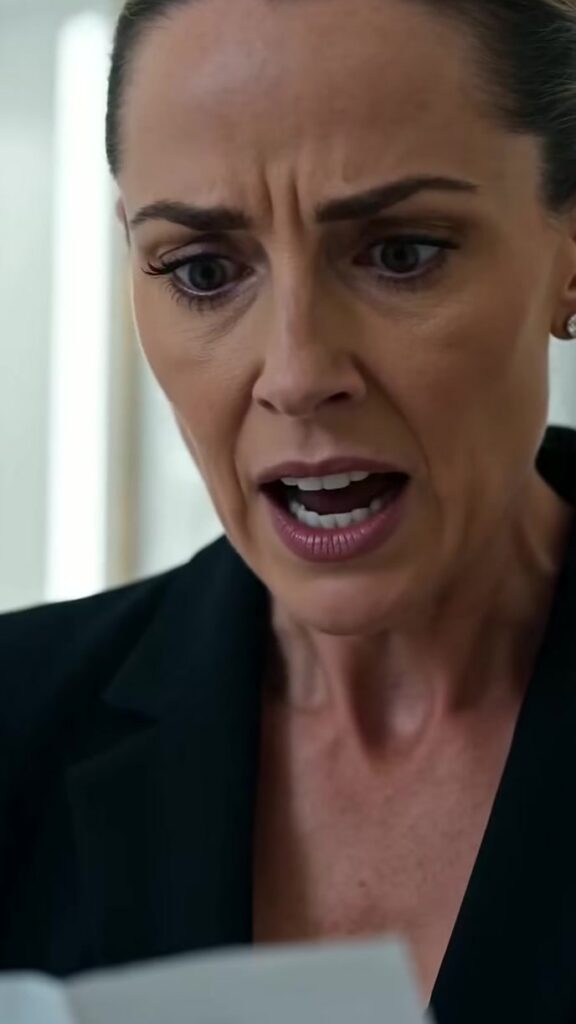
The manager came fast, heels striking like gavel blows. She was precise: hair sleek, suit sharp, lipstick the color of authority. She didn’t look at the shards first. She looked at the boy. “Do you understand what you’ve done?” Her voice was controlled, but the control made it crueler. Around her, customers leaned in with the hungry attention of people who believed they were safe from humiliation because it happened to others.
A woman in pearls let out a small laugh that carried too far. Another person lifted a phone, then another, screens blooming like pale flowers. The boy’s throat bobbed. His fingers tightened on his backpack. “Please,” he whispered, not asking for forgiveness so much as asking for air. “My mom… she’s sick. I— I came to buy her medicine.” The manager’s expression sharpened as if the word medicine were an insult to the showroom’s perfection.
With trembling hands, the boy unzipped the backpack. He didn’t pull out stolen goods or a weapon. He pulled out coins—carefully counted, mismatched, wrapped in a scrap of paper as if the paper could keep the hope together. Beneath them was a wristwatch, old but polished clean, its leather band cracked at the edges. He held it up like an offering. “I can give this,” he said, voice thin with terror. “It was my dad’s.”
“Put that away,” the manager snapped, reaching instead for the folded paper tucked beside the coins. She snatched it without permission and opened it as if she expected a lie. It was a prescription, the ink slightly smeared from being handled too often. Her eyes moved across the name at the top—and then stopped. The manager’s face drained, not into sympathy, but into shock. “Where did you get this?” she asked, suddenly quiet. Then, slower: “Your mother… is she Anna?”
The boy nodded hard, tears breaking free at last. “Anna Reyes,” he said, like saying it aloud might make her real enough to be saved. The manager’s mouth parted, but no sound came out. The room, which had been buzzing with judgment, shifted into a colder silence. A few phones lowered. Someone coughed and then thought better of it.
A cane clattered against marble. An elderly man near the far display lurched forward with a speed that didn’t belong to his years. His suit was expensive, but the fabric hung on him like it had been put on for a role he no longer knew how to play. He stared at the boy as if looking at a ghost trying on a child’s face. “Anna’s son?” he rasped. His hand shook violently as he reached into his inner pocket and pulled out a photograph, edges soft from being touched too many times.
He held it up, and the image caught the chandelier light: a younger version of himself standing in front of the same showroom, a woman beside him smiling with tired brightness. “That’s my daughter,” he said, voice tearing on the last word. “My Anna.” The manager took a step backward as if the photograph emitted heat. “No,” she breathed. “That can’t be. We were told—”
“You were told what you wanted to believe,” the old man cut in, each syllable trembling with anger held too long. He turned to the boy, eyes wet and wide. “Where is she? Is she alive?” The boy swallowed, nodding again, and the nod looked like it cost him everything. “She said… you told people she was gone,” he whispered. “She said not to come here. But she can’t work anymore. She said the medicine is expensive and… I thought if I sold the watch…”
The manager’s hands rose to her throat. The showroom’s perfection—its marble, its quiet, its polished cruelty—suddenly looked like a mask stretched tight over something rotten. Behind the manager, a security guard glanced uncertainly at a hidden earpiece, waiting for instructions that didn’t come. The old man reached for the boy’s shoulders with shaking hands, stopping an inch away as if afraid to bruise him with touch.
“What did you do to her?” the old man demanded, not to the boy, but to the room itself—and then directly to the manager. The manager’s eyes darted to the cameras in the corners, the silent observers that had recorded every flawless day. Her lips moved soundlessly, rehearsing lies that suddenly tasted wrong. All around them, the wealthy customers stood stiff and uneasy, their phones now capturing a different kind of spectacle: not a child’s mistake, but an adult’s reckoning.
The boy looked down at the shattered crystal glittering at his feet, and his voice—small, exhausted—cut through the silence. “I didn’t mean to break anything,” he said. “But my mom said this place broke her first.”