The park looked harmless at first glance. Autumn leaves painted the ground in gold and brown, and the wind moved softly through the trees like nothing in the world could go wrong there. The maples were at their peak, their branches lifting and lowering with the breeze as if breathing. Children shrieked by the swings, a dog barked at a squirrel, and somewhere beyond the pond a city bus sighed at a stop. Nothing here seemed capable of sharp edges.
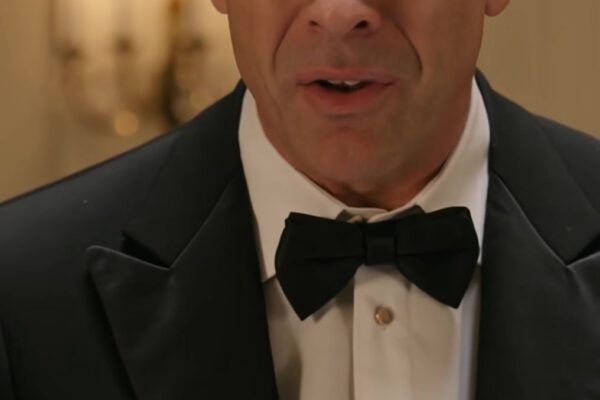
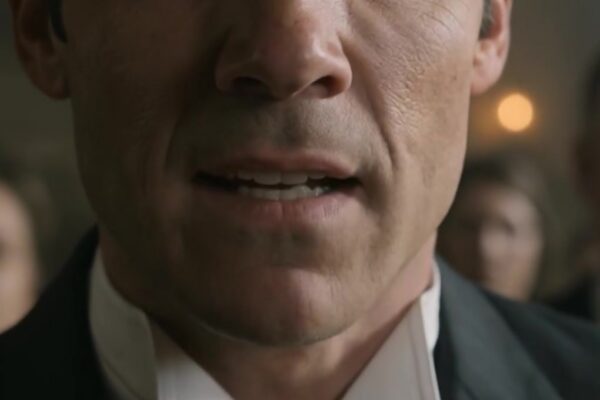
Adrian Hart sat on an old slatted bench near the path, the varnish long worn down by seasons and hands. His coat was too fine for the weather—dark wool, clean collar, the kind of cut that made strangers assume trustworthiness. In his lap, his daughter rested against him as if made of glass. Mara wore dark sunglasses despite the cloud cover, and a small white cane lay angled along the bench beside her thigh, its rubber tip barely touching the fallen leaves. She did not fidget. She did not ask for anything. She barely breathed in a way that could be seen. The stillness of her seemed like a vow.
Adrian’s palm lay on her shoulder, steadying. He had mastered this posture over the last year: protective without appearing controlling, concerned without begging for pity. When people looked at them—when their gaze snagged on the cane, the glasses, the girl’s silence—Adrian gave them a gentle, practiced nod. He had learned how to live in the theater of sympathy without cracking.
He watched the path where it bent toward the footbridge. He was waiting for Celeste. She always ran after her yoga class, always claimed the park “cleared her mind.” She had insisted the fresh air would help Mara’s nerves, that the sounds of leaves and birds might soothe her. Adrian had argued, quietly, until the argument had worn down into surrender. Celeste didn’t shout. She never needed to. She could make a room obey with softness.
A gust rolled through the trees and stirred a small storm of leaves. Mara’s head tilted as if listening to the rustle, though she would not respond when Adrian asked what she heard. Then, from the far end of the path, a figure broke into the calm like a stone hurled into still water.
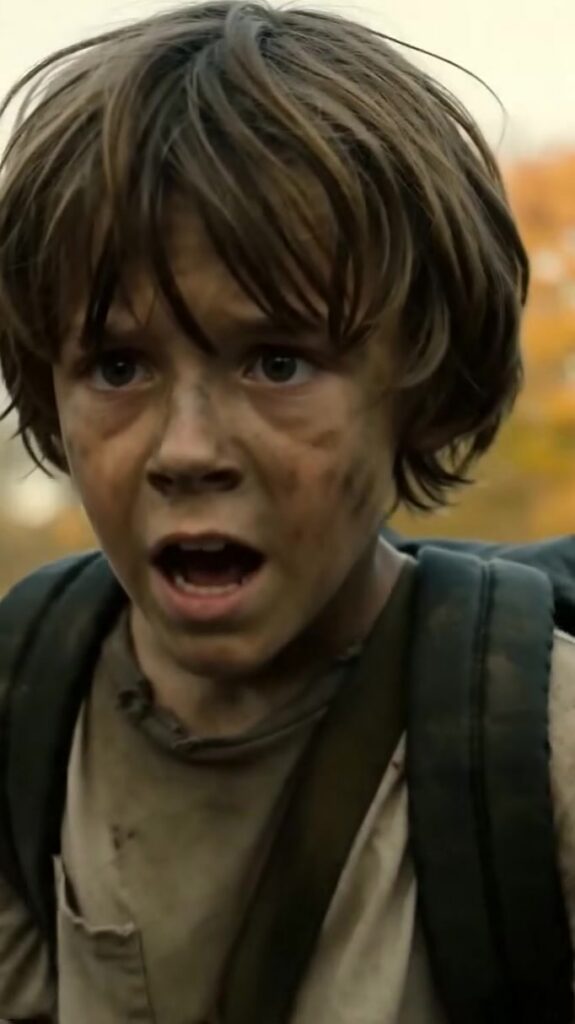
The boy ran in ragged spurts, not like someone late for something but like someone chased by invisible hands. His jacket was torn at one sleeve, his shoes mismatched. A backpack bounced against his spine, one strap barely holding, its zipper gaped open so that a notebook and a crumpled hoodie threatened to spill out. His breathing came in hard, barking bursts that drew glances from passing walkers—glances that slid away quickly, as if worry might be contagious.
He reached Adrian’s bench and stopped too close, so close Adrian smelled sour sweat and rainwater and the metallic tang of fear. The boy grabbed Adrian’s sleeve with a grip startlingly strong for his size.
“Your daughter isn’t blind,” he said.
The words landed wrong, like a foot stepping through rotten floorboards. Adrian’s first response was anger—hot and instinctive, rising to defend the one thing he believed he could still keep safe. His second response was shock, colder and more precise, because the boy’s voice didn’t have the casual cruelty of teasing. It had the tight certainty of a warning.
“What did you just say?” Adrian heard his own voice thin, almost polite.
The boy didn’t release his sleeve. His eyes flicked toward Mara, then away again, as if looking at her was dangerous.
“I saw her,” he whispered. “She looked.”
Adrian tightened his arm around Mara, feeling the small bones beneath her sweater. The bench creaked. “Get away from us,” he said, though he made no move to shove the boy off. He couldn’t. Something in the boy’s stare pinned him in place.
A leaf, slow and elegant as a falling coin, detached from a branch above and drifted down, turning in little lazy spirals. It floated in front of Mara’s face, near enough that Adrian could see its veins. He watched it, absurdly, as if the entire afternoon hinged on the leaf’s path.
Mara’s chin turned. Just a fraction. A natural adjustment, too smooth to be coincidence. Her head followed the leaf for the briefest second, aligning her face with its descent. Her fingers reached for the cane—and caught it instantly when it shifted on the bench, a reflex quick as a blink.
Silence dropped like a weight. The park sounds seemed to recede, muffled by the blood thundering in Adrian’s ears.
Adrian’s hand went rigid on Mara’s shoulder. His mouth opened, but no words came out. His mind tried to assemble explanations—wind, habit, luck, anything—but each piece he offered himself crumbled the moment it touched what he had just seen.
The boy released Adrian’s sleeve and took a step back, trembling as if the truth had physically jolted him.
“I sleep near your house,” he said. “Behind the hedge, by the gate. People don’t notice me if I stay still.” He swallowed, Adam’s apple bobbing. “I see things I shouldn’t.”
Adrian’s throat tightened. “Who are you?”
“Doesn’t matter.” The boy’s gaze darted toward the bend in the path again, toward the footbridge. “Listen. It’s your wife. She puts something in her food.”
Adrian felt the world tilt, as if the bench had become unbalanced. “What are you talking about?”
“Every night,” the boy said, rushing now, words tumbling as if they might be taken away. “I saw her at the kitchen window. She mixes it into the oatmeal. Into the juice. She wears gloves sometimes. Like she’s scared of it. And your girl… she fights it at first. Then she gets quiet. Like the lights go out.”
Adrian’s stomach clenched so hard it hurt. A memory flashed—Mara refusing breakfast, Celeste smiling too wide, coaxing her gently. Another memory: Mara’s sudden aversion to orange juice, the way Celeste had called it “a phase.” And beyond those, stranger things Adrian had dismissed because he had wanted to: Mara’s glasses appearing one morning on the counter with the price tag still on; Celeste’s insistence that the cane was “for confidence”; doctors who found nothing conclusive and suggested stress, trauma, adjustment.
“She’s my wife,” Adrian said, but his voice didn’t carry conviction. “She wouldn’t—”
The boy flinched and looked past Adrian’s shoulder.
From the distance, between the trees, a woman jogged into view. Her stride was controlled, her ponytail swinging like a metronome. She wore sleek athletic clothes and a bright watch that caught the pale sun. Celeste’s face held that calm, luminous expression she wore in photographs, the one that made strangers assume she lived without secrets.
But as she drew closer, Adrian saw something he had never let himself name: the way her eyes calculated before they smiled. The way she scanned the bench, the boy, the cane, taking inventory.
Mara remained still, sunglasses masking everything, but Adrian felt a new tension in her body, a subtle tightening as if she knew the jogger’s footsteps by heart. The boy backed away again, as if afraid the air around Celeste might cut him.
Celeste slowed to a walk, lifting a hand in a casual wave. “There you are,” she called, voice light and affectionate, meant for onlookers as much as for Adrian. “I thought I’d find you by the pond.”
Adrian could not decide whether to stand or stay seated. His hands felt wrong on his daughter, as though he had been holding her in the wrong way for months. His mind tried to leap forward into action—take Mara, run, call the police—but his body remained pinned by the most terrifying question: if Mara could see, how much of what he believed had been staged? And how much of what he loved had been used?
Celeste came closer, her sneakers whispering on leaves. She glanced at the boy with a polite frown, the sort reserved for inconveniences. “Is everything all right?”
The boy’s lips parted, but no sound came out. His eyes pleaded with Adrian, then flicked toward the path behind him as if mapping his escape.
Adrian stared at Celeste and, for the first time in their marriage, he saw her not as the center of their home but as something approaching from a distance—beautiful, composed, and suddenly, unmistakably separate from them.
“Celeste,” Adrian said, and the tremor in his voice betrayed him. “What have you been giving her?”
Celeste’s smile held. It held like ice holds shape. “What do you mean?” she asked, as if he had mispronounced a word. Her gaze slid to Mara, softening. “Baby, are you tired?”
Mara’s fingers tightened on her cane. Under the sunglasses, her head angled just slightly toward Adrian, not toward Celeste. It was the smallest movement, but it felt like an answer—an alignment, a choice.
Celeste’s eyes narrowed by a fraction, almost imperceptible. The park around them kept breathing, kept rustling, kept pretending nothing in the world could go wrong here. Yet Adrian understood, with a clarity that made him nauseous, that the harmlessness had been a costume. Something had been happening in their house, in their kitchen, in their daughter’s body, and the park was only where the stage lights finally turned.
The boy took one more step back. “She’s going to make you think you’re crazy,” he whispered, the words barely carrying over the wind. “She’s good at that.”
Celeste reached the bench. She placed a hand on Adrian’s shoulder—possessive, not comforting—and leaned in close enough that only he could hear the change in her tone, the softness sharpening into a blade.
“Don’t listen to strangers,” she murmured. “You know what grief does to people. It makes them imagine things.”
Adrian looked down at Mara, at the cane and the sunglasses and the careful stillness. His heart hammered against his ribs like it wanted out. He realized he had been trusting the wrong kind of quiet all along.
And as another leaf drifted down, he watched not the leaf, but his daughter, searching for the moment her eyes would betray the truth again—because now, truth was the only thing that might save them.