At first, no one noticed her because the room had been designed to make people disappear.
It was all gleaming symmetry: a long table polished to a black mirror, chairs spaced like measured pauses, walls washed in a light so even it felt artificial. The city beyond the high windows was blurred by rain, reduced to a moving watercolor meant to suggest distance and importance. Every person inside wore the same look—tight, attentive, carefully uninterested—like they were waiting for a cue that would tell them which emotions were allowed.
The girl sat in the narrow strip of shadow between two chairs, small enough to be mistaken for a bag or a forgotten coat. Her hair was tied back with a plain band. Her shoes were scuffed. Her hands were folded in her lap as if she were practicing stillness the way other children practiced piano. No one had asked how she got in. No one had offered her water. In the hierarchy of this place, children were either ornaments or errors.
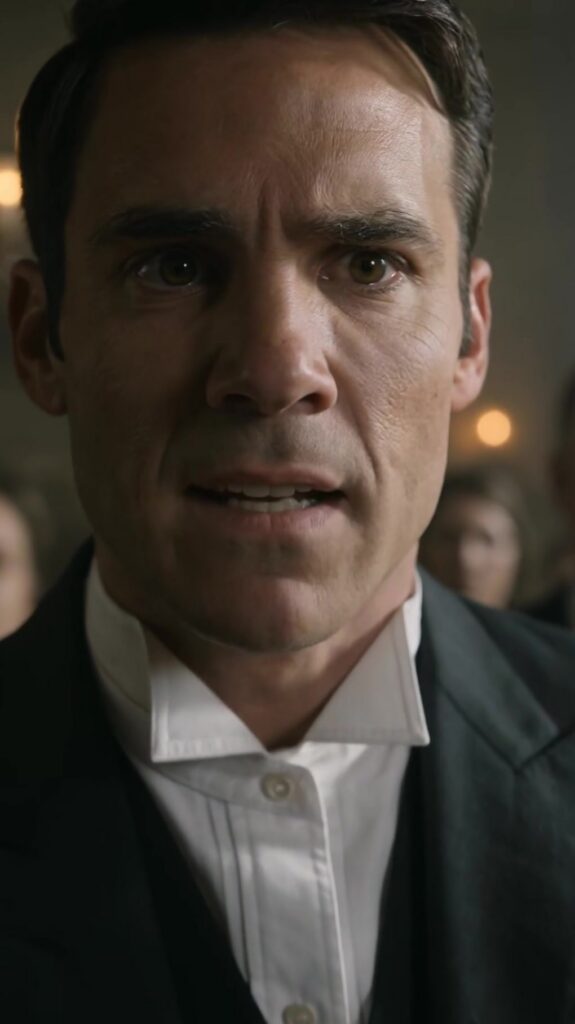
At the head of the table, Adrian Voss spoke with the calm of a man whose words could rearrange lives. He had the kind of suit that seemed to swallow light, and a voice that made people lean forward without noticing they’d moved. The others watched him as if he were a screen showing a safer world.
“We will proceed,” Voss said, sliding a thin folder across the table. A silver watch flashed at his wrist as his cuff shifted, just a sliver of metal and leather, just a glimpse of something beneath the performance.
The girl’s gaze snapped to that flash.
It wasn’t the watch itself that caught her. It was what sat just above it: a faint, crescent-shaped mark on the inside of his wrist, pale against his skin. Not a scar from a cut. Not a burn. Something old. Something purposeful. The kind of mark you couldn’t explain away with an accident unless you rehearsed the explanation.
She inhaled, slow and quiet, as if trying not to stir the air.
Voss continued, describing the terms like they were weather—inevitable, impersonal. Around him, pens hovered. Throats cleared. A man in a gray tie nodded as if nodding were his job. A woman with a gold pin tapped her fingernail in a steady, nervous rhythm.
The girl waited until Voss’s hand moved again, until the watch turned and the mark was visible once more.
Then she stepped forward.
Her chair made no sound. Her feet made no sound. Even her breath seemed to decide it would not betray her. She reached the table in three small strides and placed her hand over his wrist.
Warm skin, the pulse under it fastened suddenly to her palm.
“I’ve seen that before,” she said.
For the first time all morning, Voss stopped mid-sentence. The room did not immediately react—not because they were uninterested, but because people like this had trained themselves to pretend surprise did not exist. They were statues waiting for permission to turn.
Voss’s eyes dropped to her hand. His jaw tightened, and he pulled back as if the contact burned. “Let go.”
The girl did not move. “My father had it.”
The air changed. The temperature didn’t shift, the lights didn’t flicker, but something in the room’s confidence cracked. The table seemed longer. The silences between breaths grew heavy, measurable.
Voss stared at her then—really stared, like someone suddenly aware there had been a figure at the edge of the frame all along.
“…Who are you?” he asked.
She released his wrist and, without being asked, climbed into one of the big chairs. The leather sighed under her small weight, a sound too intimate for a boardroom.
She didn’t answer his question. Instead, she reached into the pocket of her plain coat and brought out an object that looked like it had survived fire and water and time.
A locket.
It was brass, dulled by years of touch. The hinge was worn. A faint pattern—vines or maybe thorns—curled across its face. She set it on the mirrored table and pushed it forward with one finger.
Voss’s breathing changed instantly, subtle but unmistakable, like someone catching the scent of a place they’d sworn never to return to. His hand hovered above the locket without touching it.
“…Where did you get that?” he asked.
Her eyes didn’t blink. “He told me you wouldn’t admit it.”
The woman with the gold pin leaned in despite herself. The man in the gray tie swallowed. Someone at the far end of the table shifted, the legs of their chair scraping softly—an accidental confession of fear.
Voss’s fingers finally closed around the locket, but he didn’t lift it. He looked at the pattern as if it were a language he’d once spoken fluently and hated himself for remembering. “He’s dead,” he said, the words clipped. “If you’re selling a story—”
“He’s not dead,” the girl replied. “Not the way you mean.”
Voss’s eyes narrowed. “You don’t know what you mean.”
Her small hand rose again, not toward him this time but toward her own throat. She drew out a thin chain from beneath her collar and let it spill onto the tabletop. At its end hung another locket, identical in shape and age, the same thorned pattern, the same bruised brass.
A twin.
Voss went very still. It was a stillness that didn’t come from composure; it came from calculation failing.
Slowly, as if moving too fast might shatter whatever reality he still trusted, he reached beneath his cuff and pulled out his own locket on a chain, tucked against his skin like a secret. The third piece glinted dully under the perfect lights.
Now the room wasn’t merely watching. It was waiting.
Voss’s voice dropped until it felt like it belonged to the walls. “…Say his name,” he whispered.
The girl leaned forward. Her face was close enough that Voss could see the pale flecks in her irises, the tiny scar at her chin that looked like a childhood accident and wasn’t. Her voice, when it came, was soft, almost careful—as if speaking the name too loudly would summon consequences.
“Elias Marrow.”
The name struck the room like a thrown stone. Not everyone recognized it, but everyone recognized Voss’s reaction: the involuntary flinch, the tightening around his eyes, the way his fingers reflexively curled as if holding onto something slipping away.
“That’s impossible,” Voss said, and his certainty sounded like a door being kicked shut. “No one knows that name.”
“You did,” she answered. “Before you became Adrian Voss.”
A few of the people at the table traded quick, panicked glances. Corporate myths were safer than personal histories. People like Voss were meant to be born fully formed—polished, powerful, untraceable.
The girl’s gaze flicked to the pale crescent on his wrist. “He said you’d mark yourself the same way he marked you,” she continued. “So you wouldn’t forget. So you’d always know where the hinge goes.”
Voss’s hand trembled, nearly imperceptible. “Who sent you?” he demanded, but his voice betrayed him; it was too human now, too raw. “What is this?”
She touched her locket and flipped it open. Inside was no photograph. There was a folded sliver of paper, edges worn as if it had been unfolded and refolded a hundred times. She slid it out and placed it on the table between them like a verdict.
Voss stared at the paper without opening it, as if he could already read the ink through the folds. His throat moved. His eyes shone with a fury that had nowhere to go without revealing guilt.
“Read it,” the girl said.
“If this is a threat—”
“It’s a promise,” she corrected. “And it’s yours. He said you’d understand when you saw my face.”
Voss’s gaze lifted to hers, searching. There, in the set of her mouth, in the stubborn angle of her brow, something surfaced—an echo of someone he’d buried behind new documents and clean suits and a name that sounded like money. He swallowed hard.
“He said,” the girl went on, “that you’d built a perfect room so you wouldn’t have to hear the people outside it. He said you’d forget what silence costs. He said you’d pretend you didn’t notice.”
She placed her fingertips on the folded note and pushed it forward, inch by inch, until it touched Voss’s locket like the meeting of two magnets.
“At first,” she said, “no one noticed me either.”
Voss’s hand closed over the note. For a moment he held it as if it might explode, or as if it might save him. Then his thumb worked the fold.
The people around the table leaned in, their masks cracking, their bodies betraying their curiosity and dread. The rain beyond the window intensified, a sudden hard drumming like applause for something terrible.
Voss read. His lips parted slightly. The color drained from his face. And when he looked up again, the man at the head of the perfect table looked less like a ruler and more like someone who had just been found by the past he’d abandoned.
“Where is he?” Voss asked, not as a demand now, but as a plea.
The girl’s expression softened only enough to be more frightening. “He’s in the place you made,” she said. “The place with no windows.”
Voss’s eyes widened.
“He said you would come,” she continued. “He said you would finally notice.”
She stood, the chair sighing again, and the sound seemed to wake the room from its spell. The executives shifted, ready to speak, ready to object, ready to protect the narrative that kept them comfortable.
But Voss raised a hand, and for the first time, his authority wasn’t performative. It was desperate.
“Clear the room,” he ordered, voice hoarse. “Now.”
No one argued. Chairs scraped. Papers were gathered with trembling fingers. The perfect room emptied itself of witnesses until only Voss remained at the table with the girl and three matching lockets lying like an accusation between them.
When the door shut, sealing them into a quiet thick enough to drown in, the girl finally answered the question he’d asked at the beginning.
“I’m Mara,” she said. “He called me his second chance.”
Voss closed his eyes for a brief moment, like a man bracing for impact. When he opened them again, the rainlight painted him in gray, and the mark on his wrist looked less like a scar and more like a shackle.
“And you,” Mara added, her voice barely above a whisper, “are the reason he survived long enough to send me.”