No one noticed the girl until she stopped right in front of him.
That was the strange part. The room had been built to make noticing inevitable—glass walls, bright recessed lights, a crescent table polished so clean it reflected the faces leaning over it. Men in fitted suits. A woman with hair pinned tight, the sort of pin that looked like an argument. A bank of cameras in the corners, little black eyes staring down at the proceedings. Security posted like punctuation marks by the door.
And yet the girl crossed the carpet as if she were moving through fog no one else could see. She wasn’t a child, not quite. Seventeen, maybe, with straight dark hair pulled behind her ears and a plain coat too thin for the early winter outside. No purse. No phone in her hand. No nervous tapping.
She didn’t belong in a room like that. Too quiet. Too still. Too… certain.
Alexander Vane sat at the center of the crescent, his hands folded as though they were holding a secret. He was the kind of man people said had “presence” because they didn’t want to say power. Founder. Philanthropist. The face of campaigns that promised a better city. The subject of news stories that used soft verbs—misplaced funds, questionable ties, misunderstood intentions. A man who could buy a room and make it his before he spoke a word.
Tonight was not about promises. Tonight was about damage control. The board was meeting behind closed doors because the city’s attorney had filed a lawsuit against Vane Holdings that morning. Allegations of contract manipulation. Bribes dressed as “donations.” The air itself felt legal.
Alexander’s lawyer, a hawk in an expensive suit, was mid-sentence when the girl stopped at the table’s edge, directly across from Alexander. The hawk faltered, the sentence breaking like thin ice.
A few heads turned, mostly out of annoyance. One of the security men took a step forward, then stopped as though an invisible line had been drawn.
“Wrong place,” someone murmured. It was a board member—Evelyn Hart, the CFO—leaning toward the person beside her. Her mouth formed the words as if they tasted unpleasant.
But the girl didn’t move.
Her gaze stayed fixed on Alexander’s face. Not worshipful. Not afraid. More like she was reading him, turning him over in her mind, comparing him to something she’d carried for years.
Alexander had grown used to being watched: by voters, by rivals, by photographers. He usually returned their attention with an unbothered smile. Now he simply stared back, the smile absent, his eyes narrowing as if he were trying to place her in a memory he didn’t want to own.
“Who are you?” the hawk demanded, voice sharp enough to draw blood. “This is a private meeting.”
The girl didn’t answer him. She reached into her coat pocket slowly, the movement controlled. Security tensed. One of them put a hand near his earpiece.
“Don’t,” Alexander said.
His voice wasn’t loud. It didn’t need to be. The word stopped the guard’s hand midair and cut through the room’s static as though Alexander had flicked a switch. He didn’t take his eyes off the girl.
She drew out something small and pale in her palm, then placed it on the gleaming table between them.
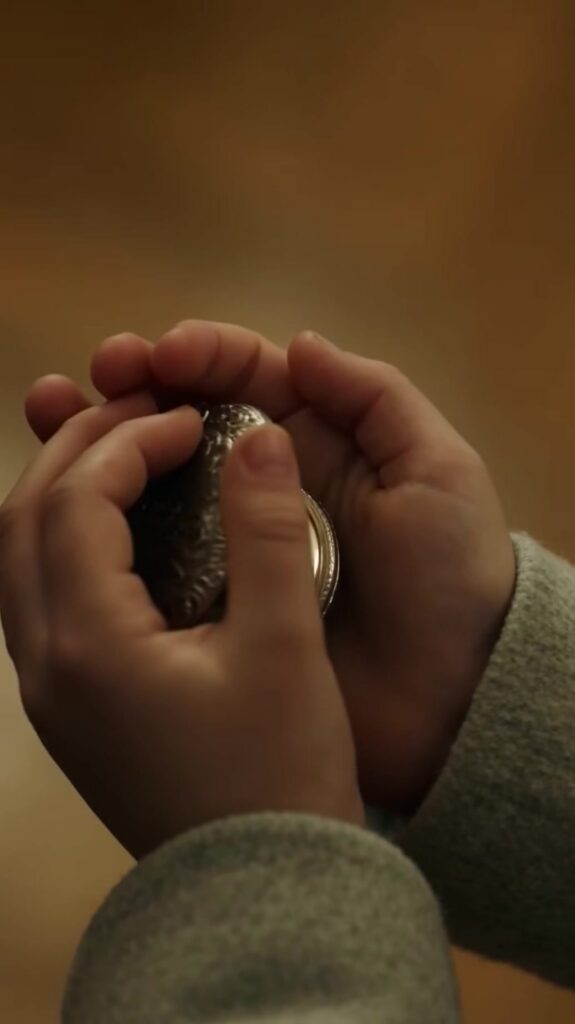
A silver locket.
It made a soft, precise sound when it touched the wood, like a coin dropped in a church. Plain oval, slightly scuffed at the edges, an engraved vine curling around the back. A simple thing in a room full of polished ambition.
Alexander barely looked at it at first. His eyes flicked down the way a man glances at an unexpected bill, ready to dismiss it.
Then his expression fell apart.
It wasn’t gradual. It wasn’t a carefully managed reaction. One second he was Alexander Vane, composed and in control. The next, the color drained from his face as though someone had opened a hidden valve.
Without thinking, his hand went to his neck.
He pulled a thin chain from beneath his collar, fingertips trembling, and drew out an identical locket.
Same shape. Same scuffs. Same engraved vine, as if both had once been pressed in the same mold and then separated for a lifetime.
“That can’t be,” Alexander whispered. The words sounded old, like something he’d said before in another room a long time ago.
The girl leaned closer, bracing her hands on the table. Her voice, when she finally used it, was steady. “My mom said you wouldn’t believe it.”
Every person at the table seemed to inhale at once. Not because of sentiment, but because they understood instinctively that something had shifted. Stories in rooms like this were weapons. A locket was a fuse.
Evelyn Hart stiffened. Her gaze snapped from the girl to Alexander’s hand at his throat, to the locket, and then to the girl’s face. Understanding made her look suddenly ill.
“Where did you get that?” Alexander asked. His hand closed around his own locket like he could crush the past if he squeezed hard enough.
The girl’s mouth twitched—almost a smile, but too tired to become one. “It was in a tin box with my birth certificate. My mother kept it under the floorboard in her closet. She said it was the only proof anyone would ever accept.”
The hawk found his voice again. “This is—this is inappropriate. Mr. Vane, we should adjourn, we should—”
Alexander lifted a hand without looking away. The hawk fell silent like a trained animal.
“Your mother,” Alexander said slowly, as if speaking the word might summon a ghost, “what is her name?”
The girl swallowed once. “Mara.”
Alexander’s eyes shut for a heartbeat, and when they opened, they were different—no longer calculating, but raw with a private kind of devastation. Around the table, people shifted, the leather of their chairs creaking like uneasy confessions.
Evelyn’s fingers tightened around her pen until her knuckles whitened. She stared at Alexander as though she were seeing him for the first time. In her face flickered something like fear. Or recognition.
“Mara Quinn,” the girl added, because names needed full weight in rooms built to deny them. “She died last spring.”
A pause. In that pause, the room seemed to remember it was on the top floor of a tower above a city that did not care who broke inside it.
Alexander’s jaw worked. “Mara’s—” He stopped, breath snagging. “Mara wouldn’t—”
“She wouldn’t what?” the girl asked, voice still level. “Wouldn’t have a child? Wouldn’t keep a secret? Wouldn’t leave you?”
The words landed like stones dropped into deep water.
Alexander flinched, almost imperceptibly, and the motion cracked his polished composure. The board members watched as if the man at the center of their empire had just shown them the seam in his armor.
“She told me,” the girl went on, “that you were the kind of person who could make inconvenient things disappear. So she kept me away. She worked two jobs. She moved every time the rent went up. She said it was safer to be invisible.”
Evelyn’s breath came sharp. Her eyes flicked to the security guard by the door, then to Alexander, and then down to the file folder in front of her like it might suddenly start burning. The lawsuit. The allegations. The years of carefully laundered virtue.
Everything made sense in the space between two identical lockets.
Alexander’s voice was hoarse. “What do you want?”
The girl’s gaze did not soften. “The truth. Not yours. The one you buried.” She tapped her locket lightly. “She said you gave this to her the night you promised you’d come back. She said you left yours with her so she’d know you meant it.”
Alexander’s hand opened slowly, revealing his own locket in his palm as if it had grown too heavy to hold. “I did mean it.”
“Then why didn’t you?”
He stared at her, and for the first time that evening, Alexander Vane looked genuinely cornered—not by law, not by headlines, but by a girl the room had failed to notice.
His eyes darted to Evelyn Hart, and something passed between them—an old agreement, a shared sin. Evelyn’s face hardened, as if she’d been bracing for this day without knowing its shape.
“Because,” Alexander said, and the word seemed to scrape his throat, “someone told me Mara stole money from my foundation. Someone told me she’d used me. Someone showed me papers—documents. They said if I went back, I’d destroy everything I’d built. They said Mara would ruin me.”
The girl’s expression didn’t change, but her fingers curled against the table. “Who said that?”
Alexander’s gaze remained on Evelyn for a beat too long.
Evelyn rose halfway from her chair, forced a laugh that sounded like a snapped wire. “This is absurd. Mr. Vane, we’re in the middle of a legal crisis, and—”
“Sit down,” Alexander said.
His tone made the room freeze. Evelyn sank back, her face pale beneath her powder.
The girl watched him closely, as if she were listening not just for what he said but for what the room refused to admit. “My mother kept every letter she wrote you,” she said. “They were never opened. They were returned. Always returned.”
Evelyn’s pen clattered onto the table.
Alexander’s eyes widened, the last pieces clicking into place with sickening clarity. “No,” he breathed. “No…”
He looked at the locket again, then at the girl, and something inside him seemed to collapse in on itself. It wasn’t just regret. It was the realization that his life’s architecture had been built over a missing person, and the foundation had been designed to keep her buried.
The girl slid a folded paper from her pocket and placed it beside the locket. “That’s my birth certificate. And that’s the address of the apartment where she died. If you want to pretend I’m not real, you can. She said you would try.”
Alexander’s hand hovered over the paper without touching it, like a man afraid it might bite.
“But,” the girl said, leaning in, voice lowering so only he could hear, “if you’re as powerful as everyone says, you can do one thing for her now. You can stop hiding behind other people’s lies.”
He met her eyes then, and the room—full of cameras, full of money, full of people who thought they understood control—felt suddenly small.
Alexander Vane, who had made a career out of shaping stories, opened his mouth as if to speak.
And for the first time in decades, he seemed unsure which story would save him—and which one would finally ruin him.