No one noticed the girl at first, and that was the strangest kind of mercy. In the Hall of Marrow & Glass, where the chandeliers dripped light like frozen rain and the silverware was polished to an almost cruel gleam, invisibility was a shelter. People came here to be seen. They wore their wealth like perfume and laughed in careful, cultivated notes over wine that cost more than a month of someone else’s rent. The staff glided between tables in black and white, eyes trained not to linger. Even the music was trained—strings moving softly enough to flatter conversation.
The girl moved against all of it like a wrong note held too long.
She was barefoot. The marble chilled her soles, and she trembled with the persistent shiver of someone who had not been warm for days. Her dress had been nice once, perhaps a pale color now smeared with the city’s gray. At the hem, it was torn, and one sleeve hung in a loose thread that caught on her elbow each time she lifted her hand. She clutched the fabric at her collar as if she could cinch it into respectability. Her eyes were too old for her face, wide and wary, not pleading so much as measuring—counting exits, counting anger, counting the distance between herself and the thing she wanted.
She stepped toward a table that had no place for her. The table belonged to an older man sitting alone. He ate with the steady restraint of someone whose life had been arranged by habit: knife and fork moving with calm precision, napkin folded neatly, the gleam of an expensive watch disappearing and reappearing as his wrist turned. His hair was gray at the temples, his posture straight, his expression unreadable in the way powerful men learn.
He should not have noticed her either.
But then he felt it—the kind of presence that doesn’t announce itself with sound. It pressed against him, not demanding, not threatening, simply there. Like a hand on the edge of a door you thought you’d locked long ago.
He looked up.
And there she was, standing close enough that the candlelight caught the grime at her knees and made it look like bruising.
“I’m hungry,” she said. Her voice barely rose above the clink of glasses and the muted laughter. “Can I eat?”
The question didn’t have the shape of begging. It didn’t even have the shape of hope. It sounded like a fact spoken aloud because there was nothing left to do with it but name it.
The man’s fingers paused mid-motion over the plate.
A beat passed—one small gap in the room’s choreography—and then the correction came, sharp and swift. A security guard moved in with the speed of someone trained to remove discomfort before it spreads. His hand reached toward the girl’s shoulder, not quite touching, but close enough that she flinched as if she’d already been struck.
“You need to leave,” the guard said, his voice hard with rehearsed authority.
At a nearby table, an elegant woman in a pearl-colored dress turned and recoiled. She made a small sound of disapproval, as though the child had tracked mud across her own shoes. “This is disgusting,” she muttered, looking away as if refusal to see could scrub the scene clean.
The girl’s shoulders drew inward. Her hands tightened on her torn neckline. She didn’t run. She didn’t argue. She simply stayed, eyes fixed on the older man with a steadiness that made the guard hesitate for a fraction of a second.
Something shifted in the man’s face. It was subtle—no dramatic flare, no sudden anger—just the tiniest tightening around his mouth, the softening of his gaze as if he’d been startled into recognition by a sound only he could hear.
He raised one hand, palm outward.
“Stop,” he said.
The guard froze as though the word had weight. The air around the table changed. Conversations dimmed. The violinist, sensing the room’s tension, drew a slower note that lingered too long.
The man leaned forward, not studying the girl’s dirt or her bare feet, not even the torn dress. He studied her face. Her eyes. The way she held herself like someone bracing for weather.
“What’s your name?” he asked, quietly.
She swallowed. “Lina.” It came out as if she wasn’t sure it would be safe to answer.
“Lina,” he repeated, letting the syllables settle. “Who brought you here?”
She hesitated, then lifted her chin a fraction. “No one. I followed the lights.” A pause. “I smelled food.”
The older man’s gaze flicked to the guard. “Give her space.”
The guard’s hand fell away, but he remained close, like a shadow that would not agree to become harmless.
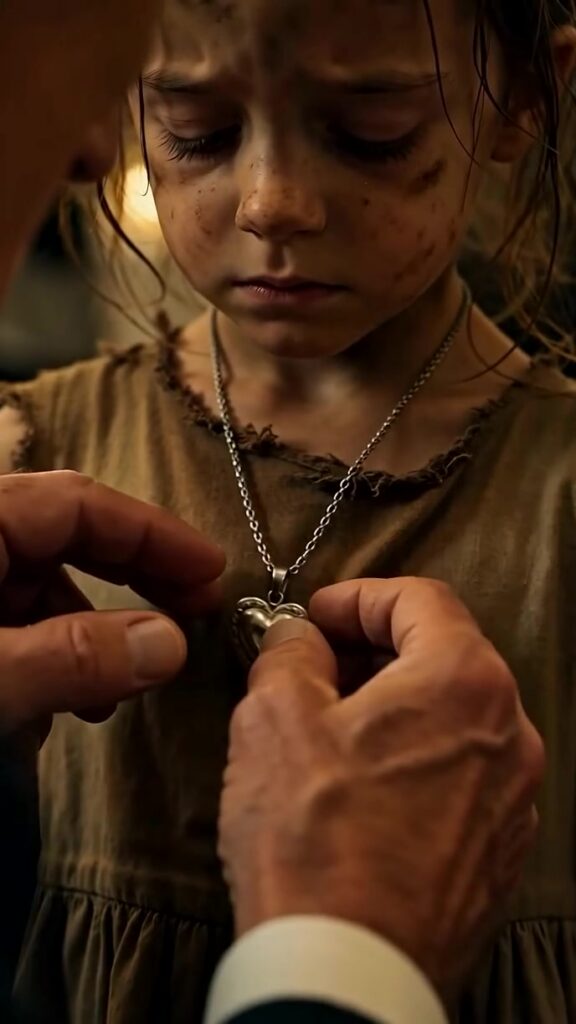
The girl’s eyes never left the man. She edged nearer, one careful step at a time, and as she did, her trembling fingers slipped at her collar. The torn fabric pulled down slightly, revealing the thin chain around her neck.
A small silver heart hung there, dulled by time and grime but unmistakable in its shape. At the center of the heart was a tiny notch where something had once been fitted—an inset stone, perhaps, or a second piece that completed it. The metal caught the candlelight and sent a faint flash across the man’s face.
His entire body went still.
It was as though the room—chandeliers, laughter, wine—collapsed into silence, leaving only that small heart and the man’s widening eyes. His breath hitched, an involuntary break in his composure.
Slowly, with the care of someone approaching a relic, he reached out. His fingers hovered an inch from the necklace, then gently lifted it between thumb and forefinger. The chain made a faint metallic sound as it tightened, and the girl stiffened, but she did not pull away.
The man’s hand trembled.
“Where did you get this?” he asked. His voice had lost its practiced smoothness; beneath it was something raw, close to pain.
“My mom gave it,” Lina said, confused by his reaction. “She said it was for… for when I’m scared.”
The man’s eyes shone, not with sentiment but with a kind of fierce clarity. He leaned closer, lowering his voice as if the room itself might steal the answer from him.
“What is your mother’s name?”
Lina took a small breath. Her gaze flicked toward the guard, toward the elegant woman watching from the corner of her eye, toward the strangers whose attention had sharpened into quiet hunger. Then back to the man, as if she had decided he was the only real thing in the room.
“Mara,” she said. “Mara Vale.”
For a moment the man looked as if he’d been struck. The name landed on him with the force of a door kicked open in the dark. His fingers tightened around the heart until his knuckles paled.
“No,” he whispered, and the word was not denial so much as disbelief. His throat worked. He swallowed hard, then lifted his eyes to Lina’s face again—searching her features like a map. The shape of her mouth. The set of her brow. The shadow of something familiar in her cheekbones.
“Mara Vale is…” His voice faltered. “Where is she?”
Lina’s bravado—thin as it was—fractured. Her mouth opened, closed. She blinked quickly, as if trying to keep tears from turning into something worse. “I don’t know,” she said, and now the hopelessness in her voice was unmistakable. “She told me to wait. She said she’d come back. But—”
She clutched the necklace instinctively, but the man still held it. The chain tugged gently between them, binding them with a piece of silver that suddenly felt like a hand across time.
“How long have you been waiting?” he asked.
Lina’s voice grew smaller. “Two sleeps. Maybe three. I got hungry. I got cold.”
The man’s chair scraped the floor as he stood, abrupt enough that nearby diners flinched. He looked taller now, not merely because he was upright, but because something in him had risen—an authority sharpened into purpose. He did not release the necklace yet. He didn’t let go of the only proof that the past was not as buried as he’d believed.
He turned to the guard. “Get the manager. Now.”
“Sir—”
“Now.”
The guard moved, finally, but his eyes held suspicion, as though he feared a trick. The elegant woman at the adjacent table drew herself away, lips pursed as if the scene offended her appetite.
The man faced Lina again and, with a gentleness that looked unfamiliar on him, let the heart slip from his fingers. It fell back against her chest with a soft tap. He crouched so his eyes were level with hers.
“Lina,” he said, and his voice carried the weight of a promise he hadn’t made in decades. “My name is Adrian Kells.”
The name meant nothing to her. She only stared, trying to decide if he was like the others—danger dressed in politeness.
“That necklace,” he continued, “it was made in a shop on Harbor Street. It was made for a girl named Mara when she was seventeen. She wore it every day until she disappeared.”
Lina’s brow furrowed. “My mom isn’t disappeared. She’s… she’s just late.”
Adrian’s jaw tightened. The chandeliers above them glittered mercilessly, indifferent to truth.
He reached into his jacket and pulled out his phone with hands that were still unsteady. “We’re going to find her,” he said. “But first you’re going to eat. And you’re going to be warm. And no one here is going to touch you.”
As he spoke, Lina’s eyes flicked to the untouched bread on the table—round and golden, sitting beside a dish of butter that looked like a carved rose. Her stomach growled audibly, and her face flushed with embarrassment.
Adrian broke the bread with his own hands and held out half to her. “Here,” he said.
Lina hesitated. The room held its breath. Then, slowly, she took it. Her fingers shook as she brought it to her mouth. The first bite was small, careful, as though she feared the food might vanish if she trusted it. Then she chewed, and something in her expression softened—not relief exactly, but the faintest easing of a tension she’d been carrying like a second skin.
Adrian watched her eat, and in his eyes a different hunger burned: the need to undo something. The need to answer for time. Around them, the Hall of Marrow & Glass tried to return to its delicate rhythm, but it couldn’t. Too many people had seen the crack in the world’s polished surface.
When the manager approached, face tight with rehearsed politeness, Adrian didn’t look up. His attention remained on the child who had walked into his life like a ghost given flesh.
“Call my driver,” he said, voice low but absolute. “And call the police—quietly. Tell them it’s about Mara Vale.”
The manager blinked. “Sir, are you sure—”
Adrian finally lifted his gaze, and the air around his words turned sharp. “I’ve never been more sure of anything.”
Lina swallowed another bite, eyes fixed on him. “Do you know my mom?” she asked, barely audible.
Adrian’s face tightened with grief and something like guilt. He reached out, not to take the necklace this time, but to rest his hand on the edge of the table near hers—close enough to be offered, far enough to be refused.
“I knew her,” he said. “A long time ago. And I should have looked for her harder.”
Lina stared at the silver heart against her chest as if it had suddenly grown heavier. “Will you… will you make her come back?”
Adrian’s throat worked again. Outside the tall windows the city moved on, lights passing like indifferent stars. Inside, under the chandeliers, a man who had spent years building a life of controlled distance felt that distance collapse into urgency.
“I can’t make promises I can’t keep,” he said, and the honesty of it cut the air. Then he leaned in, voice fierce with intent. “But I can promise this: you won’t be waiting alone anymore.”
Lina’s eyes glistened. She nodded once, small and solemn, as though sealing an agreement.
In the room filled with crystal and quiet laughter, the girl who hadn’t belonged had been seen at last. And the heart around her neck—dull silver, battered by time—had turned a stranger’s attention into a reckoning.
Somewhere beyond the restaurant’s polished doors, the past was moving, whether Adrian Kells was ready or not.