The rooftop sat so high above the river that the city looked arranged for the occasion: avenues stitched with headlights, office towers blinking like patient stars, the distant bridges strung with light. The gala’s glass pavilion—an immaculate prism at the crown of the skyscraper—held back the wind with transparent walls that reflected tuxedos, diamonds, and the constant soft pulse of camera flashes. Waiters threaded through the crowd with trays that shone under the chandeliers, and every flute of champagne looked like it had been poured from liquid gold.
It was the sort of night where charity felt like fashion. People smiled for each other’s lenses, angled their wrists so watch faces caught the light, whispered numbers that were meant to be overheard. A jazz trio played near the orchids, and laughter drifted up into the ceiling like helium. At the center of it all stood Adrian Vale, the event’s patron and the city’s most studied success story: self-made, philanthropic, untouchable. He was a man who looked built for stages—shoulders square, voice capable of warmth and authority in equal measure—yet tonight his hands trembled faintly at the podium as if the air itself had weight.
“Every year,” he said, addressing a sea of black ties and jeweled throats, “we tell ourselves that the skyline below is proof of what we can build. But what we build means nothing if we forget who gets left in the shadows.” Behind him, a screen looped images of smiling children in new classrooms, the familiar montage of change. Adrian’s eyes swept over the audience, and he smiled on cue when someone called his name. Somewhere in the crowd, a prominent donor raised a phone and began recording. Others followed, as they always did. The moment was predictable, rehearsed, safe.
Until it wasn’t.
Halfway through a sentence, Adrian’s gaze snagged on something beyond the glass doors that led to the rooftop courtyard. His mouth remained open, but no sound came out. It was as if someone had reached into his chest and pressed a thumb against his heartbeat. The smile collapsed. Color drained from his face, replaced by a look that didn’t belong in a room full of donors—recognition so sharp it bordered on pain.
“No,” he breathed, barely audible. “That can’t…” The rest of the thought crumbled. His voice didn’t crack from fear; it fractured under the sudden weight of memory, the kind you spend years sealing behind expensive suits and charitable headlines.
Silence spread through the pavilion with the speed of a dropped glass. The jazz trio faltered into an awkward final chord. Laughter died mid-exhale. People turned as if linked by the same wire. More phones lifted, hungry for the unscripted. The camera of the evening—the one the event hired to capture glossy footage—whipped toward the glass doors, following the direction of Adrian’s staring, and the guests’ attention moved as one.
Outside, the rooftop courtyard gleamed with rain. Marble steps led down to a small open space bordered by planters and sculpted steel. The storm had just passed, leaving the air wet and bright with reflected neon. Security normally kept that area clear, yet at the base of the steps a child worked quietly, a broom almost as tall as she was. She couldn’t have been more than ten. Her clothes looked thin, patched at the elbows, damp around the cuffs. Her hair was tied back with a fraying ribbon. She swept with the practiced concentration of someone taught that attention kept trouble away.
She did not look up at the glass palace above her. She did not seem to notice the wealth looking down.
Adrian moved before anyone understood. He left the podium, brushing past a startled assistant, and pushed through the doors into the rain-scented air. The guests parted, murmuring, phones trailing after him like a school of curious fish. Security stepped forward, uncertain, but something in Adrian’s face made them hesitate. He crossed the slick marble with careless speed, his dress shoes splashing through shallow puddles, his tuxedo jacket already beading with water.
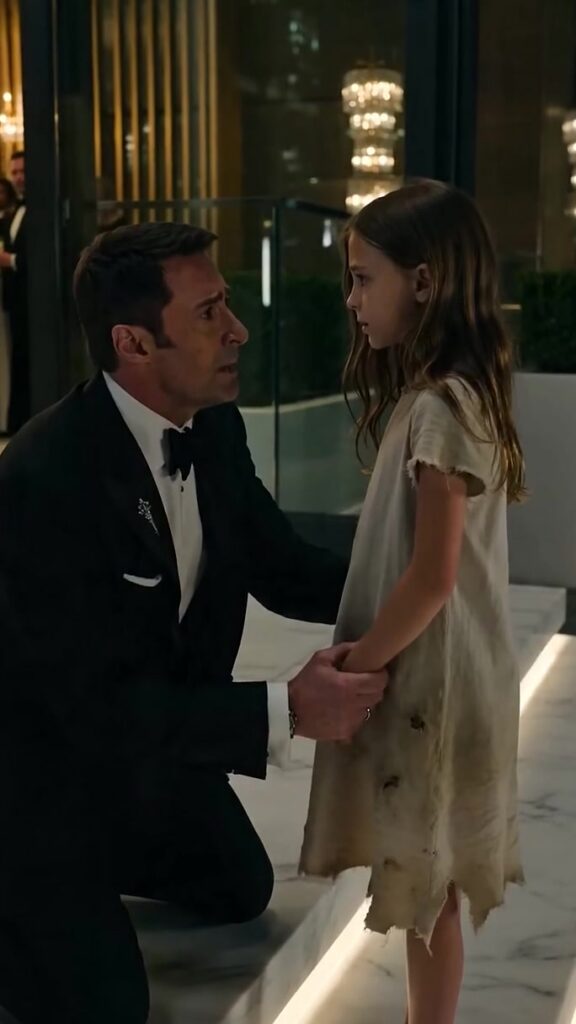
He stopped in front of the girl so abruptly that her broom bristles skidded. She glanced up at him, wary rather than afraid, as if she’d learned to measure adults by their tone. Adrian stared at her hands, then reached for one gently—too gently for a man used to controlling boardrooms.
“Wait,” he said, voice raw. “Let me see your hand.”
Her fingers were cold, small within his. Rainwater clung to her skin. And there, on the inside of her wrist, was a mark—dark as ink, shaped like a crescent bruise that had never healed. Adrian’s grip tightened as if the mark were a tether he could not afford to lose.
His face fractured. Not into anger, not into panic, but into something far older: a grief that had been waiting years for a name.
“That mark,” he whispered. His throat worked as though swallowing broken glass. “It’s real.”
The girl blinked, confused by his intensity. “Sir… I’m just cleaning. They told me to finish the steps before the next guests come out.” Her voice was steady, too steady, like someone who had learned that feelings didn’t help when you were trying to keep a job.
Adrian dropped to his knees on the wet marble. The sight of him—Adrian Vale, king of the skyline—kneeling in rain like a man begging forgiveness from the ground, sent a ripple through the onlookers. Cameras zoomed. Someone whispered his name like it was a prayer and a scandal at once. Adrian didn’t care. His eyes were locked on the child’s wrist as though that small dark crescent could open a door he’d spent years bricking shut.
“What’s your name?” he asked. The question came out shaking.
A pause stretched, filled with distant traffic and the soft hiss of rooftop fountains. “Lina,” the girl said at last.
The syllables struck him with the force of a remembered song. Adrian’s breath caught. Tears gathered quickly, humiliatingly, in the corners of his eyes. He had not cried at mergers, at funerals, at the day his mother’s apartment was emptied and sold. But a child’s name—this child’s name—undid him with brutal ease.
“Your mother,” he said, leaning forward as if the air between them could shatter. “Tell me her name.”
Lina’s gaze dropped to the marble, to the line of water her broom had pushed. Her shoulders tightened. “She told me never to say it.”
The city seemed to fall away. The laughter upstairs might as well have belonged to another planet. Adrian’s voice softened into something pleading. “Please. I need to know.”
Lina lifted her eyes, and for the first time she looked directly at him—not impressed, not dazzled, simply searching his face as though checking it against a story she’d carried alone. Rain slid down her cheek, indistinguishable from whatever she refused to call tears.
“She said… if someone ever finds me because of this,” Lina murmured, raising her wrist slightly between them, the black crescent gleaming wetly under the courtyard lights, “then he’s my father.”
Adrian’s hands flew to cover his mouth, as if to keep a sound from escaping that might split the night open. His shoulders shook once, twice. He lowered his hands and looked at Lina as though he were seeing the past rearrange itself, every polished headline suddenly stained with a truth he could not scrub away. Behind them, the glass pavilion held its breath, a thousand privileged witnesses capturing the moment a man’s carefully built life cracked under the weight of a small, rain-cold hand.
“Lina,” Adrian whispered, as if repeating her name could keep her from vanishing. “Where is she? Where is your mother now?”
Lina’s fingers curled around the broom handle, knuckles whitening. “I don’t know,” she said, and the calm in her voice finally wavered. “They moved me. They said it was safer. But she told me you would come if you were real.”
Adrian looked up at the towering glass around them—the building bearing his name, the night reflecting his wealth—and something fierce settled into his expression, an emotion the cameras had never captured: not charm, not charisma, but a vow.
“Then I’m real,” he said hoarsely. “And I’m here.”
He stood, still holding Lina’s hand, and turned back toward the doors where a hundred lenses waited. The gala inside no longer felt like a celebration. It felt like a courtroom, and he was walking into it with rain on his suit and the truth in his grasp.