Emma had stopped feeling embarrassed a long time ago. Embarrassment was a luxury, like clean socks or fruit that wasn’t bruised. It belonged to the version of her that used to flinch when someone stared too long, the version that worried about smudged mascara and awkward silences. That woman had evaporated one winter at a bus station with no money and three children who didn’t understand why their mother’s hands were always shaking.
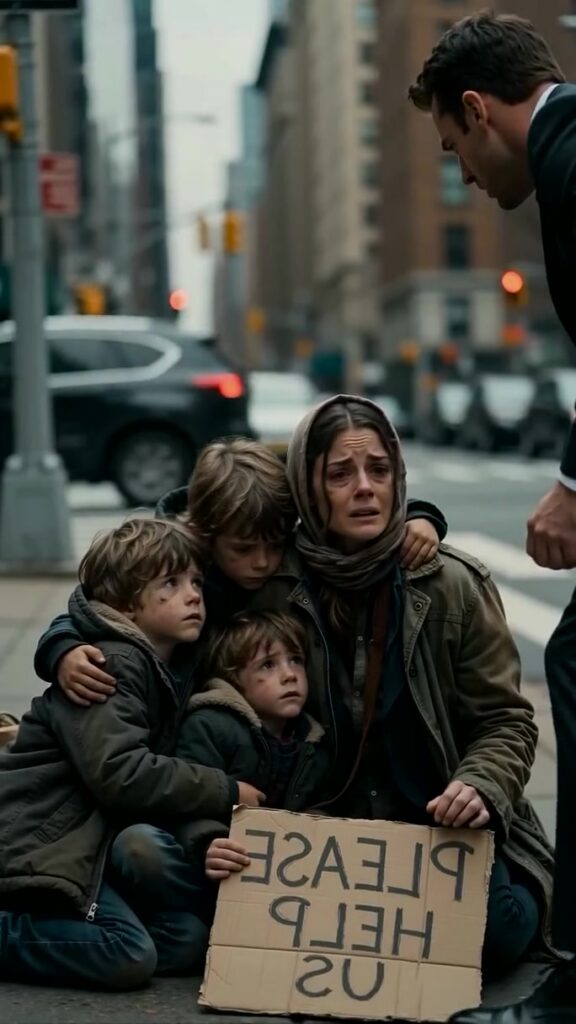
On this particular day, the wind cut along the avenue like it was sharpened for the purpose. The city’s glass buildings caught the pale light and threw it back without warmth. Emma sat on the sidewalk where the foot traffic was heavy, her back pressed to a stone wall that stole heat from her bones. Her children leaned against her in a tight, practiced cluster: Tessa drowsing in and out, Milo clutching Emma’s sleeve with raw red fingers, and Jonah—old enough to know what words cost—watching shoes pass with eyes that looked too calm for eight years old.
The sign on Emma’s lap had been rewritten so many times the cardboard had become soft at the edges. PLEASE HELP US, it said in careful block letters. She lifted it when footsteps thickened, then lowered it when the crowd thinned, because she’d learned that holding hope too high for too long made your shoulders burn.
People moved around them like water around stones. Some stared and then snapped their gaze away as if the sight of hunger was contagious. Some stepped wide, offended by the inconvenience of needing to avoid a family. Every now and then a coin appeared—rare, quick, almost apologetic—clinking into the plastic cup. It was never enough. It was always something, and something could be divided into three pieces if you were careful.
Emma’s hands trembled as she raised the sign again, fingers stiff and cracked. “Please,” she murmured to no one in particular. “Anything helps.” She’d said it so many times it had become a prayer without a god.
A pair of polished black shoes stopped directly in front of the cardboard. Not hesitating, not sidestepping. Stopping. The hem of a dark coat hung still, unbothered by the wind as if the man wore an invisible wall around himself.
Emma stared at the shoes, then at her cup, waiting for the drop of a bill or the clink of change. Nothing came. She swallowed. “Please… anything helps,” she repeated, her voice smaller than the traffic.
The man did not move. Instead he bent a fraction, as though gravity had suddenly remembered him, and the pause stretched until Emma’s skin prickled. Then he said her name like it was an accident he couldn’t take back.
“Emma?”
Her spine locked. She knew that voice the way you know a song that used to play in every room of your life. The syllables carried years, carried a particular kind of certainty, carried the smell of aftershave and the feeling of being safe in someone else’s arms.
Emma looked up slowly, as if movement might break something already cracked. The man’s face was clean-shaven, his jaw sharper than she remembered, his eyes the same dark brown that once made her laugh in the kitchen because he couldn’t pretend to be angry for more than ten seconds. Daniel. Daniel in a suit that probably cost more than the rent she hadn’t paid in months.
For a heartbeat the city disappeared. Not the cold, not the hunger—but the noise fell away, and Emma saw only the past rushing toward her like an oncoming train.
“Daniel,” she heard herself say, and hated the way her voice softened around his name.
His gaze moved over her as if he were taking inventory of a disaster. Her headscarf. Her hollow cheeks. The chapped skin. The children pressed against her as if she were their only wall between them and the world. His eyes snagged on Jonah first—on Jonah’s steady stare—and something in Daniel’s face flickered as though he’d been struck.
“What are you doing here?” he asked. His tone was low, not cruel, but wounded, as if Emma had personally built this sidewalk and chosen to sit on it just to hurt him.
Heat rose behind Emma’s eyes and she forced it back. Crying made children afraid. Crying made people look harder. “I didn’t expect to see you,” she said, and that was the kindest truth she could offer. Of all the people in the world, he was the one person she’d begged fate not to place in front of her like this.
Milo coughed into his fist, the sound thin and rattling. Emma pulled him closer, rubbing his back with a hand that wouldn’t stop shaking. Daniel watched the motion, watched the way her fingers automatically found the boy’s spine, watched the way Tessa’s head lolled against Emma’s shoulder. His expression shifted from shock into something heavier—recognition, then dread.
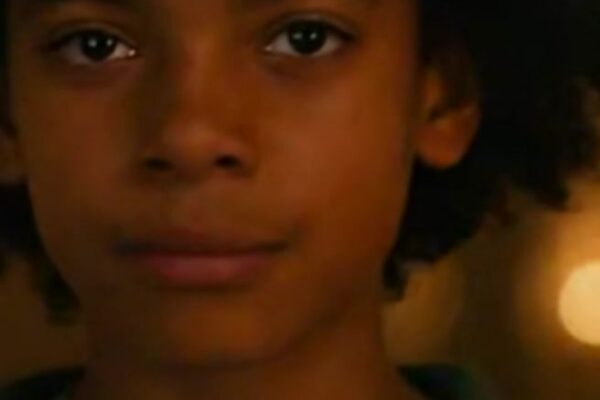
Jonah’s voice came out small but clear. “Mama,” he whispered, tugging her sleeve. “Who’s that man?”
Emma’s heart kicked hard against her ribs. She glanced at Jonah’s face—his brows, his mouth, the exact way he tilted his head when he was thinking. She’d told herself for years that resemblance didn’t mean anything. Children looked like all sorts of people. Genes were complicated. Life was messy. But Daniel was staring now as if the world had turned a fraction sideways.
“Emma,” Daniel said, barely breathing. His eyes moved from Jonah to Tessa to Milo, each time returning to her with increasing horror. “These children… how old are they?”
She could have lied. She could have said they were cousins. She could have said anything. But Jonah was watching her, and Jonah had survived too much to be fed another story.
“Jonah is eight,” Emma said, her voice flat with exhaustion. “Tessa is six. Milo is four.”
Daniel’s throat bobbed. “Eight,” he repeated, and the number seemed to slice him open. He looked down at Jonah again, at the steady eyes that were too similar to his own. “Emma… are they—”
Jonah’s question cut through before Daniel could finish. He looked straight at Daniel as if the man’s suit and clean hands did not matter. “Are you the man Mommy cries about at night?”
The sidewalk, the passing feet, the cold air—all of it felt suddenly too sharp. Emma flinched as though Jonah had shouted. She hadn’t known he’d heard her. She hadn’t known her grief had leaked that far.
Daniel went pale. For a second he looked like he might step back, like he might run. Then he crouched, not caring about the stone dust on his coat, his attention fixed on Jonah with a kind of fragile reverence.
“What does she say?” Daniel asked, voice rough.
Jonah shrugged with the bluntness of a child who has learned not to waste words. “She says your name. She says she shouldn’t have been proud. She says you would’ve helped if you’d known.” He frowned. “And she says sorry.”
Emma’s chest tightened until she couldn’t draw a full breath. Pride. Yes. Pride had been the last piece of herself she’d clung to, even when everything else broke. When Daniel left—when he believed the lie she’d let him believe because she was angry and terrified and too young to ask for mercy—she’d told herself she would manage. She would not crawl back. She would not beg. She would not give him the chance to look at her with pity.
But pride didn’t buy formula. Pride didn’t stop fevers. Pride didn’t keep the heat on when the landlord hammered at the door.
Daniel’s eyes lifted to Emma’s face. In them she saw the man he had been, and the man he might still be—if the world had treated him kindly enough to stay soft. “Why didn’t you tell me?” he asked. It wasn’t accusation so much as anguish, a question that had no safe answer.
Emma’s jaw trembled. She pressed Milo’s head into her shoulder and inhaled his hair, the faintest scent of cheap soap from a shelter bathroom. “Because you were done with me,” she whispered. “And because I thought I could survive without you.” She swallowed against the sting. “I was wrong about the second part.”
Daniel stared at the children again, like he was seeing the shape of an entire hidden life. Then he did something Emma didn’t expect: he took off his gloves. His hands were warm-looking, steady. He set them gently on Jonah’s shoulders, as if asking permission through touch alone.
“I’m not done,” he said, voice fierce and shaking. “I was never done.” He looked up at Emma, and the polished world around him—his coat, his shoes, his distance—seemed to crack. “Come with me. All of you. Right now.”
Emma’s first instinct was to refuse. Her pride rose up like an old reflex, angry and useless. But Milo’s cough answered for her, and Tessa’s small body shivered against her side. Jonah watched her, waiting to see what kind of mother she would choose to be: the kind who clung to dignity, or the kind who chose warmth.
Emma lowered the cardboard sign into her lap. The words stared up at her—PLEASE HELP US—no longer a plea aimed at strangers, but a confession she could finally stop carrying alone. She looked at Daniel’s face, at the fear there, the guilt, the determination, and she let herself imagine a door opening instead of another one slamming shut.
“If this is a mistake,” she said, voice hoarse, “it will break them. Not just me.”
Daniel nodded once, sharply, as if he’d been waiting for that exact condition. “Then I won’t make it a mistake.” He held out a hand, not to pull her up like a charity case, but to steady her, to acknowledge the weight she’d been bearing. “I can’t fix the years I missed,” he said. “But I can start now.”
Emma stared at his hand. The wind kept cutting through the street. People kept hurrying past. But in that small space between her palm and his, the world paused, balanced on the edge of what came next.
She placed her hand in his, and the heat of it startled her like sunlight. Then she gathered the children, one by one, and stood. Her legs wobbled. Daniel’s grip held firm. As they stepped away from the wall, Emma realized she hadn’t been embarrassed for a long time—because survival had made shame feel small. Now, with Daniel beside her and her children pressed close, a different feeling crept in, unfamiliar and dangerous.
It was hope. And it was heavy enough to make her tremble.