No one knew the boy’s name, and that was the first way the city had learned to keep him small.
He moved through the late afternoon like a shadow that didn’t belong to any body—thin arms, cracked heels, hair stiff with dust and old sweat. The street he worked was always loud: buses grinding their teeth at the curb, vendors shouting over one another, horns pressed in impatience as if noise could split traffic open. The sun sat mercilessly above it all, flattening every color into glare. Somewhere in that brightness, the boy was invisible.
He wasn’t supposed to be there. Not in the way people meant it when they said it. Children like him were meant to exist in alleys, behind markets, in the gaps between buildings. Not in the middle of the boulevard where the city pretended to be clean.
He crouched beside a dented trash barrel, fingers moving quickly, practiced. He wasn’t hunting for treasure. He was hunting for survival: a half-crushed water bottle he could trade, a scrap of metal, an unopened packet that hadn’t been soaked through. He found a bruised mango skin and frowned at it as if it had disappointed him personally. Hunger had a way of making you angry at everything, even fruit peels.
People streamed past. Shoes clicked. Perfume drifted. Laughter flew over his head like birds that never landed. A woman in a pale dress tugged her child closer without looking down, as if the boy were a puddle to avoid. A man in a suit stepped around him with irritation, never breaking his phone call. The boy’s shoulders tightened but he didn’t lift his eyes. If you looked at them, sometimes they noticed you—and being noticed could be as dangerous as being ignored.
He had a plastic bucket beside him, once white, now the color of every street it had ever been dragged across. In it sat water he’d pulled from a leaking pipe behind the bakery earlier, the kind of water that carried an oily sheen and the memory of rust. He used it to rinse his hands, to dampen rags for wiping windshields when drivers felt generous. He used it for bargaining—“Look, I can clean,” he would say, even when no one asked.
That day, no one asked.
He dug deeper, knuckles scraping against the barrel’s jagged edge. A bead of blood rose, bright as a forbidden jewel. He stared at it, then wiped it on his shorts, smearing red into old dirt. Behind him, the street surged and snarled, the city’s endless appetite.
And then the sound changed.
It wasn’t silence—cities don’t fall silent. It was a shift, like a room when someone important enters and the air rearranges itself. The horns softened. Conversations thinned. Heads turned without anyone admitting they had turned.
Rolling forward as if it owned the lane, the light, the sun itself, came a car so glossy it looked wet. Black as a cut throat. Its windows were dark, hiding whatever sat inside. Chrome lines caught the sunlight and threw it back in sharp flashes. It moved slowly—unhurried, deliberate—like a predator that knew its prey had nowhere to go.
The boy’s stomach tightened.
He had seen cars like that only in reflections: in shop windows when he passed too close, in the polished shoes of rich men, in magazines that had been thrown away. Cars like that didn’t come to streets like this unless they were lost, or hunting, or showing off. The way it glided through the chaos felt like a taunt. Every dented taxi and sputtering motorcycle gave way, as if the car carried an invisible weapon.
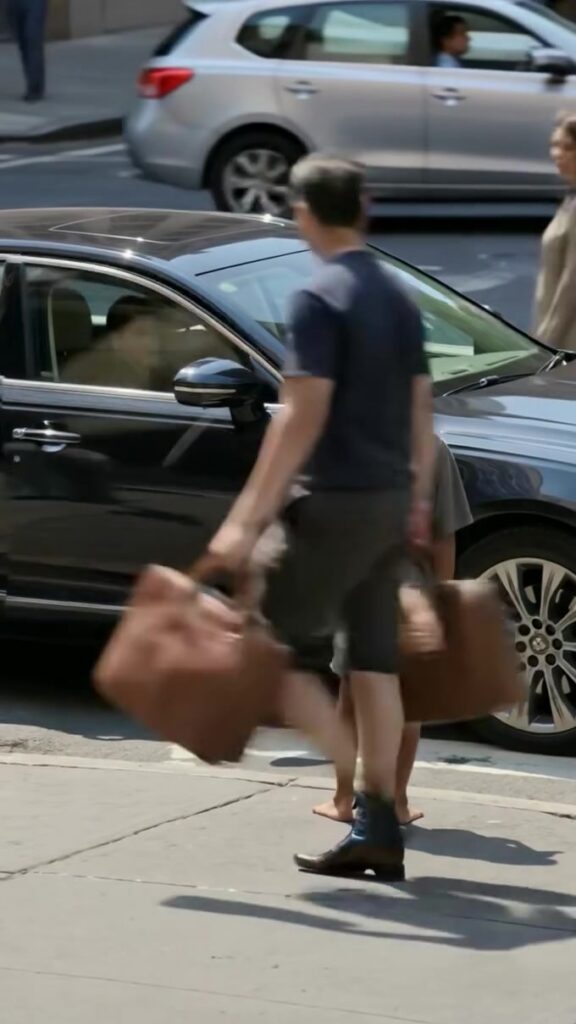
The boy rose from his crouch without thinking. His bare feet planted on the blistered pavement. He watched the car’s front grille, the emblem like a cold eye. He felt every stare now—people had noticed him only because he was in the same frame as something expensive.
He didn’t know why anger came so hard and fast. Maybe it had been building for years. Maybe it was the mango skin. Maybe it was the way the car’s perfection made his own filth feel like a verdict.
His fingers closed around the bucket handle.
Someone laughed nervously, thinking it was a joke. A vendor muttered, “Don’t.” A man near the curb lifted his phone, already anticipating a story to tell later. The boy heard none of them. All he heard was his own pulse, loud as drums.
He stepped toward the car. It slowed even more, as if curious. As if amused.
At the front passenger window, his reflection flashed—small, smeared, a ghost. He saw himself and hated the image. He hated the city for making it. He hated the car for gleaming like a promise that had never been offered to him.
He swung the bucket with both hands.
The water left the rim in a thick, arcing sheet—murky, flecked with grit. It slammed against the car’s side with a wet, ugly sound, sliding down the door in a crawling stain. Droplets speckled the tinted window, turning its sleek darkness into a spotted mirror. The emblem disappeared behind dirty streaks.
The street froze.
Not entirely—engines still idled, a distant siren still wailed—but people stopped moving. A dozen phones rose like periscopes. Mouths fell open. Someone whispered, “He’s dead.” Another voice, sharp with delight, said, “Look at this.”
The boy stood with the empty bucket hanging from his fist, chest heaving. For a moment, with all eyes on him, he was not invisible. The attention burned like sun on raw skin. He waited for it to turn into a fist, a boot, a baton. He waited for the universe to correct itself.
The car stopped completely.
A breath stretched across the asphalt. Even the vendors seemed to hold their calls. The boy’s palms went slick; the bucket trembled.
Then the door swung open with a decisive, heavy motion—metal clicking, hinge sighing—and the sound cut through the hush like a slap.
A polished shoe touched the ground first, leather so clean it looked unreal. A cuff of dark fabric followed. Someone stepped out, tall, controlled, the kind of presence that made space around it. The boy couldn’t see the face yet, only the shape of authority emerging from the car’s dark interior.
He tasted grit in his mouth. He wanted to run. He wanted to stand his ground. He wanted, irrationally, to throw the bucket again, empty as it was, just to prove he could still do something in a world that did things to him.
The stranger straightened fully beside the drenched door, and the city leaned in, hungry for consequences.
The boy lifted his chin a fraction, bracing for impact.
The man reached back into the car and pulled something out—not a weapon, not a cane, not the furious gesture everyone expected. A white handkerchief, folded neatly, untouched by dust. He looked at the muddy streaks on the black paint, then at the barefoot child who had dared to stain him in public.
His voice, when it came, wasn’t loud. It didn’t need to be.
“Tell me,” he said, as if they were alone, “what makes you brave enough to do that?”
The question hit the boy harder than a slap would have. His throat tightened. Words crowded his tongue and refused to come. Around them, phones kept recording, waiting for a scream or a shove.
The boy swallowed, eyes burning with heat and something sharper than heat. He tightened his grip on the empty bucket until the plastic creaked. Then, finally, he spoke—quietly, but with a tremor that carried across the stunned street.
“Because no one sees me,” he said. “So what’s the difference if I ruin something you love?”
The man’s gaze didn’t soften. It sharpened, like he’d found the edge of a truth he could use. He glanced at the handkerchief in his fingers, then at the boy’s cracked feet on the blistered road, then past him at the trash barrel, the crowd, the sun-blasted city pretending it hadn’t built this moment.
He folded the handkerchief again, slowly, as if making a decision.
“Get in,” he said.
The boy didn’t move. The street didn’t breathe. And somewhere inside the car’s dark interior, the open door waited like a mouth.
That was when the boy realized the worst part of being invisible wasn’t that no one looked at you.
It was that, when someone finally did, you had no idea whether it meant rescue or ruin.