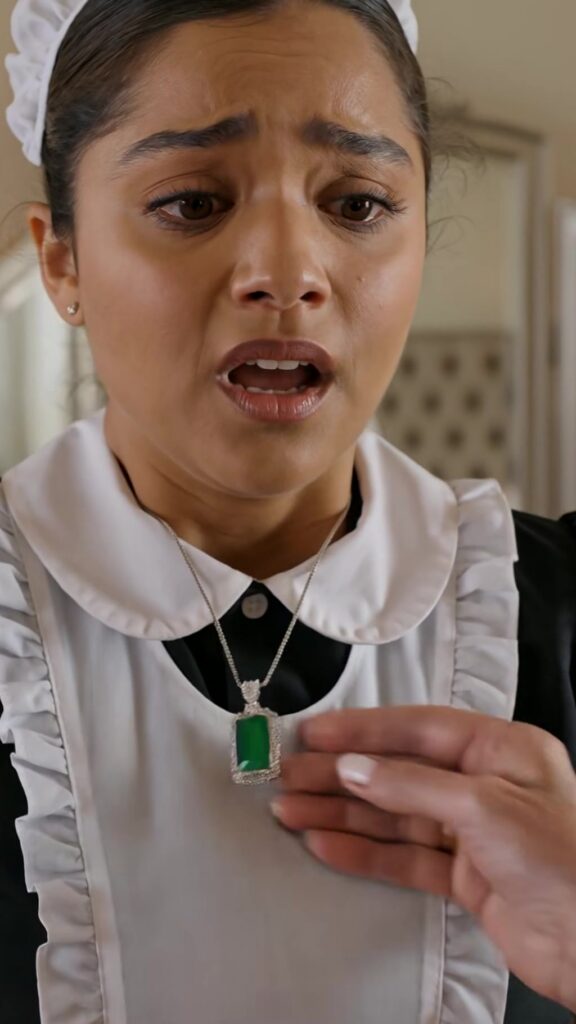
The older woman noticed the necklace before she noticed the girl’s fear.
It was a flash of green in a room designed to swallow color—mirrors throwing back pale walls, crystal sconces winking like cold stars, gold trim gleaming with practiced restraint. The mansion’s drawing room could have been a cathedral for wealth: quiet, polished, and merciless. And there, moving between guests with a tray of champagne, was a maid with her hair pinned too tight and her eyes trained on the carpet as if the pattern might save her.
At the maid’s throat, resting against the stark white collar of her uniform, hung an emerald pendant so bright it looked wrong, as if someone had pressed a piece of summer into winter.
Lucienne Varron did not allow “wrong” to exist under her roof.
She crossed the room with the swiftness of a woman who had spent her life being obeyed. She did not call for security. She did not signal for her steward. She simply reached out and gripped the maid’s shoulders, thumbs digging through cheap fabric until she felt bone beneath.
“Where did you get that?” Lucienne’s voice kept its low, social register, but the edges sharpened. “There are only two pendants like it. One vanished years ago.”
The maid flinched so hard the tray tilted. Glass chimed. A guest laughed at some distant joke, unaware of the small earthquake forming near the mirrors. The girl steadied the tray with trembling fingers and lifted her gaze.
Lucienne expected defiance or deception. What she found was panic so raw it seemed to strip the girl of age—she could have been fourteen instead of twenty, could have been a child caught in a lie she had never chosen.
“I—I didn’t steal it,” the maid said. Her words stumbled out as if her mouth didn’t know the way. “The sister who raised me said it was the only thing my parents left me. She made me wear it on my first day of work. She said—she said it would keep me from disappearing.”
Lucienne’s grip loosened in spite of herself. The anger that had risen like a blade in her chest drained away and left something worse—recognition, the kind that makes the body go cold before the mind understands why.
Lucienne released the girl and stepped back. For a heartbeat she stared at the pendant as if it were an accusation. Then she turned so abruptly that the guests near the fireplace looked up, offended by the disturbance.
“Stay here,” she ordered, and it was not a request.
She moved through an adjoining sitting room to her private salon, where a mirrored vanity stood like an altar. Her hands were already shaking when she unlocked the top drawer. The key resisted, as though the furniture remembered what it contained and wished to keep it buried.
Inside lay a dark-blue velvet box, dustless though it was never touched. Lucienne opened it with the delicacy of a surgeon and the fear of a sinner.
An emerald pendant waited in its nest.
Same silver chain. Same teardrop cut. Same unearthly glow, like light condensed into a stone and taught to keep secrets.
Lucienne’s breath caught. She heard footsteps behind her—soft, uncertain, but coming closer. The maid had followed, driven by terror or curiosity or both. She hovered in the doorway as if afraid to step into a room meant for people with names that mattered.
Lucienne lifted her pendant from the box. It felt heavier than it should, as if the stone carried every year since it had last been worn.
She looked from the pendant in her hand to the one at the maid’s throat, and her voice broke in the smallest place. “No,” she whispered. “That can’t be… Then you are my—”
The words refused to form. They stuck like splinters.
The maid’s stare had shifted. Her fear remained, but now it had direction. She stepped forward, hands hovering near her own necklace as though it might burn her skin.
“Turn it,” the girl said hoarsely. “The back.”
Lucienne’s fingers fumbled. She rotated the pendant, and in the mirror she saw it: a tiny engraving—so small it could be mistaken for a scratch, except the numbers were precise. A date.
She had never looked. In all the years she had kept the pendant locked away, she had treated it like a relic, too dangerous to touch and too sacred to examine.
The maid pulled her own pendant forward. Her fingertips—pink from dishwater and winter—found the back. She swallowed hard.
“It’s here too,” she breathed.
Lucienne’s knees threatened to fail. The room swam with reflections: Lucienne’s pale face in the mirror, the girl’s wide eyes behind her, two emeralds throwing green shadows against their throats and fingers.
“Who are you?” Lucienne demanded, but the question sounded like a plea.
“My name is Mara,” the maid said. “Mara Sorel. That’s what the sisters called me.” Her voice tightened. “Sister Agathe made me memorize one thing. She said if I ever found the second necklace, I should ask who was buried in my mother’s grave.”
The sentence landed like a gunshot, quiet but final.
Lucienne stared at Mara, and in her face she saw angles that were not unfamiliar: the same slight tilt of cheekbone, the same crease between the brows when startled. Not a mirror image—something more cruel. A variation on a theme she had tried to burn from her life.
Lucienne turned away as if the vanity might hide her. “Your mother is dead?”
Mara nodded. “That’s what they told me. They took me once a year to a stone with her name. I used to leave the wildflowers I could steal from the convent garden.” She hesitated, then said, “But the sisters never let me touch the soil. They said it wasn’t proper.”
Lucienne’s pendant shook in her hand.
“Show me the engraving,” Lucienne said, because she needed to hear the numbers out loud, needed to understand what she had been too cowardly to learn. “Read it.”
Mara’s lips moved silently as she traced the tiny etching with a fingernail. Then she said, “Twenty-nine March. Two thousand and six.”
Lucienne’s throat closed. That date was not a birthday. Not a wedding. Not a day anyone celebrated.
It was the day Lucienne signed the papers that made her grief tidy. The day she accepted the sealed coffin, the day the doctor assured her there had been complications, the day the nurse said, gently, that sometimes infants were born too small to hold on.
It was the day Lucienne had buried a daughter she never saw.
“No,” Lucienne whispered, and the word cracked open her composure. “I watched them lower her.”
Mara’s eyes glittered with tears she refused to let fall. “Did you?” she asked. “Or did you watch a box?”
Lucienne’s mind reeled backward through years, searching for the places where her memories did not fit. She remembered the heaviness of sedatives, the softness of voices, the way her husband’s hand had been too firm on her wrist when she reached for the coffin lid. She remembered how quickly everything had moved, how efficient grief had been made. She remembered the hospital’s name—now long closed after a scandal she had never read about.
In the mirror, two women stood close enough to touch, separated only by a decade of silence and a wall of money and etiquette. Between them, two identical emeralds glowed like twin eyes finally opened.
Lucienne drew a breath that scraped her lungs. “Who sent you here?” she asked.
Mara flinched as if expecting blame. “No one,” she said. “Sister Agathe died last month. Before she did, she pressed the necklace into my palm and told me to find work in this house. She said the truth lives where the mirrors are.” Mara’s voice broke. “I thought it was just… a riddle to keep me brave.”
Lucienne closed her fist around her pendant until the edge bit her skin. In that pain was something steady, something real.
“If there are two,” Lucienne said, more to herself than to Mara, “then someone made sure there would be.”
Outside the salon, laughter drifted like smoke from the party, unaware that an old lie had cracked. Lucienne looked at Mara again—at the fear, at the stubbornness beneath it, at the necklace that should not exist.
Lucienne’s voice lowered, becoming the voice she used when she intended to dismantle an enemy. “We are going to the cemetery,” she said. “Tonight. And if there is not a body in that grave, I will tear open every grave my husband ever paid for until I find the one where the truth is hiding.”
Mara’s breath shuddered. “And if there is?”
Lucienne met her eyes in the mirror, forcing herself to hold the reflection steady. “Then,” she said, “we will find out who stole a child and sold me a funeral.”
Mara’s hands rose to her throat, clasping the emerald as if it were a lifeline or a curse. “What am I to you?” she whispered, the question smaller than the room, heavier than the jewels.
Lucienne’s mouth trembled. The word she had almost spoken earlier tried to return, but it came with knives attached. Still, she chose it, because anything else would be another lie.
“You are,” Lucienne said, and for the first time her voice sounded like a woman and not a statue, “the daughter I was told I lost.”
The mirrors held their faces side by side—one marked by years of control, one by years of waiting. Between them, the emeralds burned with the same impossible green, as if the stones had been keeping time until someone finally dared to look at the back.
In the mansion beyond, the party continued. In the salon, a mother and a daughter—strangers by design—stood on the edge of a grave that had not yet been opened, and the room tightened around them, bracing for what would come next.