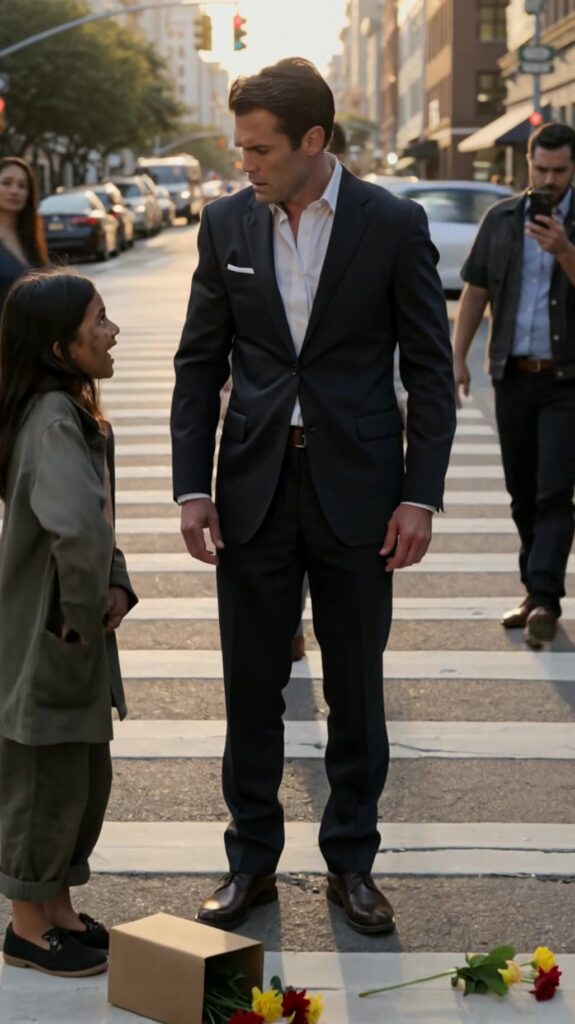
No one noticed the girl at first, because the city trained its people not to. In the boiling noon at the crosswalk on Mercado Avenue, everyone’s eyes were either on the light, or on the glowing rectangles in their hands, or on the narrow slice of distance between their own life and someone else’s. She blended into the heat the way exhaust did—another smudge in a place built to scrub its conscience clean.
She was small enough that the crowd swallowed her. Her hair was tied with a string that might once have been blue. Her dress had been a dress, long ago, before the seams gave up and the fabric dulled into the color of sidewalk dust. She carried a shallow cardboard tray on a frayed strap. In it, a handful of flowers—street flowers, thin-stemmed and bright in defiance—wrapped in torn newspaper. She moved with practiced caution between bumpers and knees, offering blooms to strangers who never learned her name.
Most people didn’t even see the flowers. They saw only the angle of her shoulders, the speed of her steps, the suggestion of need. A man in a suit stepped around her as if she were a puddle. A woman with shopping bags looked through her, straight ahead, lips pressed into a firm line that meant, I cannot afford your story. The traffic surged and paused in waves. Horns stuttered. The crosswalk signal blinked its impatient green man. Life went on.
Then, in the midst of it, there was a moment that snagged the air like a hook.
The wrong man came out of the bank on the corner—tall, expensive, sharp. His shirt was the kind that never wrinkled. His shoes shone like they were lit from inside. On his wrist, a watch whose face glinted as the sun slid behind a passing bus. He carried himself like someone who had learned to treat the world as a hallway made for him. He checked his phone once, jaw tightening at whatever he saw there, then strode toward the curb, already halfway gone in his mind.
The girl stepped in front of him with the instinct of someone who had to try. “Sir,” she said, not loudly. Not pleading. Just a small voice that didn’t dare to compete with engines. “Flowers?”
He didn’t slow. His shoulder clipped the edge of her tray. A petal fluttered down, landing on his polished shoe like an accusation. He snapped his head up as if something had bitten him. His eyes, cold from a life of transactions, fixed on her with irritation that had been searching for a target all day.
“Get out of the way,” he barked. He shoved her with the flat of his hand, not hard enough to break bones, but hard enough to erase her from his path. It was the sort of push that said: you are not real. You do not count.
She staggered. The tray tilted. Flowers spilled across the asphalt—yellow and white scattering into the cracks like tiny suns being extinguished. A few people turned at the commotion. Most didn’t. The signal changed. A car honked, furious at the delay of human friction.
The girl did not run.
She bent, slowly, as if the heat had thickened into glue, and set the tray down beside the curb. Then she straightened and looked up at the man. There was dirt on her cheek and something older than dirt in her eyes.
“You promised you’d come back,” she said.
It wasn’t loud, but it cut through the bank’s revolving doors and the hiss of brakes and the impatient clicking of heels. The man froze mid-step. His phone slipped a fraction in his grip. For a heartbeat, he stood absolutely still, as if the words had found a hidden switch inside him.
“I don’t know you,” he said, quickly, too quickly. The denial came out polished, practiced. “Move.” He tried to step around her again, but his feet betrayed him with hesitation.
She didn’t move. She didn’t flinch. She looked at him the way someone looks at a photo of a person they once trusted, trying to locate the face beneath the changes. “You said you’d come back for me,” she insisted, her voice tightening not with anger, but with certainty. “You said it would be only a little while.”
His gaze flicked over her as if searching for a clue he could crush. “Listen,” he said, lowering his voice, aware now of the few heads turned their way. “I think you’re mistaken. I’m late.”
“You’re not mistaken,” she replied. “You’re pretending.”
Something in that—pretending—made his nostrils flare. His face held the neat mask of a man who had built an empire of distance, but beneath it, faintly, there was strain. He glanced toward the bank, then toward his waiting car at the curb, as if calculating escape routes.
The girl reached into the pocket of her dress.
He watched her hand with sudden, sharp focus, like someone who had learned that small movements could become disasters. The crowd’s hum dimmed as attention drew inward. Even the man’s chauffeur, half out of the driver’s seat, paused.
She withdrew a small object and held it up between finger and thumb. A pendant, dull with wear, shaped like a simple coin. It hung from a broken chain. On its face, a shallow engraving—two initials entwined around a tiny star.
The man’s skin drained of color so fast it looked like the sun had switched him off.
He stared at the pendant as if it were a weapon. His throat bobbed once. His eyes, which had been hard and flat, widened with an animal fear he could not disguise. “Where did you get that?” he whispered, the words escaping him without permission.
“You gave it to my mother,” the girl said. “In the hospital. The day the sirens wouldn’t stop. You said—” Her voice caught, and for the first time something like pain broke through the calm. “You said you’d take us away from the smoke.”
His hand lifted, trembling, not quite reaching for the pendant, not quite daring to touch it. “That was… that was years ago,” he said, as if time could absolve him. He looked around, suddenly aware of the small ring of watchers, their phones angled subtly like periscopes. “You shouldn’t have that.”
“It’s mine,” she said. “It’s proof. It’s the only thing that didn’t burn.”
The light changed again. Cars surged forward, then braked when they saw bodies in the crosswalk. Horns blared. A man cursed out a window. The city tried to drag the moment back into its machinery, but the moment held.
“What’s your name?” the man asked, and his voice had lost its edge. It sounded like a door cracking open against rust.
She blinked once, as if surprised the question existed. “Lina,” she said. “My mother called me Lina. Before…” She glanced at the scattered flowers at her feet as though they were graves. “Before she stopped talking about you.”
The man’s mouth opened and closed. He swallowed. In his eyes there was a struggle—a life built on forgetting colliding with a child standing in the street refusing to be erased.
“I can’t…” he began, and then the word broke. He looked down at his immaculate hands, at the watch that measured his meetings and flights and deadlines. He looked back at her, and for a second the mask slipped far enough to reveal a different man beneath: one who had once stood in a hospital hallway with soot on his sleeve and promised the impossible because it was easier than facing the flames.
Lina held the pendant higher. “You can,” she said quietly. “You just didn’t.”
The sentence landed like a verdict. The man flinched as though struck. His chauffeur took a step forward, uncertain, reading his employer’s face the way employees learn to read weather. The bank’s security guard hovered at the door, indecisive, as if he sensed the story was older than any policy manual.
In the distance, an ambulance wailed—somewhere else, another emergency, another promise about to be made. The sound threaded into the man’s expression and pulled something loose. He exhaled, long and thin.
“Where is she?” he asked, almost inaudible. “Your mother.”
Lina’s eyes did not blink. “You already know,” she said. “You stopped asking.”
He shut his eyes for a moment, and when he opened them, they were wet in a way that didn’t match his suit. He reached into his own pocket, fumbled, and pulled out his wallet—leather, thick, stamped with a gold emblem. His hands were unsteady now, the way hands get when they finally admit they are not in control.
He didn’t offer money. He offered a card, and behind it, something else: a key on a plain ring, the kind without shine. “Come with me,” he said, and the words sounded like they had been buried for years and were only now digging their way up. “Please. Let me…”
“Don’t say it,” Lina interrupted, and though she was small, the warning in her tone made him stop. “Don’t say you’ll come back. Not again.” She stepped closer, close enough that he could see the thin scar at her temple, the faint tremor in her fingers holding the pendant. “If you’re going to do something, do it now. In the street. With everyone watching.”
The man looked at the crosswalk, at the people who had paused their lives to witness the fracture in his. He looked at the flowers scattered like spilled blood and sunlight. Then, with a movement that seemed to cost him, he shrugged off his suit jacket and crouched down onto the hot asphalt.
In the middle of Mercado Avenue, among horns and heat and staring strangers, he began to pick up the crushed flowers one by one, setting them carefully into the girl’s tray. His expensive sleeves brushed the dirt. His watch face flashed, uncaring. A petal stuck to his thumb.
Lina watched him, expression unreadable. The pendant swung slightly from her fingers, catching the light. A few people murmured. Someone’s phone camera zoomed in. The city, always hungry, took its first bite of the story.
When the tray was full again, the man looked up at her from his crouch, his pride left somewhere behind him on the curb. “I’m here,” he said, voice rough. “I’m not leaving.”
Lina lowered the pendant into her palm and closed her fist around it. She didn’t smile. She didn’t forgive him with a gesture. She simply nodded once, as if marking a point on a timeline, and stepped toward the curb where his car waited like a clean escape.
Behind them, the traffic light cycled, impatient as ever. But for a moment, the crosswalk held two lives together—one that had run, and one that had refused to be pushed out of existence. And in that brief, dramatic pause, everything that had been ignored began to demand its due.
Because the girl had been invisible only until she spoke. After that, no one could pretend they hadn’t seen her.