The gala hall glittered with crystal chandeliers, polished glass, and people who had never gone hungry a day in their lives. Light fractured into a thousand obedient rainbows over the marble floor, over wrists heavy with watches that cost more than houses, over lips that laughed without listening. The charity’s name—printed in gold on every program—promised mercy in an elegant font, as if hunger could be solved by cursive.
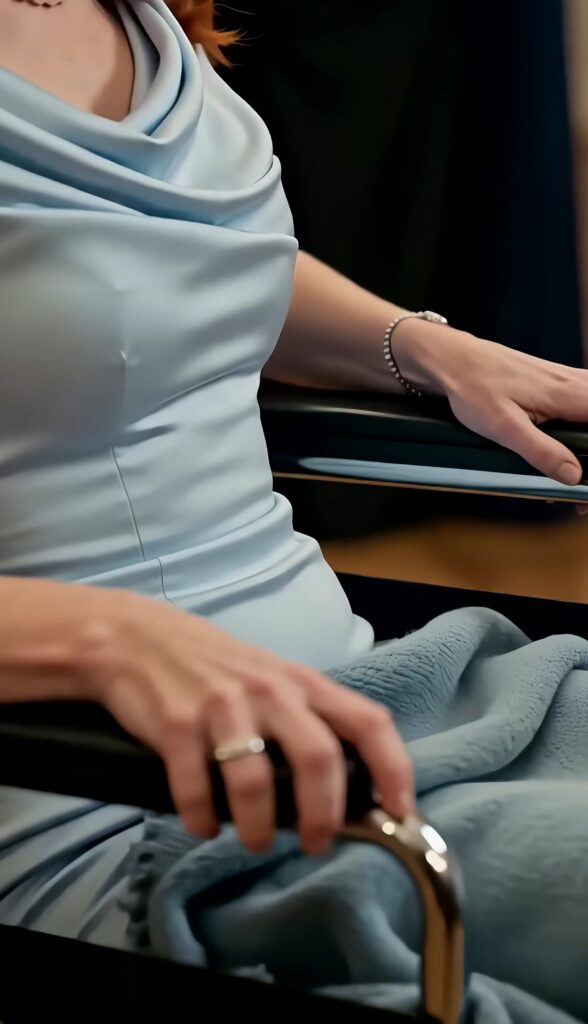
On the dais, beneath a curtain of orchids and applause, Lenora Voss sat like a portrait no one dared touch. Pale blue silk fell over her knees, arranged to hide the braces beneath. Pearls cupped her throat like a promise she’d made long ago and never broken. Her red hair was swept into a smooth knot, and her hands rested atop a blanket that matched her gown, as if the cloth could soften the fact that her legs had not answered her in seven years.
She smiled at the donors. She thanked them. She spoke about resilience with a voice trained to never crack. The band threaded sweet music through the room, and every sentence landed cleanly, polished, complete. Only her eyes betrayed her—fixed too long on dancing couples, on the easy bend of a knee, on shoes that had never been chosen for wheelchair-friendly soles.
Then the crowd shifted.
It began as a ripple: heads turning, voices thinning, a lane opening down the center of the hall as if the air itself had decided to make room. A boy stepped out of the moving bodies, and the room’s brightness looked suddenly cruel against him.
He was dirt-smudged, thin enough that his shirt hung like it belonged to someone else. A faded Yankees logo cracked across his chest; his jeans were ripped in places no designer would dare. His hair stood up in chaotic tufts, and his sneakers carried the city on them—salt, grime, a long walk. Yet he moved as if the chandeliers were not above him and the wealth was not around him, as if he’d walked through richer rooms before and refused to be taught shame.
Security started forward. A man with a champagne flute raised a brow, more offended than afraid. Lenora’s aide stiffened at her shoulder, whispering a question. Lenora lifted a gloved hand—just a fraction—and the aide froze, uncertain whether the gesture meant caution or curiosity.
The boy walked straight to the dais, to the woman in pale blue who sat like a coastline under siege. He stopped at her side, close enough that Lenora could smell him: cold air and soap and something metallic, like coins held too long in a sweaty fist.
Before anyone could intercept him, he lowered himself on one knee beside her wheelchair, an old-fashioned devotion in a child’s body. His hand—small, rough, trembling—settled gently on the blanket over her own.
Lenora jerked at the touch. Her composure snapped like a thread. “Who are you?” she demanded, and the question carried more fear than anger.
He didn’t pull back. His eyes were rimmed red, too steady and too tired for his age, as if sleep had abandoned him for years. “I can help,” he said. The words were not loud. They did not need to be. The hall had fallen quiet in a way no auctioneer could command.
“Help?” Lenora’s fingers curled into the armrest. “With what?”
His breath shivered, as if he’d carried this moment a long distance and was afraid it might blow away. “Please,” he said, voice thin as paper. “Trust me.”
Somewhere behind them, a glass lowered halfway to a mouth and hung there. The band’s melody stumbled and dwindled, instruments choosing silence over wrong notes. Security paused, caught between protocol and the uneasy weight in the air—like thunder held back by manners.
Lenora stared at the boy’s hand on her blanket. She had spent years with doctors who touched her with clinical certainty, who pressed and tapped and explained. She had learned to flinch inwardly at the hopeful: it was a currency she could no longer afford. Yet there was something in his face—an insistence that did not beg for applause—that made her hesitate.
He leaned closer, mouth near her knuckles, as if the words were meant only for her. “One… two… three.”
For a beat, nothing changed. Lenora’s heartbeat thudded against her ribs, furious at being watched. She waited for the embarrassment, for the inevitable collapse of this child’s impossible claim.
Then her breath snagged as if someone had hooked it.
A tremor, tiny as a trapped moth, fluttered through her left leg. She felt it, undeniable, a whisper of sensation where there had been only silence for years. Lenora went perfectly still. Her hands clamped the wheelchair’s arms so hard her rings bit into her skin.
The boy’s eyes shone with tears that didn’t fall. “Again,” he murmured, and it sounded like prayer and instruction at once. “Please.”
Lenora’s throat tightened. Her mind ran through every explanation—spasm, coincidence, cruelty—but her body answered with another faint movement. The hall around them ceased to exist. There was only the pressure of his hand, the warmth seeping through fabric, the strange returning hum beneath her skin.
She swallowed a sound. “How—”
“Let it remember,” the boy whispered. He shut his eyes as if he could hear something inside her. “My mom said your heart would remember first.”
The sentence struck Lenora harder than the tremor. Her heart, which had been trained to perform in public, suddenly felt caught—naked, private, real. She bent forward, breath shaking, and in that moment the blanket slipped. Silk slid from her lap and fluttered down to the marble.
The room inhaled as one body.
Lenora’s feet—elegant shoes chosen for sitting—rested on the footplates. She stared at them as if they were foreign objects that had appeared overnight. The boy’s hand tightened, not gripping, but anchoring. “Stand,” he said, not as a command but as an invitation he would not take back.
Her muscles quivered. Pain flared, sharp and clean, then receded under something else: connection. Lenora pushed down. She felt the floor through rubber soles, felt the weight shift, felt her knees lock and unlock like rusty hinges. Her body rose in a slow, disbelieving arc.
She stood.
The dais seemed to tilt beneath her. The chandeliers blurred as tears rushed into her eyes too fast for dignity. The band stopped entirely, bow hovering over strings. A fork clinked once against a plate like a dropped thought. A gasp tore through the hall, raw and unchoreographed.
Lenora looked down at her legs, at the small tremble that meant they were alive, and a sound escaped her—half laugh, half sob. “How?” she breathed, the single word breaking every polished sentence she’d ever delivered.
The boy stared up at her, his face split open by relief and fear. “I don’t know,” he admitted. “I just… I heard about you. I knew it could happen.”
Lenora reached toward him, hands shaking so badly her bracelets chimed. In the movement, the light caught on something at his chest: a pendant on a thin chain, tucked beneath his worn collar. It swung forward now, and Lenora’s vision sharpened around it as if the rest of the room had dimmed.
It was small, old, silver. A crest engraved on its face—an emblem she had grown up tracing with her thumb, an emblem stamped on wax seals in the Voss estate library, an emblem her father had guarded like a surname could keep a family safe.
Lenora’s knees threatened to buckle, not from weakness but from shock. “Where did you get that?” she whispered, and the question sounded like grief trying to become anger.
The boy lifted trembling fingers to the pendant as if to reassure himself it was still there. “From her,” he said. “From my mom.”
Lenora’s chest tightened until she could scarcely breathe. She reached, and her glove brushed the metal. It was real. Cold. Familiar. Like a door handle from a house she had left burning behind her.
“Your mom’s name,” Lenora said, each syllable scraped out. “Tell me her name.”
He hesitated, eyes flicking over the watching faces, the stunned stillness, the security men who had forgotten to move. His voice dropped to a fragile thread, meant for Lenora alone and yet somehow loud enough to silence the chandeliers.
“She said,” he whispered, “you’re my—”
The word did not come. Not because he couldn’t say it, but because Lenora’s hand flew to her mouth as a memory detonated in her: a hospital corridor smelling of antiseptic and roses, a signed document she’d never read twice, a baby’s cry cut off behind a door, her father’s voice calm as ice—You’ll thank me when it’s over.
Lenora’s gaze snapped to the boy’s eyes, and in them she saw a familiar stubbornness, the same storm that stared back at her from old mirrors when she was too young to understand power. The hall waited, rich and cold and suddenly irrelevant.
Lenora took a step—small, shaking, miraculous—and the boy flinched as if expecting her to vanish. Instead she reached down and cupped his face in both hands, her gloves dampening with tears. “Finish it,” she pleaded, her voice finally without polish. “Say it. Whatever she told you, say it.”
The boy swallowed, and the crest at his neck glinted like a confession. “She said you were taken from me,” he said, and the words landed like a verdict. “She said you didn’t choose it. She said… you’re my mother.”
Lenora’s breath broke apart. Around them, the gala hall—its crystal, its glass, its hungerless laughter—became a distant, meaningless stage. The only thing that mattered was the boy’s trembling chin, the pendant between them, and the fact that her legs were holding her up for the first time in years, as if her body had waited all this time to stand for this truth.
“What’s your name?” Lenora asked, and her voice sounded like someone pulling herself out of water.
He blinked hard, tears finally falling. “Eli,” he said. “Eli Voss. That’s what she wrote.”
Lenora turned, still standing, and faced the room that had applauded her speeches and never asked what she had lost. “Someone,” she said, the word sharp enough to cut silk, “is going to tell me what was stolen from me.”
And as the richest people in the city stared back—suddenly afraid of a woman who could stand—Lenora realized the boy had not come to the gala to perform a miracle.
He had come to collect one.
And this time, she would not be wheeled away.