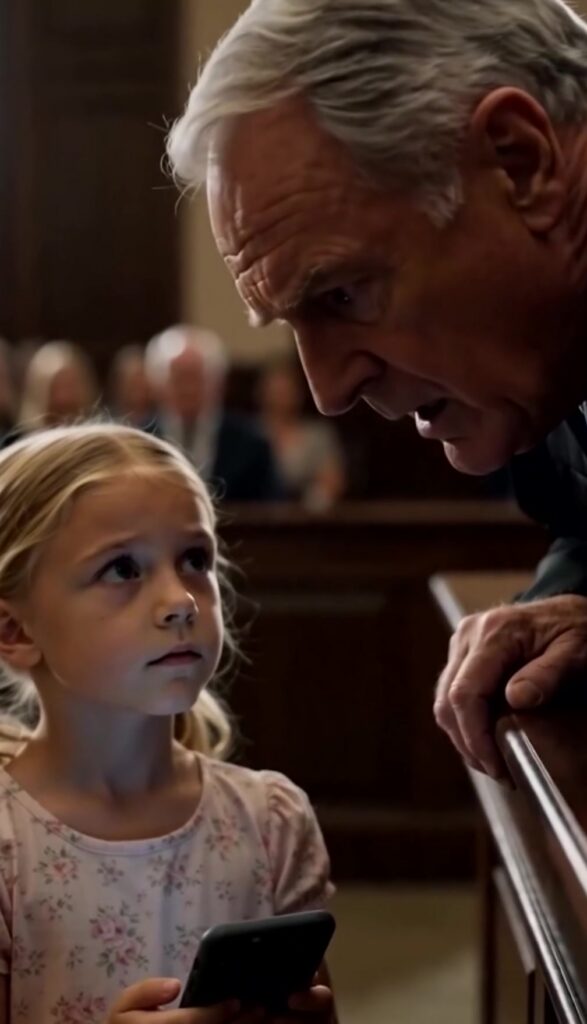
The courtroom was supposed to be ordinary that morning. The docket was a stack of minor arguments dressed up in legal language—property lines, a shoplifting charge, a motion about late fees. Even the light through the high windows seemed routine, laying pale bars across the floor as if it had done so a thousand times without noticing who stood beneath it.
Judge Elias Hart liked ordinary. He had built his life around it the way a man builds a house after a storm, selecting each nail with care. Ordinary meant rules, schedules, and outcomes that could be defended. Ordinary meant the past stayed in the past.
Then the bailiff opened the side door and said, quietly, “Your Honor, the next matter is… unusual.”
A social worker entered first—Ms. Rivas, wearing a gray cardigan and the expression of someone trying not to alarm anyone. Behind her walked a little girl, no more than seven, blonde hair brushed into tidy waves, a pale pink dress printed with small flowers. She held a smartphone with both hands, as if it were a warm cup she couldn’t afford to spill.
“Sophie Lane,” Ms. Rivas announced, guiding the child to stand at the witness line. “Petition for temporary guardianship transfer. She insisted on addressing the court herself.”
Elias softened his face. Children made him careful. He leaned forward, offering the patient tone he kept reserved for small people and skittish animals. “Hello, Sophie. Do you know why you’re here?”
Sophie’s eyes went to the benches, where strangers stared with curiosity, and then back to the judge. She nodded once, very precise. “Yes, sir.” She lifted the phone a little. “I’m supposed to show you.”
Ms. Rivas cleared her throat. “Your Honor, the child was found alone at a rest stop two nights ago. No listed family. No record of a legal guardian. She had this phone and refused to let it be taken. She kept repeating a name.” Ms. Rivas glanced down at her notes as if the ink might provide courage. “She said, ‘Take me to Grandpa Hart.’”
The courtroom made the tiny sound crowds make when they want to speak but don’t dare. Elias felt his smile become something else—stiffer, less cooperative. “I’m not—” he began, then stopped. The child’s earnest stillness held him.
Sophie stepped forward one small pace, close enough that the microphone caught the faint click of her shoes. “The lady told me not to be scared,” she said, nodding toward Ms. Rivas. “But I am a little. Because she said you might say it can’t be true.”
Elias’s hands tightened on the dark edge of the bench. “Sophie,” he said, carefully, “who told you I was your grandfather?”
Sophie’s chin lifted, not defiant—determined. “My grandma did.” She tilted the phone so he could see the screen. A paused video sat there, the thumbnail of a woman’s face: older, tired, eyes bright with held-back tears.
For a second, Elias’s mind rejected it. His thoughts tried to shove the image aside like a file that had been sealed years ago. But the woman’s mouth, the line of her cheek, the scar near her hairline—it all reached into him with a hand that knew exactly where to grip.
“That’s not—” he whispered, and the words fell apart. It couldn’t be.
Ms. Rivas spoke softly. “She wanted you to see it, Your Honor. Sophie would not cooperate with placement until we agreed.”
Elias looked down at the child and found no mischief there. Only a solemn patience, like she had been trusted with a task too heavy for her bones.
He swallowed. The courtroom had become a tunnel—narrow, airless, echoing. “Play it,” he said, and heard his own voice sound unfamiliar.
Sophie tapped the screen.
At first, there was the faint hiss of old recording equipment, then a shaky breath. A woman’s voice filled the room—not loud, but complete, as if it had been waiting behind the walls.
“Sophie,” the voice said, trembling. “My love… if you’re hearing this, it means you found the phone. It means you’re brave, even when you’re scared.”
A few people in the gallery smiled, the reflex of hearing a woman speak to a child. Then the voice continued, and the air changed.
“I don’t have much time,” the woman said. “And I need you to listen. There’s a man you must find. His name is Elias Hart. He’s your grandfather.”
Elias felt his ribs lock around his breath. His throat tightened so fast it hurt. He had not heard that voice in thirteen years. He had spent those years telling himself he’d never hear it again.
On the recording, the woman swallowed hard. “If you found him… tell him I tried. Tell him I never stopped looking for you.”
Somewhere behind Elias, the bailiff shifted his stance. The court reporter’s fingers slowed, then resumed, as if they had to convince themselves this was real.
Elias leaned forward, unable to stop. “No,” he whispered, the word escaping like steam from a cracked pipe.
The woman in the video spoke again, and Elias’s vision blurred at the edges. “Eli,” she said, and used the old nickname like a key. “I know you’ll think this is a trick. You’ll think I’m gone. You’ll think you buried me and the memory will stay quiet if you never dig.”
She laughed once—small, bitter. “I didn’t die. Not the way you were told. The fire wasn’t an accident. The report was written by people paid to make a story neat.”
Elias’s fingers dug into the wood. Thirteen years ago, the warehouse blaze had taken his daughter Mara. That was what he had been forced to accept: a closed casket, an investigation that ended too quickly, a set of condolences from men with clean suits and dead eyes. He had survived by turning his grief into order, by becoming a judge who believed in evidence and endings.
On the screen, Mara—older now, face marked by time and worry—leaned closer to the camera. “They told me your wife was sick,” she whispered. “They told me you’d moved, that you didn’t want me near you. They threatened me until I couldn’t see daylight without expecting a hand to close around my throat.” Her eyes darted, as if she could hear footsteps outside the frame. “I ran. I hid. And then Sophie happened.”
Sophie, standing below the bench, lifted her gaze to Elias as if checking that he was still there. Her small fingers clenched the phone tighter, knuckles whitening.
“Her father isn’t safe,” Mara continued. “None of this is safe. The only person with power enough to open doors is you, Eli. I’m sending her to you because I can’t outrun them anymore.”
Elias heard a sound and realized it came from him—a ragged breath, half sob, half protest. The courtroom’s ordinary structure—procedures, posture, authority—was collapsing in his chest like wet paper.
Mara’s voice softened. “There’s something I need you to know. The day they came for me, I called you. I left a message. But you never heard it because it never reached you. They controlled the lines. They controlled the report. They controlled the story.”
The video shook slightly, as if the phone had been adjusted by trembling hands. “If Sophie makes it to you, hold her. Don’t let them claim her the way they claimed me. And tell her—tell her I loved her every minute, even from far away.”
There was a pause, a quiet that felt like a prayer.
“Sophie,” Mara whispered, “if Grandpa Hart is listening… tell him the proof is in the cedar box. Under the floorboard. He’ll know which one.”
The screen went dark.
For a long moment, no one moved. The silence was not respectful. It was the shocked stillness of people who have watched the world slip sideways.
Elias sat as if nailed to his chair. A cedar box. Under the floorboard. His mind pulled up the memory with cruel clarity: a hidden compartment in the old family cabin, the place he had sold after Mara’s “death,” the place he had never been able to visit without shaking.
He looked down at Sophie. She stared back without flinching, though her eyes shone with tears that hadn’t fallen.
“Grandpa,” she said, the word careful, as if it might crack if spoken too loudly. “She told me to bring this to you. She said you’d know what to do. She said you’d be mad, but you’d still help.”
Elias stood. It was a simple movement, but the entire room reacted—the bailiff’s hand twitching toward caution, Ms. Rivas stepping subtly closer to the child. Elias lifted both palms, empty, and forced air into his lungs.
He came down from the bench through the side gate, walking not like a judge but like a man crossing a bridge in fog. When he reached Sophie, he lowered himself until they were eye level.
“I don’t know what to do,” he admitted, voice breaking on the honesty. “But I know what I won’t do.” He glanced up at the watching courtroom, at the seal on the wall, at the symbols he had trusted. “I won’t let anyone erase you.”
Sophie’s shoulders loosened as if she had been holding herself upright by will alone. She leaned forward, uncertain, then stepped into him. Elias gathered her gently, stunned by the warmth of her small body and the frightening truth of it.
Somewhere behind him, Ms. Rivas exhaled in relief.
Elias rose with Sophie in his arms and looked back at the bench—at the place where he had tried to keep life tidy. “Court is in recess,” he said, voice suddenly steel again. “Effective immediately.”
The gavel was within reach. He did not use it. He didn’t need a sound to command attention anymore. The story had already struck harder than wood on wood.
As he carried Sophie toward the private exit, Elias felt the weight of the phone pressed between them like a heartbeat. Ordinary had been a lie he told himself to survive.
Now the past had walked into his courtroom in a pink floral dress, holding a fragile device that contained a living voice. And the man who had spent years delivering verdicts realized, with dread and fierce purpose, that the next judgment would be his own: whether he was brave enough to tear open the sealed files of his life and find the truth waiting beneath the floorboards.