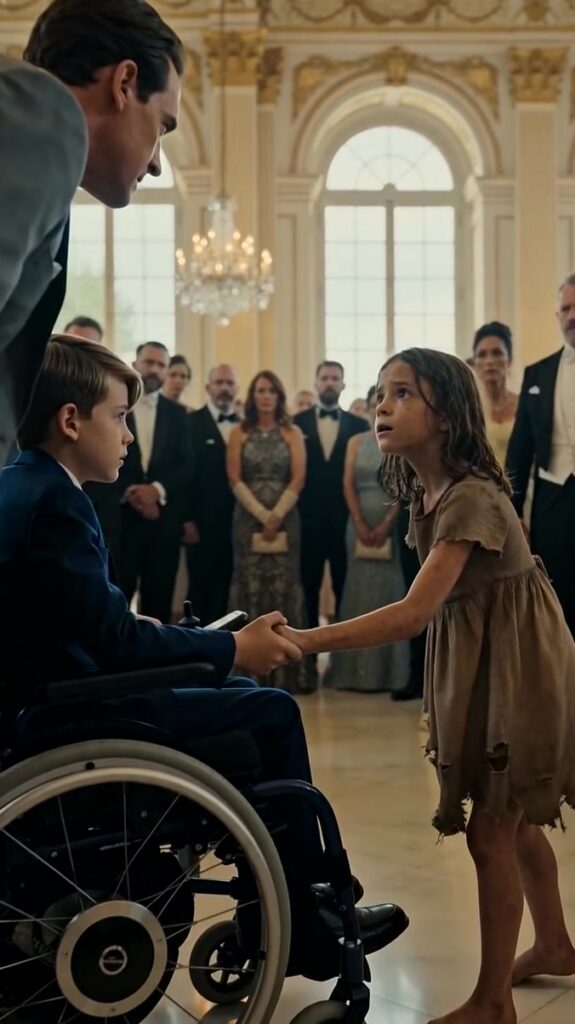
The grand palace hall was glowing with afternoon light, the kind that turned dust into gold and made every polished surface look like it had been freshly blessed. Sun poured through towering arched windows and broke across marble floors in long, pale blades. Above, chandeliers heavy with crystal hung like inverted constellations, scattering brightness over a room that did not know how to be ordinary.
The guests knew their roles. They stood in a careful circle, expensive fabrics whispering as they shifted their weight, laughter measured and thin. Glasses hovered at mouths without touching them. Questions were traded in fragments—politely disguised, cruelly aimed. In the center sat the boy everyone came to see, as if he were a relic and not a person.
Prince Adrian—twelve years old, too young to have learned emptiness so well—rested in a sleek motorized chair whose dark metal matched his navy suit. The suit fit perfectly, as if the palace tailors could stitch dignity into cloth. His hair had been brushed into submission, his collar pristine, his hands placed neatly on the armrests like props. He did not look toward the musicians, nor the painted ceiling, nor the eager faces. His gaze stayed somewhere distant, beyond all of them, where the room could not reach him.
Beside him stood Lord Varron in a tailored gray suit, tall as a pillar and twice as cold. Varron had the habit of leaning slightly forward, as if listening for trouble. When someone approached, Varron answered before Adrian could. When someone asked the boy a question, Varron provided the boy’s smile, the boy’s gratitude, the boy’s silence. And whenever Adrian’s fingers twitched—as though he might speak, as though he might attempt a thought that belonged to him—Varron’s gloved hand would drift to the chair’s handle, a reminder disguised as care.
The story was old enough to have become a legend polished smooth by repetition. A fall. A fever. A mysterious accident on palace grounds. He had not walked since. Physicians with foreign titles had bowed solemnly and declared their failures in exquisite words. Therapists had promised miracles and left with generous compensation. The palace had learned to celebrate the boy’s survival instead of mourning the parts of him that had been stolen.
Then the circle broke.
A girl pushed through the ring of aristocrats with the blunt momentum of hunger. She was barefoot, her toes smudged with street dust. Her dress—brown, torn at the hem—hung off her shoulders as if it had once belonged to someone bigger. Dirt streaked her cheekbones, and her hair had been braided and re-braided until it refused to obey any longer. In a room designed to keep the world out, she arrived like weather.
She went straight to Adrian. Not to Varron. Not to the king’s advisors. Not to the guards who stiffened in alarm. She reached for the boy’s hand and took it as though it had always been hers to hold.
Silence hit the hall so hard the chandelier crystals stopped chiming.
Varron moved instantly. His outrage was a rehearsed reflex, his body already between the girl and the chair. “Release him,” he snapped, voice low and sharp, the kind of command meant to slice through panic. “You have no idea where you are.”
The girl did not flinch. Her grip remained firm, small fingers wrapped around the prince’s as if anchoring him. She looked at Adrian, not at the man who claimed him, and spoke with a calm that did not belong to someone in rags.
“Come with me.”
A ripple of gasps traveled around the circle. Someone’s glass clinked against a ring. Somewhere near the windows, an elderly countess made a strangled sound and pressed a hand to her throat, as if she’d swallowed a secret.
Adrian did not pull away. That was the first shock. The second was the way his eyes changed—focusing, narrowing, turning from distant to present, like a lamp being lit behind a locked door. He looked at the girl as if her face was a page from a book he’d been forced to forget.
Varron’s jaw clenched. “Get away from him,” he said again, colder now, and the nearest guard’s hand hovered at a weapon he hoped not to use.
The girl’s voice remained steady. “I can make you stand.”
The words cut through the room like a thrown knife. Even the musicians—who had been playing softly as decoration—let the notes die in their throats. A minister in black froze mid-step, his expression caught between scoff and fear. Hope was not welcome here; it disrupted the architecture.
Varron’s eyes flashed. “This is cruelty,” he hissed. “A lie.”
She finally turned to him. Her gaze did not tremble under the weight of his authority. “It’s not a lie,” she said. “It’s a memory.”
Adrian’s breathing changed. Small, uneven pulls, like a runner waking in his own body. His fingers curled around hers, tighter than before, and for a heartbeat he looked less like a prince and more like a child who had been drowning.
“The last time you stood,” the girl continued, her voice lowering, “they took me.”
The hall became a vacuum. No rustle of fabric. No clink of jewelry. Even the sunlight seemed to pause on the marble.
Adrian’s lips parted, soundless. His gaze slid to the girl’s bare feet, to the dirt under her nails, to the torn seams of her dress. And then—like a curtain pulled aside—recognition flickered across his face. His posture changed; he leaned forward, the chair’s quiet hum suddenly indecently loud. Both of his hands lifted from the armrests, as if the simple act were a rebellion.
Varron lunged, reaching for the girl’s wrist, desperation breaking through his composure. “No,” he said, and it was not a command this time. It was a plea shaped like a threat.
The girl did not resist him with strength. She resisted him with truth. She leaned close to Adrian, close enough that her words were meant for only him, not for the watching court.
“You stood in the garden,” she whispered. “On the stone path by the fountain. You grabbed my hand. You said you’d never let them take me.”
Adrian’s eyes widened, filling with something brighter than tears. A garden flashed behind them both—sunlight on leaves, laughter that didn’t know it could be stolen, a fountain singing. A boy on unsteady legs. A girl spinning in circles because she could. A shout. Boots on gravel. A hand ripped away.
Varron’s face drained of color as though the palace itself were drawing it out. “Stop,” he breathed, and the word carried panic he could no longer hide. His gaze flicked to the guards, to the courtiers, to any witness who might be dangerous if they understood.
Adrian’s throat worked. He swallowed like someone forcing open an old lock. His hands trembled, not with weakness, but with the strain of waking something that had been kept asleep.
He stared at the girl’s face, at the dust and the defiance and the impossible familiarity beneath it. Then he spoke—one word, cracked and astonished, as if saying it could shatter the hall.
“Mira?”
The girl’s eyes shone, and for the first time her certainty softened into something like grief. “Yes,” she said. “And you’re not broken, Adrian. You were made to forget.”
Varron stepped in, too late to close the door that had already opened. In the afternoon light, his shadow stretched long and thin across the marble, reaching for the boy like a chain.
Adrian tightened his grip on Mira’s hand. And somewhere deep in his body—beneath the years of stillness, beneath the quiet obedience—something answered back. Not a miracle. Not magic. A decision.
He leaned forward as if the floor were calling him by name.
And the palace, built to contain every truth, began to tremble around them.