Cool daylight poured through the wall of glass as if the sky itself had paid for admission. Everything in the suite was designed to reassure: the silent air filtration, the warm lamps with their dimmed gold glow, the polished wood floors that never caught a scuff, the vase of pale lilies that smelled like money pretending to be kindness.
Silence sat in the room like a third doctor—present, observing, impossible to dismiss.
Dr. Sato stood near the back with her hands folded so tightly her rings pressed into her skin. Beside her, Dr. Harlan shifted his weight from heel to heel, glancing at the door as if it might suddenly unlock the rules of this place. The patient’s chart said “non-weight-bearing,” “complex fracture,” “prolonged recovery.” The patient himself said whatever he pleased.
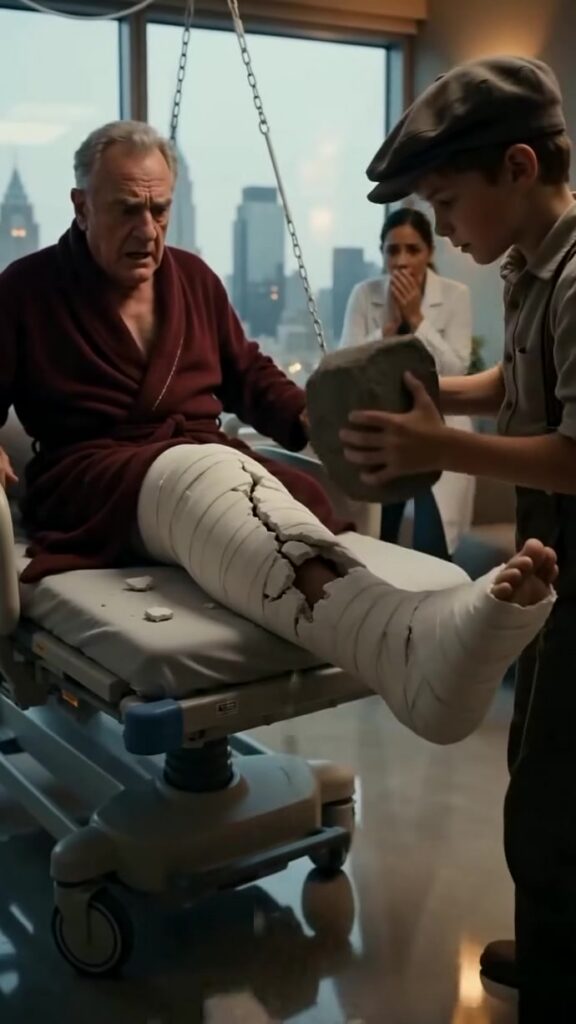
Silas Merrow lounged high in the bed, a burgundy robe draped over him like theater curtains. His leg, wrapped in a thick white cast, hung in a sling as though it had been displayed on purpose—an ivory monument to his suffering. On the bedside table sat a silver tray with sliced pears, untouched, and a small bell that had been rung so often the nurses had started flinching at the mere sight of it.
“Bring the boy closer,” Merrow said, not because he needed help, but because he liked commanding motion in rooms where he was supposed to be still.
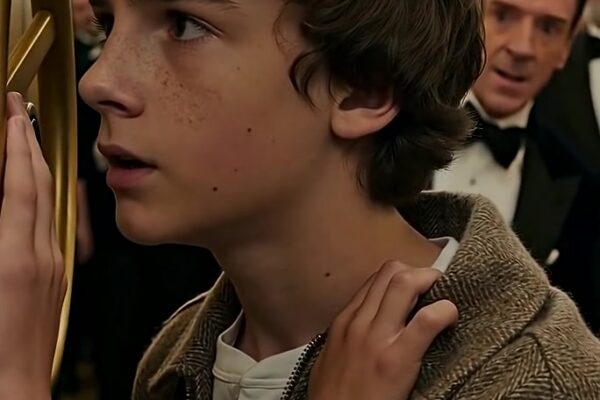
The boy stood near the foot of the bed, underdressed for the luxury around him. A vintage cap shadowed his eyes; suspenders held up trousers that had been mended more than once. His hands clenched a heavy, dark stone as if it were the only honest object in the suite. It wasn’t polished like the floor. It didn’t glow like the lamps. It was rough, dense, ancient—something pulled from a riverbed or a gravesite.
Merrow’s gaze flicked from the boy’s thin wrists to the stone. His mouth widened into a grin that looked practiced. “That’s it. That’s the miracle worker they’ve been whispering about?”
Dr. Sato opened her lips. “Mr. Merrow, this is not—”
“Not what?” Merrow cut in, and laughed as though the question itself were entertainment. “Not proper? Not scientific? Please. The hospital has hosted worse on my dime.” He waved a hand, indulgent. “Listen, kid.”
The boy didn’t respond, but the room tightened with his stillness. Dr. Harlan watched him the way one watches a dog that hasn’t decided whether it’s cornered.
Merrow spread his arms as if offering the entire world in exchange for a trick. “Heal me,” he said, loudly, mockingly, for the doctors to hear. “And I’ll give you one million. Cash. I’ll even let you pick the suitcase.”
The doctors exchanged a look—the brief, weary language of professionals who’d seen cruelty disguised as charisma. Merrow had made similar offers to nurses, to interns, even to a priest who’d come to bless the wing. It always ended with laughter and humiliation, and Merrow leaving behind the unmistakable scent of someone who believed pain was a currency he could spend on others.
But the boy didn’t smile. He didn’t glance at the doctors for permission. He stepped closer to the suspended cast with a slow, deliberate motion, like someone approaching a locked door.
Merrow’s laughter rolled on, loud enough to fill the corners. “Come on then. Touch the magic bone.”
Before the laughter could collapse into breath, the boy swung the stone.
The crack was not loud so much as it was final, a brutal punctuation that seemed to turn the air solid. Plaster fractured. The sling jerked under the sudden weight shift. A white vein split down the cast’s side.
Dr. Sato’s hand flew to her throat. Dr. Harlan took one involuntary step forward and stopped, as if an invisible line had been drawn across the floor.
Merrow’s grin vanished. He seized the bedrails so hard the tendons in his hands rose like cords. “What did you do?!” he shouted, his voice shredding the curated calm of the suite.
The boy stared at the spreading fracture line, unblinking. “It wasn’t healing,” he said, quietly.
The words were simple, but they landed with the weight of accusation. The room went still again, the silence now sharpened into a blade.
Merrow’s face changed. Anger slid away from his eyes, replaced by something older and harder—fear trying not to be seen. “You don’t know what you’re talking about,” he said, and it came out too fast.
The boy lifted the stone again. The movement was careful, not frenzied. It was the calm of someone doing what must be done.
“Stop!” Dr. Sato said, voice cracking. “Security—”
Dr. Harlan reached for the call button, but his thumb hesitated. He was watching Merrow now, watching the patient’s breathing, the way his gaze kept darting to the door, not the doctors.
Merrow’s composure snapped. “Stop!” he screamed, and the word wasn’t command anymore. It was pleading, naked and humiliating.
The stone came down a second time.
Another crack tore through the cast, and a chunk of plaster broke loose, bounced once on the bedspread, and rolled to the side like a bone fragment. Beneath the split, skin appeared—healthy, unbruised. The toes at the end of Merrow’s foot were exposed, pale but alive.
Dr. Sato covered her mouth. Dr. Harlan swore under his breath, eyes widening as the truth took shape in the opening.
Merrow stared down at his own foot as if it belonged to a stranger. His breathing turned ragged, the kind of breath a man takes when his own story betrays him.
The boy let the stone slip from his fingers. It hit the polished floor with a dull thud that felt almost respectful compared to the violence of the cracks.
Then he pointed at Merrow’s exposed toes. “Move them.”
No one moved. Not the doctors. Not the lilies. Not even the sunlight. The suite held its breath.
Merrow’s eyes flicked to Dr. Sato and then to Dr. Harlan, pleading without words for rescue from this moment. His jaw trembled. Slowly, as if the air itself had become thick, one toe twitched. Then another. A small, undeniable motion—less than a step, more than a confession.
The doctors gasped in unison, a sound of shock and dawning horror. Dr. Harlan’s hand dropped from the call button. He looked at the cast, then at Merrow’s leg, then at the untouched chart in his grip, as if the paper might erupt into flames.
The boy stepped closer to the bed and lifted his eyes to Merrow’s face. There was no triumph there. Only a bleak steadiness, like someone who had learned not to expect apologies.
“So why were you pretending?” the boy asked.
Merrow’s throat worked, swallowing words he couldn’t afford to speak. In the gleaming suite, surrounded by comforts purchased to numb the world, he looked suddenly small—like a child caught faking illness to avoid consequences.
The boy leaned in just enough that his voice slipped beneath the doctors’ panic and into something private and dangerous. “Because if your leg works,” he whispered, “then what else have you been lying about?”
Merrow jerked his head up, eyes wide, terror flashing through his carefully built persona. The quiet luxury of the room didn’t soften it. It amplified it. Somewhere in the hallway, a cart wheel squeaked, distant and ordinary, but inside the suite everything had changed shape.
Dr. Sato finally found her voice. “Who are you?” she asked, not as a clinician, but as someone staring at an avalanche that had started with a single stone.
The boy didn’t answer her. He looked at the broken cast, at the exposed foot that could no longer hide behind plaster, and then at the man whose money had purchased silence for years. “You bought a room where the truth would be quiet,” he said, almost to himself. “But quiet doesn’t mean safe.”
Merrow’s hand clenched the bedrail again, but now it was not power in his grip. It was desperation. The sunlight kept spilling in, clean and indifferent, as if the day had no idea what it was witnessing—and as if the room, for all its luxury, had never been designed for what was about to happen next.