“WAIT! DON’T DRIVE!”
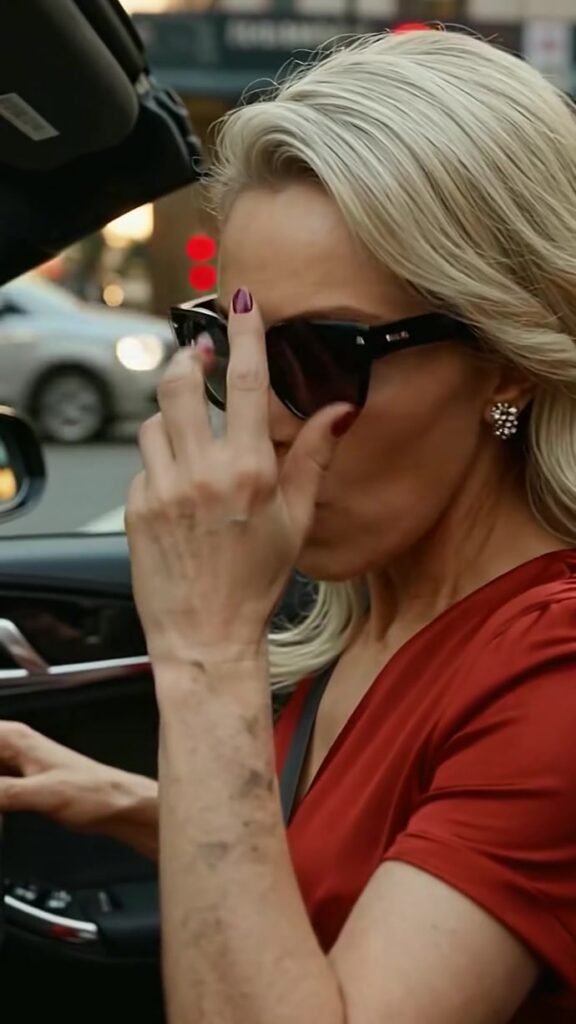
The cry split the honeyed evening, sharp enough to make the air feel brittle. Vivienne Marlowe’s foot slammed the brake before her mind had time to object. Her black convertible lurched to a stop in the turning lane, seat belt biting into her shoulder. Behind her, a chorus of horns detonated—angry, impatient—yet the noise seemed to fold away as if the city had suddenly been wrapped in cotton.
A small hand pressed against her door.
Vivienne recoiled as though the touch carried disease. “Hey!” Her voice came out colder than she intended, a practiced chill she used on waiters who hovered too long and men who mistook her smile for an invitation. “What do you think you’re doing? Don’t touch my car.”
The boy on the other side of the door was thin as a shadow, his hair matted with dust. His cheeks were streaked with something that could have been sweat or tears or both. He didn’t try the handle; he only stood there, shaking, his palm still against the paint as if he needed to anchor himself to something solid.
Then he lowered his hand.
His fingers trembled so hard they looked like they were losing their shape. He stared at them as if he didn’t trust them. “She has the same hair,” he whispered, barely loud enough to reach the glass.
Vivienne pushed her sunglasses down the bridge of her nose. “What?” The impatience in her voice was almost relief—annoyance was familiar; this tightness under her ribs was not. “Who has the same hair?”
The boy lifted his eyes. They were too old for his face, a storm trapped in a child’s skull. “My mom said I’d find you here.”
Something about that sentence snagged the evening. Not its meaning—absurd on its face—but its certainty, like a message delivered by someone who had already seen the end of the story.
Pedestrians slowed on the sidewalk. A couple paused mid-argument. A man in a delivery van leaned out, phone already in hand. Vivienne could feel the audience forming around her, and with it, the reflex to perform calm control.
She gave a short laugh. “Listen, kid. Whatever this is—some scam, some dare—move. You’re holding up traffic.”
The boy didn’t move. Instead, he opened his fist.
In his palm lay a hair clip: silver, curved like a crescent, set with tiny stones that caught the last light and threw it back in blue-white sparks. Vivienne’s throat tightened. The clip was so familiar that for a moment she tasted hospital disinfectant and heard the muffled beep of a monitor.
“That’s…” Her voice failed and returned as a whisper. “That’s not possible.”
A tear slipped down the boy’s cheek, cutting a clean line through the grime. “She said you’d say that.”
Vivienne’s hand went to her own hair on instinct, as if checking whether she still wore it. She hadn’t seen that clip in years. It had disappeared the night she signed the last document and watched the river take what it was paid to take.
She leaned forward, knuckles whitening on the steering wheel. “Where did you get that?” Her words snapped now, not icy but electric. “Where is she?”
The boy’s gaze flicked past Vivienne, over the hood, across the street.
Vivienne followed it.
Under a streetlight that flickered as if uncertain of itself stood a woman. Still. Upright. Watching. Same sharp jaw. Same high cheekbones. Same dark hair—a glossy sheet in the failing light. The face was Vivienne’s face, with one subtle difference: the woman across the street looked like she had never learned to smile without pain.
Vivienne’s breath stopped. Her fingers went numb. The driver’s door creaked as she pushed it open without realizing she’d moved.
“No,” she mouthed. “No…”
Then she saw the man beside the woman.
He stood half in shadow, hands folded behind his back, posture neat as a photograph. His suit was the same cut Vivienne remembered, the kind that didn’t wrinkle even when the world did. His hair was combed back, and when the streetlight flared, it caught the pale line of a scar along his temple.
Recognition hit her like a dropped elevator.
Gideon.
Gideon Holt was supposed to be dead.
Her mind refused the image at first, flicking through the file her memory kept: the boat listing in black water, the scream swallowed by rain, the official report that matched the bribe, the funeral that had never opened the casket. She had watched the river that night and told herself it washed clean.
Her lips trembled. “No… no, no, no.”
The horns behind her faded into a distant, irrelevant animal roar. The street felt unreal, as if the city had become a stage set and someone had forgotten to paint the sky.
The boy tugged at her sleeve now that she’d stepped out, gentle but urgent. “Don’t drive,” he said, voice cracking. “She said if you drove, you’d die.”
Vivienne stared at the boy, then back at the woman who wore her face. The woman lifted a hand, slow, and in her fingers—mirrored, impossible—was a matching hair clip.
Vivienne’s stomach turned cold. “Who are you?” she called across the street, though her voice came out thin.
The woman didn’t answer at first. Gideon’s head tilted slightly, like he was listening for something beneath the pavement. Then the woman stepped forward into the light.
“I’m the version of you that didn’t get bought,” she said. Her voice carried without effort, as if the air itself wanted Vivienne to hear it. “And he’s the man you tried to erase.”
Gideon smiled. It wasn’t warmth. It was a blade. “You did everything right, Vivienne,” he said. “Paperwork. Witnesses. Water deep enough to swallow a name. But the river doesn’t keep secrets. It returns them.”
Vivienne’s mouth went dry. She tried to speak and failed. Images flashed—her signature at the bottom of a contract, her hand steady while her insides shook; Gideon’s eyes on her that last night, disappointed more than angry; the slap of rain on metal; the soft weight of money in a briefcase that smelled like leather and guilt.
“Why are you here?” she managed.
Gideon nodded toward her car. “Because you’ve been driving away from it for years.”
The boy stood close, as if afraid the wind might steal him. “Mom said you’d pretend you don’t remember,” he whispered. “But you do.”
Vivienne looked down at the child. The eyes. The set of the brow. Something inside her, long entombed, shifted and cracked. “Your mom,” she said slowly, tasting each word, “is she…”
The woman across the street touched her own throat, where a thin scar glimmered at the collarbone like a pale thread. “They told you I drowned,” she said. “They told you the river took me. But I crawled out. I lived.” Her gaze flicked to the boy. “And I made sure someone would find you before you made the last drive.”
Vivienne’s pulse hammered. “Last drive?”
Gideon’s smile widened, and for the first time he looked almost pleased. “You were on your way to the bridge,” he said. “Same bridge as before. You think it’s coincidence that you keep choosing the same route? That your hands keep turning the wheel toward the water?”
Vivienne’s breath hitched. She had been headed to the bridge. She hadn’t told anyone. She hadn’t even admitted it to herself—not in words, not directly. Just a pull, a familiar gravity.
The woman’s voice softened, and that softness was somehow worse than anger. “Wait,” she said, echoing the scream that had stopped Vivienne’s car. “Don’t drive. Not because I want mercy for you. Because you don’t get to pick an easy ending.”
Across the street, Gideon raised his hand. The traffic light above Vivienne’s lane blinked, stuttered, and changed. A low mechanical groan rolled through the asphalt. The smell of ozone prickled Vivienne’s nose.
Her car’s engine, which she hadn’t turned off, revved on its own—once, twice—like a throat clearing. The steering wheel jerked against her fingers, pulling toward the bridge road.
Vivienne stumbled backward. “What are you doing?” she shouted, panic flooding her voice at last.
“Giving you the truth,” Gideon said. “You can’t outrun what you paid for.”
The boy grabbed Vivienne’s wrist with both hands, surprisingly strong. “Don’t let it take you,” he pleaded. “Choose something else.”
Vivienne stared at her car as if it had become a predator. The tires inched, creeping forward with sick intent. The crowd’s phones were up now, capturing the spectacle, their screens glowing like tiny indifferent moons.
Vivienne looked at the woman who wore her face, and for one trembling second she saw not a ghost, not a threat, but a mirror held to her worst decision.
She made herself breathe. She yanked the keys from the ignition, hard enough to hurt, and the engine died with a cough. The car rolled a few inches more, then stopped.
The city’s volume rushed back—horns, footsteps, murmurs—yet beneath it, Vivienne heard something else: the river, far away, patient.
Across the street, the woman closed her hand around the matching clip. “Good,” she said. “Now come and see what you left behind.”
Gideon stepped back into shadow, his outline thinning as if the light could no longer hold him. “And Vivienne,” he added, voice fading but sharp, “if you try to drive away again, the road will remember.”
Vivienne stood trembling beside her stalled car, the boy still gripping her wrist. In the deepening evening, she realized the scream hadn’t saved her from an accident.
It had saved her for a reckoning.