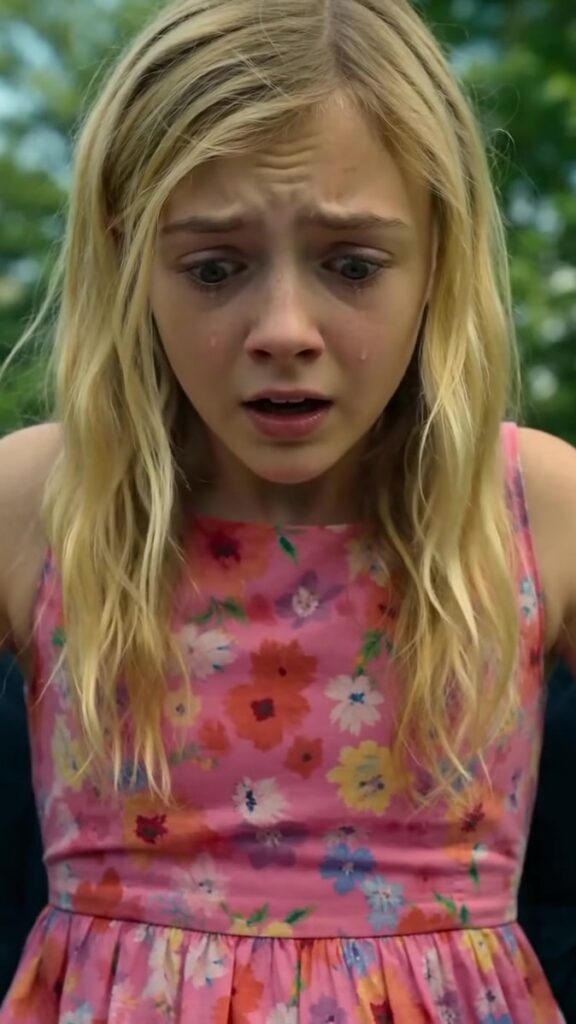
For three years, Lily had lived in that wheelchair the way other people lived in their own skin—without question, without escape. The chair’s metal frame was always cold in the mornings, even in summer. Its wheels knew every threshold in the house, every soft spot in the rug, every narrow turn that made Lily’s father flinch and hold his breath as if the slightest bump might finish the job the accident had started.
Doctors came and went in the first months like weather. They pressed her knees, tapped tendons, slid needles into skin, spoke about signals and pathways as if Lily were a map someone had folded wrong. There were pills lined up in plastic organizers, glossy brochures about rehab, and a chart with smiling stick figures that looked like it had been made for a different child. In the end, the strongest moment was not the day Lily stopped feeling her feet—it was the day the surgeon lowered his voice and said to her father, “You should prepare for the possibility that she won’t regain function.”
After that sentence, the house learned a new religion: silence. The halls filled with expensive equipment that never made Lily feel more capable—just more observed. A new ramp replaced the front steps, and the old porch swing was taken down, as if it mocked them. Her father’s laugh became rare, something that belonged to old photographs. Even the air seemed heavier, like it had absorbed their unsaid words and couldn’t let them go.
Lily did what she could to survive inside the quiet. She became good at reading faces, at deciding when to smile so people wouldn’t pity her too openly. She learned to say “I’m fine” with convincing rhythm. But there were days she stared at the lawn through the wide glass doors and felt something inside her chest tighten, the way it used to when she ran for the bus and thought she might miss it.
That was how Malik first became real to her—not as a blur beyond the window, but as a presence. He was the gardener’s grandson, a skinny boy with hair that never lay flat and a shirt the color of a late dandelion. He appeared in the mornings with a rake or a bucket, and by afternoon he’d be perched on the low stone wall, eating an apple and watching the house like it was a puzzle with one piece missing.
Lily noticed him because he didn’t stare the way adults stared—quickly, guiltily, and then away. Malik looked straight at her through the glass, and when Lily’s eyes met his, he nodded, as if to say: I see you. Not the chair. You.
It should have been unsettling. Instead, it felt like sunlight.
One day, after a session with the physical therapist that left her arms shaking and her father forcing brightness into his voice, Lily rolled herself to the back doors and sat with her forehead against the cool pane. Outside, Malik was trimming the hedge with steady hands. The scent of cut leaves drifted in every time the door opened and closed, sharp and green, the smell of things that still grew. Lily didn’t realize she’d spoken aloud until she heard her own whisper, thin as thread: “I don’t even remember what it feels like.”
Malik’s clippers paused.
He didn’t come to the door then. He didn’t wave. He simply went back to work, slower, as if he were thinking hard enough to change the shape of the day.
The next afternoon, Malik waited until the house had settled into its routine. Lily’s father had a call in his office—a voice too firm and too calm, the voice he used when he was pretending he wasn’t afraid. The nurse had stepped into the kitchen. The therapist wasn’t due until Thursday. The backyard was empty except for the whisper of wind through the trees.
Malik appeared at the side gate carrying a shallow white basin. It looked absurdly ordinary, like something meant for washing paintbrushes or rinsing fruit. He filled it at the spigot, testing the temperature with his wrist, then rolled it carefully across the patio as if it contained something precious.
When Lily saw him, she instinctively tightened her grip on the armrests. “You’re not supposed to—” she started.
“I know,” Malik said, and he said it the way people spoke when they meant: I’ve decided anyway. He approached the wheelchair and set the basin on the grass where the sunlight pooled. “Come outside. Just for a minute.”
Lily’s gaze flicked toward the house. The curtains in her father’s office were drawn, but she imagined he could still see her somehow, could still sense her breaking an unspoken rule. Her throat tightened. “If he finds out…”
“Then he finds out,” Malik replied softly. “But you’re allowed to feel the day on your skin.”
It was such a strange sentence that Lily almost laughed. Almost. Instead, she let Malik guide her chair across the threshold and down onto the lawn where the grass bent under the wheels. It had been months since she’d been on the grass. The ground smelled alive, and she hated how much she’d missed it.
Malik knelt in front of her, close enough that Lily could see the faint scratch on his knuckle, the dark crescent of soil under his nails. “Can I?” he asked, gesturing toward her shoes.
Lily’s cheeks warmed. “Why?”
Malik didn’t answer immediately. He untied the laces with careful fingers. “My grandmother says fear can sit in the body like a stone,” he said finally. “Sometimes it won’t move until you give it a reason.”
He slipped her shoes off, then her socks, folding them neatly like he’d been taught manners by someone strict. Lily’s feet looked pale and unfamiliar to her—like they belonged to a doll that had been left in a drawer.
Malik lifted her heels with both hands and lowered her feet into the basin. The water kissed her skin, cool and clean. Lily inhaled sharply. For a heartbeat there was nothing but sensation: water, air, the faint hum of insects. Malik swirled the water gently as if trying to wake something without startling it.
“Do you think this is going to fix me?” Lily asked, and her voice tried to sound mocking, but it shook.
Malik looked up. His eyes were darker than his sunlit shirt. “I don’t know,” he admitted. “But I know you deserve to remember.”
The words hit Lily with a force she wasn’t prepared for. She blinked, hard, like she could keep tears from forming by sheer will. Malik’s hands moved slowly, washing her feet as if it were a sacred task. The water rippled around her ankles.
From inside the house came the sharp sound of a door thrown open.
Lily’s heart slammed against her ribs. She turned her head and saw her father on the back steps in his navy suit, tie loosened, face already drained of color. His mouth formed her name as if it were a warning and a prayer at the same time.
“Lily!” he shouted, and he was running, shoes tearing through grass, panic written into every line of him. “Stop! Don’t—”
He didn’t finish, because something in Lily’s body answered the water before her mind could answer him.
It began like a rumor. A flicker. Her toes shifted under the surface, barely enough to make a sound, but the water made a tiny splash, betraying the movement like a gasp in a quiet room.
Lily froze. Malik’s hands hovered, suddenly afraid to touch.
Her father slowed mid-stride as if the air had turned solid. His eyes locked on the basin. His face changed—panic cracking open into something else, something rawer.
Lily stared at her feet. “No,” she breathed. Not denial—terror. As if her own body were an animal she didn’t trust. Then another twitch came, stronger, pulling at a place she thought had been dead. The water trembled. Her lungs stuttered.
“Wait,” she whispered. “I—” She swallowed, and the word broke in half. “I feel it.”
Malik didn’t speak. He was watching her feet like he was watching a candle fight its way back to flame.
Her father reached them, stopping so abruptly his breath burst out in a harsh sound. “Lily,” he said, lower now, as if volume could shatter whatever fragile thing was happening. “Please.” His hands were half-raised, uncertain whether to grab her, to pull her away, to shield her from disappointment.
But Lily wasn’t looking at him. She was looking at the line of her shin, the curve of her ankle. With trembling hands she braced on the armrests, feeling the familiar pressure in her palms. Her mouth tasted like metal. She leaned forward, the way she’d been taught in therapy a hundred times—except this time there was no therapist counting, no mirrors, no sterile encouragement. Just grass and water and Malik’s steady presence.
Her hips lifted from the seat.
The world narrowed to a single point: her right foot, hovering above the lawn.
Malik reached up instinctively, palms open, ready to catch her if the attempt betrayed her. Her father stepped closer, face contorted with fear, as if hope itself were a knife.
Then Lily’s foot touched the grass.
It wasn’t a grand motion. It wasn’t a triumphant leap. It was contact—soft blades bending under her sole, cool earth pushing back. The sensation ran up her leg like a message traveling a forgotten road.
Lily’s eyes filled. The tears weren’t neat; they spilled as if she’d been holding them back for years.
Her father stood utterly still, his suit out of place on the lawn, his hands shaking. In his eyes, disbelief fought with the memory of every night he’d listened to her crying behind her door and had done nothing because he had no answer.
Lily’s voice came out hoarse, scraped by awe. “Dad,” she said, and for the first time in years she didn’t sound like she was protecting him. She sounded like herself. “I can feel the ground.”
Her father’s face crumpled, and something inside the house—the old heaviness, the rigid rules, the fear of saying the wrong word—shifted, just slightly, as if a locked window had been cracked open. Malik stayed where he was, still kneeling, hands ready, eyes bright with a fierce kind of gentleness.
And Lily, trembling between sitting and standing, realized she had missed more than walking. She had missed being believed by her own body. She had missed the simplest truth: that sensation could return like spring, without asking permission, without obeying the timing of sorrow.
She didn’t take a step. Not yet. But as the water cooled around her left foot and the grass held her right, Lily felt the world lean closer, listening—waiting to see what she would dare next.