The men were laughing when the boy ran into the yard. It wasn’t friendly laughter, not the kind that invites you closer; it was a booming, careless sound that belonged to men who’d survived enough winters to believe they were iron. Their bikes sat lined up like armored horses—black tanks, chrome ribs, wet tires sunk into the soft ground. The afternoon had the color of cold tin. A gust moved through the weeds and set a loose chain on one handlebar clicking like a metronome.
He came through the open gate so fast he nearly missed it, a small body in an oversized leather vest that swallowed his shoulders. The vest looked borrowed from someone twice his age, the patches too heavy for his chest. He ran as if the yard were burning behind him, both hands wrapped around a toy motorcycle—metal and wood, weighty enough to wobble his arms. His boots slid on the wet grass. He tried to correct, tried to keep the toy from tipping.
He didn’t make it. His knee hit first, then his palms, then his chest, a harsh little thud that silenced the laughter like someone had reached out and closed a door. The toy jerked forward and nearly flew, but he clutched it to himself as if it were a living thing. For a heartbeat no one moved. Wind slid past the bikes. Somewhere, a cooling engine ticked its quiet, stubborn rhythm.
Rex stepped out of the line of men. He was the kind of broad that made doorways look small, beard thick with gray and road dust, eyes narrowed by habit. Most people, grown men included, looked down when he looked at them. He should’ve looked at the kid and seen the usual trespass: a dare, a prank, a theft. Instead he saw a child trying to breathe through sobs that broke apart in his throat. The boy lifted the toy up, arms shaking, presenting it like an offering at an altar.
“Mister,” the boy said, voice shredded by crying. “Please. I need to sell it.” He wiped his face with his sleeve, smearing rain and tears together. “My dad made it.” The sentence landed oddly, too weighted for a child. Men behind Rex shifted, cigarettes paused midway to mouths, as if the air had thickened.
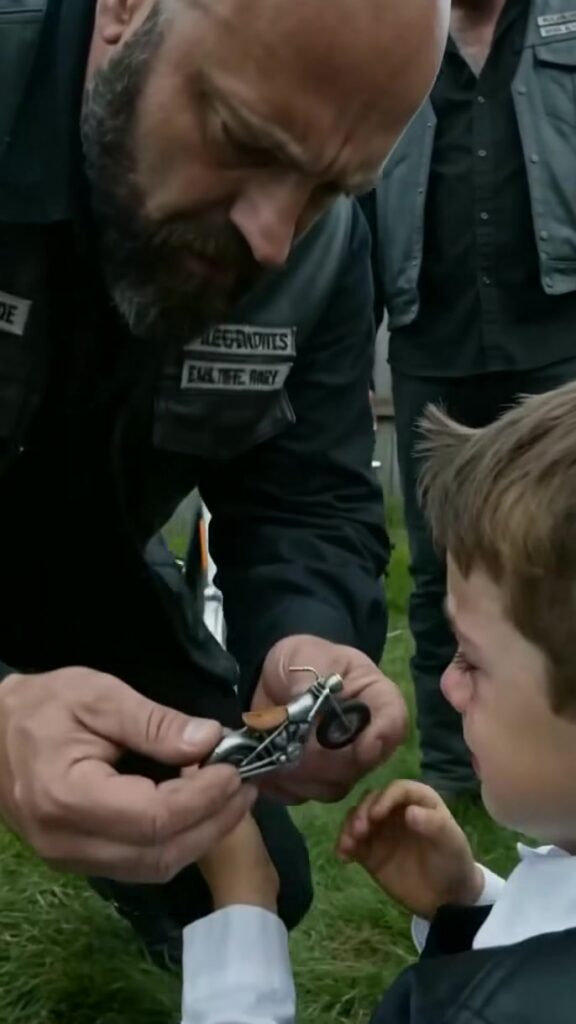
Rex crouched, boots sinking into the grass. “Let me see,” he said, careful despite himself. The boy hesitated—his fingers tightened around the toy as if letting go would tear something loose inside him—then he placed it into Rex’s palm. The toy was not cheap. It had been made by someone who knew motorcycles intimately: the balance right, the fork angled properly, the tiny chain drawn with a craftsman’s patience. The seat was stitched with dark thread, each loop clean. Rex turned it over, thinking of hands at a workbench, the hush of concentration.
Near the frame, burned into the metal so small it could be missed if you weren’t looking for it, was a mark: a wolf’s head, one eye slashed. Rex’s thumb stopped. The yard tilted. Seven years fell away as if a trapdoor had opened under his feet. He saw a younger man again—thin in the shoulders, laughing with grease on his knuckles, carving that same mark into a custom part and grinning like he’d invented fire. Eli. His brother.
Eli had vanished after the club accused him of skimming money and selling parts. Rex remembered the night like a scar: the argument, the fury, the sickening satisfaction of his own fist connecting with Eli’s face, the taste of bile afterward when Eli spat blood and still didn’t beg. Rex had told him to leave, told him never to show his face again, told himself it was loyalty to the club. He hadn’t known how to look for a brother you’d personally exiled.
Rex looked back at the boy. The kid’s eyes were dark and unblinking, stubborn even through tears. The chin had the same defiant set. There was a trembling in the lower lip that Rex had seen on Eli as a teenager, right before he refused to cry. Rex heard his own voice change—flatten, darken. “Why are you selling this?”
The boy swallowed hard. “Because my dad… my dad won’t wake up.” The words came out in pieces, like he had to pry them out of his own mouth. He hugged himself after he said it, as if he’d just stepped into cold water. Behind Rex, the men were suddenly statues. One of them lowered his cigarette without noticing it had burned too close to his fingers.
Rex held the toy tighter. “Where is he?” The boy pointed toward the road beyond the fence, toward the narrow strip of houses that crouched in the low ground. “In the small place behind the old diner,” he whispered. “He said if I found the man with the wolf on his back, you would understand. He said… he said you used to be family.” The boy’s breath hitched, and his gaze flicked to the huge patch on Rex’s jacket: the club’s wolf emblem, snarling, familiar.
Rex’s throat tightened until it hurt. “What’s your name?” he asked, though some instinct already knew. The boy wiped his nose again, staring hard at the grass as if it might save him from what he was admitting. “Cal,” he said. “Caleb.” Then, as if that wasn’t the real answer, he lifted his head and forced the next words out. “He said I’m yours too. Not like—” He shook his head, confused by adult meanings. “He said you’re my uncle. He said his real name is Elijah, and only you still remember it.”
A sound went through Rex—something between a breath and a groan. He stood too fast, knees popping. For a second he seemed to sway, as if the yard were a deck in heavy weather. “Gus,” he snapped to one of the bikers, the shortest man with the quickest hands. “Get a truck. Now. And bring the med kit.” Then, softer, to the boy: “Caleb, listen to me. You did right coming here.” The kid flinched at the sudden attention, shoulders rising, but he didn’t run.
Rex shrugged out of his own heavy jacket and draped it around the child. It swallowed him completely, sleeves hanging past his fingers. Caleb smelled like damp cloth and fear; Rex smelled like smoke and oil and the long road. Rex knelt again, this time close enough that his shadow covered the boy’s shaking knees. “How long has he been like that?” he asked. Caleb’s eyes filled. “Since the morning,” he whispered. “He was breathing loud. Then quiet. I tried to shake him. I tried to make him drink water like on TV. He didn’t.”
Rex closed his eyes for a heartbeat, and behind his eyelids he saw Eli’s grin, the way it vanished the night Rex decided to be a judge. When he opened his eyes, his men were watching him, waiting for the old rules to reassert themselves. The club had blamed Eli and moved on. Some of these men had been the loudest voices. Rex stared them down until the yard belonged to silence again.
He put the toy motorcycle carefully back into Caleb’s hands, curling the boy’s fingers around it as if it were a promise. “Don’t sell this,” Rex said. “This isn’t money. This is… a message.” He lifted Caleb into his arms—light as a bundle of winter coats—and started toward the gate. The men parted without being told. The row of motorcycles gleamed like witnesses. Above the fence, the gray sky pressed low, and the wind picked up, worrying at the patches on Rex’s vest.
As they reached the road, Caleb’s forehead found Rex’s shoulder. “Are you mad at him?” the boy asked, the question small but deadly accurate. Rex felt it hit the sore place under his ribs, the place he’d kept closed for years. He looked down at the child, at the smeared tears on his cheeks, at the stubborn grip on the toy, and realized he’d been laughing in this yard a moment ago as if nothing could touch him. “I was,” Rex said. “But I was wrong.”
The truck engine turned over with a deep cough. Rex climbed in with Caleb still in his arms, and as they drove toward the small house behind the diner, the club yard receded in the mirror like a life he’d mistaken for safety. Rex stared at the road ahead and tasted rust in his mouth, as if the past had finally drawn blood. He didn’t know what he would find in that house—whether his brother was still within reach or already gone beyond it. He only knew that the toy’s tiny wolf mark had come back to him like a verdict, and he was no longer laughing.