The rain didn’t fall so much as pursue her—hard, deliberate, as if it knew her name and wanted it back. It drove her down alleys that smelled of rust and wet paper, into doorways that offered no shelter, through streets where headlights smeared into pale rivers on the asphalt. Every time she thought she’d outwalk it, the clouds gathered their breath and exhaled again, colder, heavier. By the third day, Mara couldn’t tell where the storm ended and she began.
She wore a gray hoodie that had turned the color of bruised cement. The fabric clung to her shoulders and forearms like hands that wouldn’t let go. Her jeans were torn at one knee, the rip widened by hours of running, kneeling, crawling—whatever it took. Her shoes squelched at every step. Her eyes were the worst part: not empty in the way people mean when they say it casually, but vacant as a room after a fire, all the furnishings removed, the walls still warm.
She stopped in front of a small jewelry store wedged between a closed tailor and a pawn shop with barred windows. The sign above the door flickered once and steadied, a stubborn little glow in the afternoon gloom. The display window showed rings that could have been planets orbiting under spotlights. Mara stared at them without wanting them, like someone reading a language she no longer spoke.
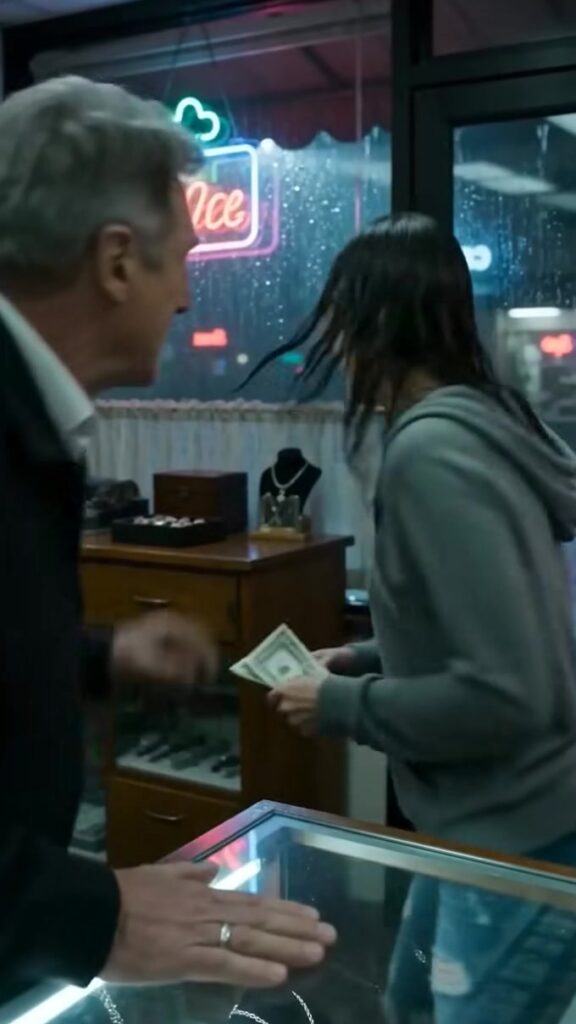
The bell over the door chimed when she entered. Warm air, a faint scent of metal polish and old carpet. Behind the counter sat a man with silver hair combed back and reading glasses perched low, his shoulders squared as if he’d been bracing against disappointment for decades. He looked up, took in her wet clothes and the way she held herself like she expected to be shoved, and then looked away with professional indifference.
Mara crossed to the counter and placed something down with a sound too sharp for such a small object. A gold locket, oval, the kind that belonged in velvet rather than in her scraped hands. Water beaded on it, trembling with the vibrations of the street.
“How much?” she asked.
Her voice was flat, stripped of every soft edge. No greeting. No explanation. No attempt to be believed.
The jeweler drew the locket toward him with two fingers, as if it might be contagious. He had seen enough people with trembling mouths and forced smiles to know desperation wore many masks. He weighed it in his palm, glanced at Mara, then at the rain tracking down the window. “Fifty,” he said.
That number landed between them like a pebble dropped into a well. He expected anger or bargaining or a story that began with I didn’t want to, but she didn’t flinch. For a second, something like relief loosened her shoulders, and it was worse than tears would have been.
“…Okay.” She said it too quickly, like she feared if she hesitated the decision would crawl back into her.
The jeweler—Elliot, his name stitched onto an old habit of being called “sir”—reached under the counter for the cash drawer. Yet his hand paused, hovering, because the locket’s clasp was familiar in a way his mind couldn’t place. Habit made him flip it open before he could stop himself. He’d learned to check for hidden damage, for false hinges, for empty shells that looked valuable from a distance.
The lid clicked back.
Inside was a photograph that had faded at the corners but remained painfully clear at the center: a little girl with a gap-toothed grin, held against a man’s chest. The man’s smile was too large, like someone trying to cover fear with joy. Beneath the image, engraved in tiny careful letters, were words Elliot had traced with his thumb a thousand times in his mind.
For my daughter, Clara.
His throat closed. The store seemed to tilt, lights bending into streaks. He felt the blood drain from his fingertips, leaving them trembling. He had ordered that locket fifteen years ago, after saving for months, because he wanted his daughter to have something that couldn’t be taken by the world’s carelessness. The day she vanished from a school field trip, he had convinced himself the locket was still in her room, safe and untouched. He had needed that belief to survive.
He snapped his head up. “Where did you—”
Mara was already stepping back, the money now in her fist, her gaze fixed on the door as if it were an exit from a burning house. Elliot shoved away from his stool, knocking it into the wall. “Wait!” he shouted, too loud for the small room, too raw for the polished glass around them.
She reached the door.
“That necklace,” he cried, stumbling around the counter. “It belongs to my daughter. My daughter is—she’s missing.”
Outside, rain hammered the sidewalk like thrown gravel. Mara stopped just beyond the awning, as if the storm itself had grabbed her. Her shoulders rose and fell once, a shallow breath she couldn’t afford to take.
Elliot ran into the rain without thinking. It hit him like punishment, soaking through his shirt, blurring his glasses. He was suddenly fifty-eight again and also thirty-eight and also a man on his knees in a police station begging strangers to care as much as he did.
“Please!” he called. “Where is she?”
Mara did not turn at first. The silence stretched between the downpour and the traffic hiss, taut as wire. Then she pivoted slowly, and Elliot felt something in him recoil—not from her ragged clothes, but from her eyes.
They weren’t surprised. They weren’t confused. They were terrified in a way that suggested she had been afraid for a long time and had finally run out of places to put it.
“If Clara is your daughter,” Mara said, and her voice wavered now, breaking through the flatness like a crack in ice, “then why did she beg me never to bring this back to you?”
Elliot’s mouth opened, but no sound came. The rain slid down his cheeks like tears he hadn’t earned. “Beg you?” he managed, the word tasting wrong. “I don’t— I’ve been looking for her. I have never stopped.”
Mara’s hand went to the pocket of her hoodie as if checking for something sharp. “You want me to say her name like it’s safe,” she said. “You want me to hand her back to you like you didn’t—” She swallowed, hard. “Like nothing happened.”
Cars passed, water fanning from their tires. A man under an umbrella glanced at them and looked away. The city was full of people who had learned not to notice.
“I was eleven,” Mara continued, staring at the pavement, not at Elliot. “I slept in places that smelled like bleach and piss. People told me to be grateful for whatever I got. Clara—she wasn’t supposed to be there. She kept saying it was a mistake, that her father would come, that the police would find her, that someone would fix it.” Her laugh was a jagged sound. “But days turned into months, and nobody came.”
Elliot’s knees threatened to fold. “Where?” he whispered. “Where were you?”
Mara’s eyes flicked up, sharp. “You say you’ve been looking,” she said. “Then you know.”
He didn’t. He had searched parks and riverbanks, posted flyers until the paper bled in the rain, paid for private investigators who offered pity and invoices. He had chased rumors the way Mara chased dry places to sleep. But he had never found a door with Clara behind it.
Mara stepped closer, close enough that Elliot could see a faint scar along her jawline, and the bruised half-moons beneath her eyes. “Clara’s alive,” she said, and the words landed like both mercy and knife. “But she’s not free. She’s somewhere she can’t leave, somewhere people are told to keep quiet if they want to keep breathing.”
“Tell me,” Elliot said, voice breaking. “Please. Tell me and I will— I will do anything.”
Mara’s lips pressed together. For a moment, she looked younger than her years, a child forced to bargain with grown-up monsters. “That locket,” she murmured, “was the only proof she kept that she used to be loved.” She glanced at the store behind him, the warm lights, the orderly world. “When she gave it to me, she said it was cursed. She said it brought people back who weren’t coming to rescue you. People who came to make sure you stayed lost.”
Elliot’s heart thudded against his ribs, loud as the rain. “Why would she think that about me?” he asked, and hated himself for how desperate it sounded to be defended by a girl who had every reason not to trust anyone.
Mara’s gaze slid away toward the street, as if expecting someone to appear at any second. “Because she remembers a man looking for her,” she said softly. “And she doesn’t remember him trying to take her home.”
The world narrowed to the space between them. Elliot saw, with sudden sick clarity, the last day he had seen Clara: a school bus, a wave through the window, her locket glinting in sunlight. He remembered the phone call that came three hours later, the way his boss had held him back, saying the police would handle it. He remembered signing forms he didn’t read, being told not to interfere, being told a hundred things that sounded like help but felt like being pushed behind glass.
“I was stupid,” he breathed, the admission barely audible. “I did what they told me. I thought… I thought compliance meant protection.”
Mara stared at him, searching for lies the way a starving person searches for crumbs. “Clara said the only way out is if someone stops being afraid of making noise,” she said. “Someone with a name people listen to. Someone they can’t disappear as easily.”
“My name,” Elliot whispered, and it tasted like rust. “You came here because you knew it would lead to me.”
Mara’s shoulders trembled, whether from cold or from the weight of what she’d done. “I needed money,” she said, and then, quieter, “and I needed to know if you were real.”
Elliot stepped forward, lifting both hands in the rain as if surrendering to something larger than himself. “Take it,” he said. “The money. All of it. Just—don’t leave.” His eyes burned. “Don’t go back into that storm alone. Tell me where to start.”
Mara hesitated, rain streaming from her hair into her lashes. The city around them roared and ignored them, but in that small strip of sidewalk, something shifted—an edge of fate catching.
“Not here,” she said at last, her voice low. “Someone will be watching.”
“Who?” Elliot asked.
Mara’s answer was almost lost to the downpour. “The kind of people who rely on everyone else believing girls vanish on their own.”
Elliot swallowed, felt the old helplessness rise, and forced it down. “Then we move,” he said, and for the first time in years, the words didn’t feel like a wish. They felt like a decision.
Mara looked at him—really looked—and the terror in her eyes didn’t disappear, but it made room for something else: a thin, trembling thread of possibility.
“If you’re lying,” she said, “if you’re part of it—”
“I’m not,” Elliot said. “I swear it on her name.”
The rain kept chasing them, relentless, cold, insisting. But as Mara turned and started walking, Elliot walked with her, and the storm no longer looked like a punishment. It looked like cover.
Behind them, the jewelry store lights glowed warmly, indifferent and small. Ahead, the street dissolved into gray sheets of water, and somewhere beyond it—somewhere hidden behind locked doors and quiet bribes—his daughter was waiting for a rescue she’d stopped believing in.
Mara didn’t run. She didn’t have to. For the first time in days, the rain followed two sets of footsteps instead of one.