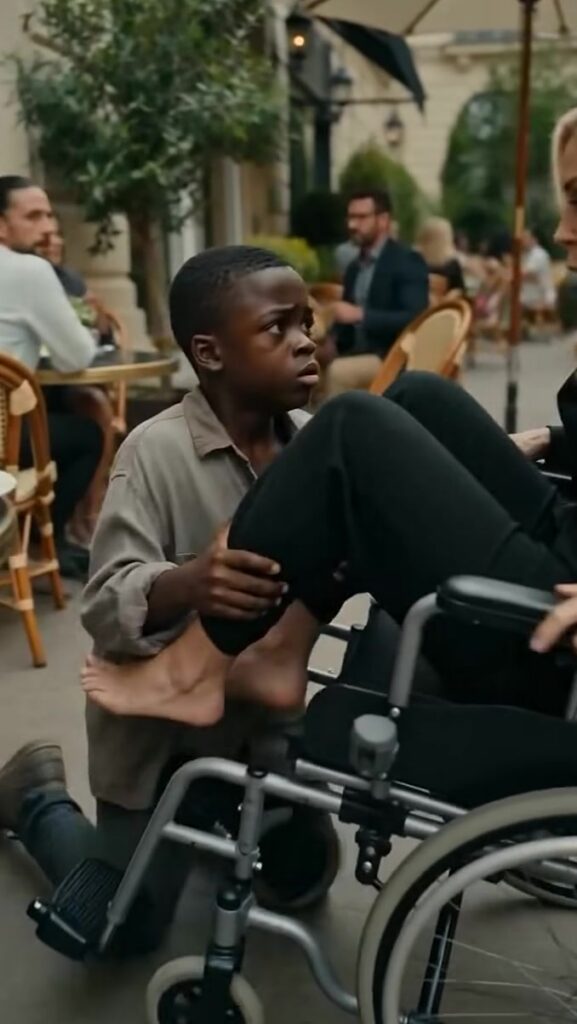
The café was full of the usual sounds of money and appetite—coins placed neatly beside saucers, the gentle clack of cutlery meeting porcelain, the sighs people made when the first mouthful landed exactly as expected. Sunlight poured through the tall windows and turned every glass of water into a pale, trembling jewel. A man in a linen jacket laughed too loudly at a joke only he understood. A woman with a watch that flashed like a small mirror stirred honey into tea with slow satisfaction.
Everything in the room had a price tag you couldn’t see, and everyone behaved as if they had already paid.
That was why the boy went unnoticed at first. He was only a shadow between brightnesses—between the entrance and the host’s stand, between the perfume counter near the restrooms and the linen-draped tables. He was thin enough to make his shirt look borrowed from a larger body, and his hair lay in uneven clumps as if he’d slept in too many places that weren’t beds. Hunger had carved him into angles. His eyes, however, were steady, as if they belonged to someone who couldn’t afford to blink.
He stopped near the richest table in the front—where the light was best and the view of the street was framed like a painting. A woman sat there with a silver-haired attendant hovering just behind her shoulder. The woman wore a cream scarf tied too perfectly to be casual. Her rings were small suns. Her wheelchair, sleek and black, looked less like a necessity and more like another luxury—polished, quiet, expensive.
Beside her, on a plate that had already given up its heat, lay a half-finished breakfast: eggs that still shone with butter, toast with a wedge of jam untouched, slices of fruit arranged like a promise. It wasn’t scraps. It was an abundance stopped mid-sentence.
The boy stared at that plate as if his stomach could see it too. His throat tightened. He swallowed in a way that suggested even imagining chewing was painful.
Then he stepped forward, crossing the invisible line that protected the wealthy from the needful.
“Ma’am,” he said, his voice thin but not timid. “If I cure you… can I have that food?”
The woman blinked, caught off guard by the oddness of the bargain. Her mouth twitched, trying to decide between amusement and outrage. “You’ll cure me,” she repeated, the words arranged like a question she already expected to dismiss.
The boy nodded once. No smile. No flourish. There was nothing theatrical in him. Only a kind of fierce certainty that didn’t ask permission to exist.
“Yes,” he said.
That was what unsettled her first—not the claim, but the way it sat in his mouth like fact. As if he’d already done it, somewhere else, to someone else. As if he wasn’t asking to try; he was asking to be paid.
“This is ridiculous,” the attendant murmured, shifting as if to place her body between the boy and the woman.
But before anyone could decide how to remove him politely, the boy dropped to his knees and seized both of the woman’s legs. It wasn’t a gentle touch. It was desperate, purposeful, as if he’d rehearsed the motion in his head a thousand times and could not allow hesitation to ruin it.
The wheelchair jolted. A chair leg screeched on tile. Nearby voices faltered mid-syllable.
The woman’s eyes widened. “Hey! What are you doing?” Her hand clamped the armrest so hard her knuckles paled against gold bracelets. Her attendant reached down, but the boy’s grip was surprisingly strong for someone made of hunger.
“Don’t fight me,” the boy said, and there was a sharpness in his tone that cut through the polite outrage. “Just try.”
The café, full of its practiced noise, began to thin into a hush. A man holding a fork paused with it suspended halfway to his mouth. Someone near the window turned with the slow interest of an audience sensing a scene has begun.
The boy pressed one of the woman’s feet downward, guiding it until the sole met the floor. It was not force, exactly; it was insistence—like he was reminding her body of a language it had forgotten.
The woman’s breath hitched. Her face, trained in control, cracked along its edges. “Stop,” she said, but her voice had changed. It was smaller now. Not indignant. Afraid.
Then something moved across her expression that was not emotion at all but sensation—surprise in the nerves, a stutter in the muscles. A tremor fluttered through her ankle, subtle as a moth’s wing. She stared at her foot as if she’d discovered a stranger at the end of her leg.
“Wait…” she whispered.
The boy didn’t let go. His eyes were locked on her, bright and terrifying in their focus. He leaned closer, as if listening for something under her skin. His thumbs pressed along the tendons with careful certainty.
Again—a twitch. This time unmistakable. A tiny lift at the toes. A pulse of obedience from a limb that, by every medical statement, should have been silent.
The woman’s mouth opened. Her scarf seemed suddenly too tight. “I…” She swallowed. “I felt that.”
A murmur rippled through the room like wind through curtains. Phones emerged from pockets, held low at first, as if shame still had influence. The attendant’s hands hovered uselessly, unsure whether to pull the boy away or hold the woman steady in case something impossible was happening.
The boy’s breathing came fast, but his hands remained precise. He shifted his grip, anchored her heel, and began to lift her forward. Not dragging—guiding, coaxing, as if her body were a heavy door that only needed the correct angle to swing open.
“You can,” he said softly, almost to himself. “You can.”
The woman’s eyes shone with a fear that looked like awe. Her fingers clenched around the armrest, then released it. Slowly, shakily, she leaned forward. Her shoulders trembled as if they were learning their job again. The boy braced her knee, his thin arms steadying what wealth and therapy had failed to awaken.
The first attempt was nothing but a trembling forward motion. The second brought her hips slightly above the seat. The café held its breath as if oxygen might ruin the miracle.
Then she rose—an inch, two—her weight shifting onto a foot that should not have been able to bear it. Her face contorted with the strange pain of unfamiliar strength. The wheelchair creaked behind her like a reminder of the years she had spent being carried by it.
The boy looked up at her, and his voice, when it came, was no longer sharp. It was quiet, raw, and threaded with something older than hunger.
“My mama said you stood the day you left us,” he whispered.
The woman froze as if the words had pinned her in place more surely than any paralysis. Color drained from her face. Her eyes searched the boy’s—really searched now, not the way you glance at a beggar but the way you look at a photograph you once tore in half and pretended you never owned.
“What did you say?” she managed, the syllables shaking loose from her throat.
The boy’s grip tightened, not on her legs now but on the truth he’d carried to this table. “She said you stood up,” he repeated. “That you could walk when you wanted to. That you got out of the chair at the airport, just once, when you thought nobody saw.”
The attendant sucked in a breath, a small, horrified sound. A few patrons glanced away instinctively, as if privacy could be restored by refusing to witness.
The woman’s lips parted. She stared at the floor where her foot pressed down—pressed down by her own will, by some newly awakened command. “Who is your mother?” she asked, but her voice already knew the answer. It had the brittle edge of someone hearing a name in their own head before it’s spoken aloud.
The boy’s gaze flicked to the abandoned plate, then back to her face. Even now, even with the room watching and the impossible unfolding in his hands, hunger still sat in him like a second heart. “Her name was Leena,” he said. “She cleaned your house. She used to hum when she washed your stairs. She said you liked lilies and hated loud clocks.”
The woman swayed. The boy steadied her without thinking, as though his arms existed for this single purpose.
“She’s gone,” he added, and the word “gone” held more than death. It held eviction notices, winters, doorways that didn’t open, sickness ignored because it was inconvenient. It held the shape of a life that didn’t fit into the café’s soft daylight. “Before she died, she told me to find you. She said if I asked for what was mine, you’d pretend you couldn’t hear. So I came with something you couldn’t pretend about.”
The café remained silent, but it was not a comfortable silence. It was the kind that forms when a room realizes it has been living inside a lie.
The woman’s hands trembled. One reached toward the boy’s head, then stopped, suspended between habit and remorse. Her eyes glistened, but no tear fell. Tears were too simple for what had climbed into her throat.
“You don’t know what you’re saying,” she whispered, though it sounded like she was trying to convince herself.
The boy’s voice hardened. “I know you stood,” he said. “I know my mama begged you not to send her away. I know you said you couldn’t help her, because you had your own troubles.” He glanced at the wheelchair, and for the first time there was contempt in his stare. “You made a trouble out of metal and wheels. My mama had a trouble out of empty cupboards.”
The woman’s breath shuddered. Her foot shifted again, a small, undeniable movement. Proof. Exposure. The lie cracking in the light.
The boy looked at the plate once more. “If I cure you,” he said, repeating his opening bargain as if it had never been interrupted, “can I have that food?”
For a moment, the question hung there—not as a request for breakfast, but as an indictment. In the café full of money and appetite, it was suddenly clear what the boy was really asking for.
The woman stared at the food, then at the boy, then at the floor beneath her feet—beneath the weight she was bearing on a leg she had kept sleeping for years. Her throat worked as if chewing on words that tasted like ash.
At last, she nodded once, small and shaken. “Yes,” she said. “Take it. Take all of it.”
The boy did not reach for the plate. Not yet. His hands remained on her knees, anchoring her to the truth of her own body. “No,” he said quietly. “Not until you stand without me. Not until everyone sees.”
And in that café, amid the polished tables and the soft daylight, the woman began to rise—slowly, painfully, unmistakably—while a hungry boy held her upright, demanding payment not just in food, but in the courage to be exposed.