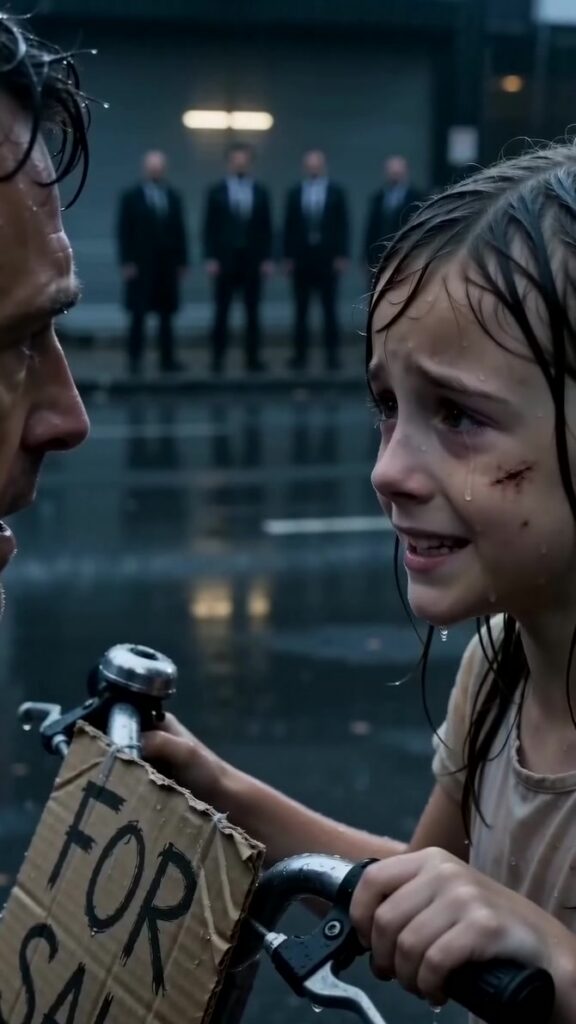
The rain had been falling long enough to make the city look rinsed of color. Water ran in clear threads along the gutter and beaded on the spokes of the bicycle that stood like a nervous animal at the curb, its front wheel angled toward nowhere. A rectangle of cardboard, tied to the handlebars with twine, bumped and fluttered with every gust, the marker ink already bleeding at the edges: FOR SALE.
The girl holding the grips was too small for the frame, too thin for the coat that hung off her shoulders. Her hair, flattened by water, clung to her cheeks in black strands. She watched the passing faces the way people watched traffic at a crosswalk—calculating, hoping, bracing for impact. Every time someone glanced at the sign, she lifted her chin as if rehearsing the role of a seller. Every time someone moved on, her fingers tightened, and she didn’t loosen them again.
Behind her, by the brightly lit doorway of a shop that sold cheap electronics and bright promises, four men stood under the awning where the rain could not touch them. They looked like they belonged to the city’s rougher underside: hands in pockets, boots planted wide, shoulders relaxed in the manner of those with time to waste. They weren’t loud. They didn’t call to her. Their patience had an edge to it, like a knife left on the counter, waiting.
The girl was not really selling the bicycle. It was a question she was asking the world—quietly, desperately—about whether it still had room for tenderness. The bicycle was not just metal and rubber; it was a small, bright proof that she had once been someone who rode in circles in a courtyard, laughing at nothing at all. It was evidence that she had once been a child and not a burden that needed managing.
A man in a grey coat stopped.
He wasn’t old, but he carried himself like someone who’d learned to move carefully. Rain dotted the shoulders of his coat and the brim of his hat. He looked at the cardboard sign, then at the girl’s hands. He didn’t reach for the bicycle. He did something stranger—he crouched, bringing himself down to her level as if he was afraid a towering posture might break something already cracked.
That simple act—knees in the wet, eyes steady, voice not raised—made the girl’s throat jerk like she’d swallowed a stone. For a moment she forgot the men behind her. Her mouth opened and closed once before sound came out.
“Would you… buy my bike?” she managed. She shaped the sentence with politeness the way she’d once been taught, but her eyes didn’t know how to keep up. They were dull with exhaustion, and in them something had already surrendered.
The man’s gaze didn’t linger where he shouldn’t. He took in the scrape along her cheekbone, the grime under her fingernails, the bruising shadow on her wrist in the exact outline of someone else’s grip. His expression tightened, not with judgment but with a kind of restrained shock, as if he’d opened a door expecting cold and found fire.
“Why are you out here by yourself?” he asked softly.
The girl tried to answer. She tried to make the story neat enough to hand over. But the words were tangled with fear, and fear didn’t like being translated.
“My mother… hasn’t eaten,” she said finally, each word squeezed out as if it cost her. “She’s been sick. We don’t… we don’t have anything left.” Her eyes flicked to the bicycle like it was a friend she was betraying. “Just this.”
The grey-coated man glanced past her shoulder, as if something in the air had shifted. The shop lights threw long reflections on the wet pavement, and in those reflections he saw movement: one of the men under the awning had changed his stance. Not leaving. Not helping. Just adjusting, like a dog sensing a door might open.
The girl followed the man’s glance and flinched. Her shoulders hunched, but she didn’t step away. She couldn’t. The bicycle, the curb, the rain—this was the only stage she had left.
“Who told you to come here?” the man asked, and there was steel under the gentleness now. “Who told you you had to bring money?”
Her lips parted and then stopped. Silence fell between them, heavy as a soaked blanket. The men behind her did not speak, but the weight of their attention pressed like a hand at the back of her neck.
The man’s eyes dropped to the bicycle, following the lines a careful observer would follow: the frame joints, the chain, the cheap lock coiled around the seat post. That’s when he noticed the strip of white cloth tied beneath the saddle, pulled so tight it bowed the fabric into a hard, deliberate knot. It wasn’t decorative. It wasn’t accidental.
His face did not change much, but his breathing did. The girl saw his attention catch, and her expression shifted as if the last mask had fallen away. Shame drained from her features, replaced by something colder and sharper.
Fear. Real fear. The kind that didn’t look inward. The kind that watched the corners of the world for footsteps.
She leaned in, so close he could smell rain and cheap soap on her skin. Her voice dropped to a whisper that barely survived the wind. “Please,” she said, and it was not a sales pitch. “Take it. Buy it. Before they come.”
The man in grey straightened slightly, still crouched but ready to move. His gaze flicked to the men again. One of them had stepped off the awning, letting the rain hit his shoulders like he didn’t care. Another had checked his phone and pocketed it, an idle gesture that wasn’t idle at all.
The man in grey did not pull out his wallet. Instead, he reached into the inside of his coat and produced something slimmer and darker: a phone. He held it low, shielded by his sleeve, and tapped once, twice. He did not hold it up like a threat; he held it like a lifeline he was careful not to snap.
“What does the cloth mean?” he asked, lips barely moving. “Tell me.”
The girl’s throat bobbed. “It means I’m theirs,” she said, each syllable tasting of rust. “It’s for the man who comes later. So he knows.” Her eyes darted toward the street. “They said I get to go home if I’m good. They said my mother will eat if I’m good.” A bitter little sound left her that wasn’t a laugh. “I tried being good. It didn’t change anything.”
Rain slid down the man’s hat brim, a steady drip. He kept his voice level, like a line a drowning person could grab. “Listen to me,” he said. “You are not going with anyone. Not today.”
The girl blinked hard. Hope made her look younger in a dangerous way, like a candle in a storm. “You can’t,” she whispered. “They’ll—”
“I can,” he said, and there was certainty in it, the kind forged from past failures and the refusal to repeat them. His thumb moved again over his phone. “I already called. But we have to do this carefully.”
He reached for the handlebars, not to take the bike away from her, but to turn it slightly so the frame blocked her from the men’s direct line of sight. Then he did something no one had done for her in a long time: he positioned himself between her and the threat without making a show of it.
The men behind them began to move as a group, like a tide deciding it was time. Their boots splashed in shallow puddles. Their faces carried the boredom of people used to getting what they wanted. The nearest one smiled, slow and thin, as if he’d been waiting for the scene to become interesting.
The grey-coated man didn’t raise his voice. He didn’t posture. He simply stood, one hand steady on the bicycle, the other still holding his phone, and watched them approach with eyes that did not look away.
“This bike isn’t for sale,” he said, loud enough for them to hear, calm enough to make the words land like a verdict. Then, lower, to the girl, he added, “When I tell you, you run. Not toward the shop. Toward the crossing. Keep the bike. Don’t let go.”
The girl swallowed. Her knuckles were white on the grips. In the rain, the cardboard sign quivered and twisted, trying to free itself from the string. She stared at the street as if it might open into another world.
Somewhere in the distance, a siren began to rise—faint at first, then clearer, threading through the hiss of rain. The men slowed, their eyes narrowing, calculating new risks. The grey-coated man didn’t relax. He shifted his stance, ready to take the first blow if it came.
“Now,” he said.
The girl moved. Not gracefully, not confidently—like a deer launching itself from a burning forest. The bicycle lurched with her, tires cutting through water, and for a heartbeat she looked back. In her face was the raw disbelief that kindness could still exist, not as a story adults told, but as a hand held out in the rain.
Then she rode, and the grey-coated man stepped forward into the space she’d left, filling it with his body and his resolve, as the men realized the deal they’d planned was breaking apart.
The cardboard sign tore loose and tumbled into a puddle, the word SALE dissolving into ink and water, as if the city itself had decided to erase the lie.
And the bicycle—her proof, her question, her last small piece of childhood—carried her toward the sound of help.