The cemetery was quiet in the way only military cemeteries are—an engineered hush, trimmed and aligned like a uniform. Even the sky seemed to stand at attention, pressed flat and gray over the rows of white stones that receded into the distance until they became a pale grid vanishing into mist. The wind did not gust. It only passed, careful and disciplined, combing the grass in slow strokes as if afraid to disturb the dead.
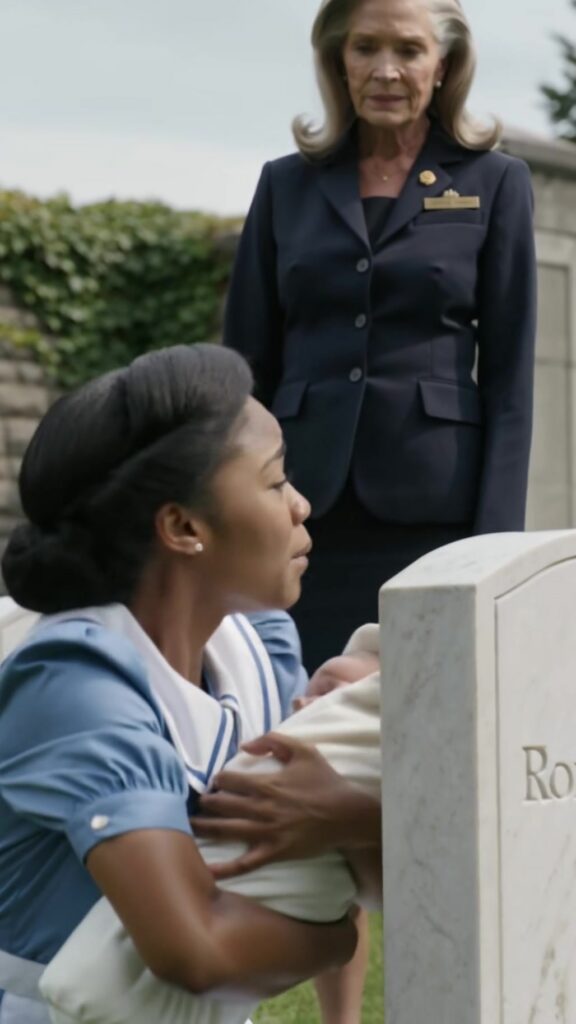
Laila moved between the markers as though she had been trained to keep her steps measured. She hadn’t. She was simply afraid of making any sound at all, afraid that one careless footfall might shatter the fragile barrier holding her together. The infant in her arms slept in that deep, unearned peace only the very young possess. His breath warmed the crook of her elbow. Against her chest, his tiny weight felt like the only real thing in a world that had turned hollow.
She wore the blue-and-white uniform of a service aide—plain, practical, the kind of clothing meant to make you invisible in hospitals and offices. It had been her disguise in town, her shield. Here it looked almost like an apology.
She stopped at a headstone that was clean enough to catch the light despite the overcast day. The letters were sharp and official, cut with the same indifferent precision as a stamped form. Name. Rank. Unit. Dates that fit too neatly on one line, as if the man had been properly stored in time. Laila knelt and brought the baby closer, angling him as if a sleeping face could be introduced.
Her throat tightened. She pressed her forehead against the cold marble edge and let the tears go, silent and stubborn, slipping down to her jaw and into the collar of her uniform.
“You should have met him,” she murmured, the words barely leaving her mouth. It was a confession more than a statement, meant for stone and soil. “You would have… you would have known what to do.”
She stayed there, cheek against the headstone, breathing in the faint scent of wet grass. If she listened hard enough, she could almost hear the world before: a laugh in a kitchen, a knock at a door, a voice behind her saying her name like it wasn’t dangerous.
A shoe scuffed the gravel behind her. Not loud, but precise. A warning rather than an accident.
“What exactly do you think you’re doing?”
The voice was controlled to the point of cruelty. Laila’s body reacted before her mind did. She tightened both arms around the infant and turned too fast, the baby’s head bobbing once against her shoulder. She steadied him with a palm and struggled to her feet.
Behind her stood a woman who looked as if she belonged on the other side of the cemetery gate, in a building with glass walls and locked doors. Dark blue suit, tailored without softness. Hair the color of polished silver, set flawlessly despite the damp air. Her face was pale, her mouth thin, and her eyes carried a sharpness that suggested she had learned long ago not to blink when she wanted something.
Laila swallowed. “I’m sorry,” she said, and hated how small her voice sounded. “I didn’t mean to—this wasn’t meant to be…” She glanced at the baby as if he could explain for her. “Disrespectful.”
The older woman stepped closer, gaze moving over Laila’s uniform, her red-rimmed eyes, the way her fingers protected the infant’s back. Her attention did not soften. It narrowed, calculating, as if she were sorting facts into columns.
“Who are you?” the woman asked. The question landed like an accusation.
Laila’s heart hammered against the sleeping child. She could have lied. She had lied before—at clinics, at bus stations, to neighbors who asked too many questions. But the grave at her back felt like a witness. Lying here seemed impossible.
“My name is Laila,” she said.
The air changed. It wasn’t dramatic like thunder; it was worse—quiet, immediate, and final. The older woman’s eyes flickered as if a hidden door had been opened in her mind. For a moment, something like shock crossed her face. Not grief. Recognition.
“No,” she breathed, but she did not step away. She looked past Laila’s shoulder to the headstone, then back, as though triangulating a memory with the coordinates of reality.
Laila’s lips parted. “You… you knew him,” she said, though it was obvious in the way the woman stood—possessive, certain, anchored by the name carved in stone.
“I am his mother,” the woman said, and the title sounded like a rank. “And I want to know why you’re here, kneeling at my son’s grave with a child.”
Something in Laila’s arms shifted. The baby’s blanket loosened, slipping down enough to reveal the corner where blue thread formed two careful initials. Laila’s hand shot to cover it, too late.
The older woman’s gaze snapped to the stitching. Her pupils tightened. The color drained from her face so quickly it looked like a mask being removed.
“Where did you get that?” she asked. The control in her voice cracked, just a hairline fracture. “Those letters—”
Laila tried to tuck the blanket back into place, her fingers clumsy. “It’s just a blanket,” she said, but the lie tasted wrong. The thread had been sewn by hands that trembled, by someone who had insisted on leaving a mark even when everything else was meant to disappear.
The older woman took another step, close enough that Laila could see the fine lines around her eyes, the kind carved by sleepless nights and decisions made without forgiveness. Her attention wasn’t on the baby’s face. It was on the initials, as if they were a code she had once sworn she’d never need.
“Those are his,” she whispered, the words scraping out of her. “He had them etched inside his watch. He said it was for luck.” She looked up sharply. “How do you know that?”
Laila’s chest rose and fell too quickly. The cemetery seemed to tighten around them, white stones leaning in, the wind holding its breath.
“Because he gave it to me,” Laila said, and the truth came out like blood finally allowed to flow. “He gave me the watch. He gave me the blanket. He gave me… a name to use when it was time to run.”
The older woman’s jaw clenched. “He did not—”
“He did,” Laila interrupted, and surprised herself with the force of it. Her eyes burned, but her voice steadied, as if grief had been a training ground. “He found me when I was nobody, and then he made me somebody that could be punished.” She looked down at the sleeping infant, at the tiny fist curled against the fabric. “He promised he’d come back. He said there were rules, and he hated them, and he would break them when it mattered.”
“My son followed rules,” the older woman said automatically, as if reciting a defense she’d practiced.
Laila laughed once, short and bitter. “He followed orders. There’s a difference.”
The older woman’s eyes flashed. “Why didn’t you come to me?”
“Because someone burned his letters,” Laila replied, the words aimed carefully. She watched the impact register—a tiny flinch, quickly smothered. “Because someone decided what was allowed to be known.”
A gust of wind finally arrived, colder than before, lifting the grass in a wave. The older woman stared at the baby’s face as if expecting her son’s features to rise up in miniature and accuse her. The infant slept on, indifferent to lineage and secrets.
“He never mentioned you,” she said, but it sounded weaker now, more like hope than certainty.
Laila shifted the baby higher against her shoulder. “He did,” she answered softly. “Not the way you think. He talked about a woman who could command a room without raising her voice. A woman who could turn love into leverage.”
The older woman’s nostrils flared. “You came here for money,” she said, and in that accusation was terror—terror of being manipulated, terror of being needed.
“I came here because I didn’t know where else to put the ache,” Laila said. “And because he asked me to bring him.” She looked toward the headstone. “He said, if anything happened, let our son hear the silence. Let him understand what it costs.”
The older woman’s gaze dropped again to the stitched initials. Her lips trembled, the first sign of anything human. “He found you,” she murmured, and the sentence sounded like a verdict, not a miracle.
Laila nodded. “He did,” she said. “And he died trying to make sure we wouldn’t.”
For a long moment, neither of them moved. The cemetery held them in its strict geometry, a place designed to keep stories brief and contained. But between the stone and the sleeping child, a story refused to stay buried.
Finally, the older woman lifted her eyes. The coldness remained, but it had shifted, aimed inward now, at an older enemy. “What’s his name?” she asked, voice quieter.
Laila hesitated, then answered. “Elias.”
The older woman closed her eyes as if struck. When she opened them, she looked at Laila not with kindness, not yet, but with the sharp clarity of someone who has realized the battle is no longer theoretical. “You shouldn’t have come alone,” she said.
Laila’s grip tightened. “I didn’t come for a fight,” she whispered.
“Neither did he,” the older woman replied, glancing at the grave. Then, with a steadiness that frightened Laila more than the earlier suspicion, she extended her hand—not to take the baby, but to touch the edge of the blanket where the initials were stitched. Her fingers hovered, trembling, just shy of contact. “But it came anyway.”
The wind moved through the rows again, soft and relentless, and somewhere beyond the gate a car door closed, too loud for this place. Laila looked down at her son’s sleeping face and understood, with a sudden, brutal clarity, that the cemetery’s silence was not peace. It was only the pause between salutes—before the next command, before the next loss, before the living had to decide what the dead had asked of them.