In the glass canyons of three continents, Arman Sayegh was spoken of the way ancient cities spoke of storms—inevitable, profitable, and beyond anyone’s power to stop. He bought shipping lanes like chess squares. He moved elections with a phone call. He built hospitals that gleamed like temples and towers that interrupted the clouds. In meetings, men twice his age waited for his nod as if it were permission to breathe.
But on the night he learned his daughter’s eyes were failing, his empire shrank to the size of a hospital room, to the rhythmic beep of a monitor and the soft rasp of Leena’s breath. She was seven, all elbows and stubbornness, and she had always looked at him as if he were the safest thing in the world. It was that trust—more than the diagnosis—that tore him open.
The specialists arrived as if summoned by a king’s decree. A retinal surgeon from London brought a case of instruments that snapped open with the neat menace of a magician’s trick. A neurologist from Dubai came with a team and a portable scanner, sterile and humming. A research professor from New York spoke in careful phrases, as if words themselves might injure her. Arman offered them money the way other men offered prayers.
Their answers never rose above the cautious. They used clinical terms—degenerative, idiopathic, atypical—words that sounded like doors closing. They tried steroids. They tried experimental infusions, blood work, imaging, genetic screens. Each week, Leena’s world dimmed a little more, as though someone were turning down an unseen dial.
At first she only complained about reading. Then she began bumping into corners. Then she stopped running. Her hands reached out before her feet moved, testing the air, searching for certainty. In the evenings Arman sat beside her bed and listened to the city’s distant noise, furious at how life continued with the same careless momentum.
He bought a new wing for the children’s hospital. He financed a lab. He offered to fly her to anywhere that had light in it—Tokyo, Zurich, Reykjavik—anywhere that promised a miracle in a different accent. But nothing held back the dark. It kept arriving with the calm patience of winter.
On an afternoon when the heat pressed down like punishment, Arman took Leena away from doctors and quiet rooms. He wanted her to feel ordinary air. He drove her to a small park near the older part of the city, a place with cracked paths and a few stubborn trees. The sun was brutal; the benches were too hot to touch. Still, she smiled when she heard children somewhere, their shrieks cutting through the heavy day like birds.
Arman held her hand and guided her under the shade of a fig tree. He tried to describe what he saw—the way the leaves trembled, how light sifted through them—but every detail felt like cruelty. He looked at her lashes, her pupil’s uncertain drift, and he hated the sun for shining at all.
Leena tilted her face upward, as if listening to the sky. “Daddy,” she asked, in the casual voice of a child asking for water, “is it nighttime already?”
Something inside him broke cleanly, like glass under pressure. He forced warmth into his voice, the kind he used to reassure investors when the numbers were bleeding. “Not yet,” he lied. “It’s still day. The sun’s just… hiding.”
She nodded, accepting the story with the generosity only children have. Her fingers tightened around his, tiny and fierce. Arman stared at the bright path before them, at the shimmering asphalt beyond the park, and felt helplessness as a physical weight. He, who had negotiated hostage releases and rerouted entire supply chains, could not bargain with the slow erasure of his daughter’s sight.
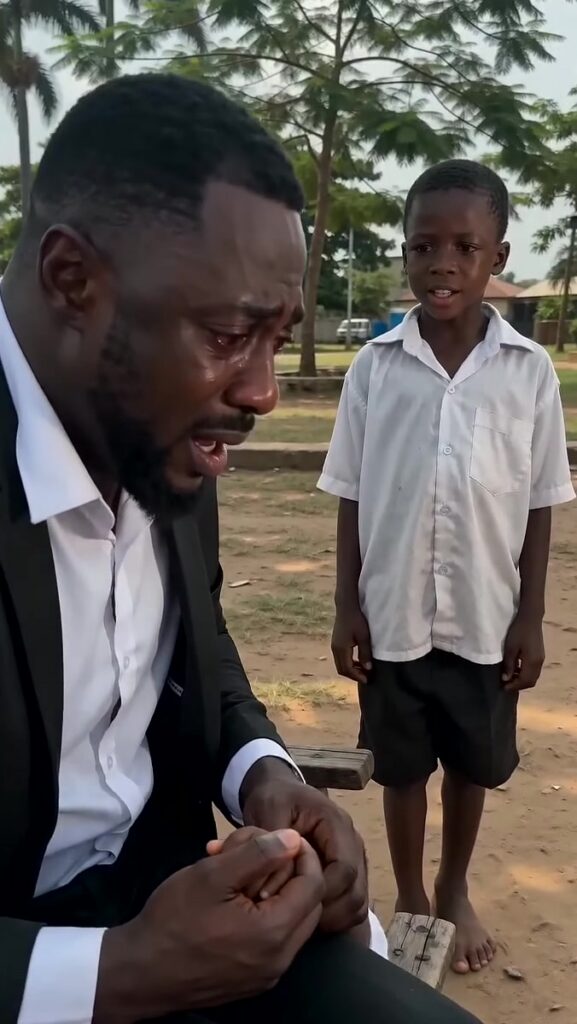
A shadow fell across the path—impossible, because the sun was overhead and the tree’s shade did not reach that far. Arman looked up. A boy stood several steps away. Barefoot. Dust on his ankles. He wore a faded shirt that might once have been white and held a small cloth bundle under one arm.
Arman’s first instinct was irritation—security should have been closer, someone should have stopped strangers. But there was no alarm, no approaching guard. The boy’s face was calm, too calm for a child alone in the heat. His eyes were dark and steady, fixed not on Arman but on Leena, as if he recognized her.
Leena turned her head toward the sound of his breathing. “Who’s there?” she asked.
The boy took one quiet step forward, then another, the soles of his feet making no sound on the baking path. He stopped at a respectful distance. “You shouldn’t tell her the sun is hiding,” he said.
Arman’s spine tightened. “Excuse me?”
The boy’s gaze flicked to Arman, and for a moment Arman felt as if the child were looking straight through him, past titles and money and the polished armor of his life. “Lies make the dark thicker,” the boy continued, as if reciting something learned long ago. “It settles in the spaces between words.”
Arman swallowed. “Who are you? Where are your parents?” He glanced around, expecting someone to rush forward. No one did. The park’s noises seemed to dull, as if the afternoon itself was holding its breath.
The boy shifted the cloth bundle to his other arm. “Your daughter’s sight isn’t leaving because of her eyes,” he said. “It’s leaving because of you.”
Arman felt the statement like a slap. Rage flared—hot, immediate, protective. “How dare you—”
“You bought hospitals and named them after yourself,” the boy interrupted, his voice still soft. “You paid for machines and ceremonies. But you never paid the debt you owed.”
Arman’s mouth went dry. Debts, in his world, were numbers, negotiated, refinanced, hidden. He had no patience for riddles from street children. “What debt?”
The boy lifted his chin toward the city skyline, where Arman’s newest tower cut a gleaming line against the sky. “There was a neighborhood there,” he said. “Before your foundation and your glass and your bright lights. There was a clinic with one doctor and a waiting room that smelled like soap. There were children who could have lived if the medicine trucks had not been stopped at the port.”
Arman’s blood cooled in an instant. He remembered the port strike years ago, the way his competitors had tried to choke his supply chain. He remembered authorizing a blockade, not thinking of the small shipments, only the larger war. He remembered signing a paper that delayed clearance until his demands were met.
He had never asked what else was in those containers.
Leena’s hand trembled in his. “Daddy?” she whispered, hearing the silence in him. “What’s happening?”
The boy took a final step closer, and Arman saw something in the child’s face that made his throat tighten—sorrow without anger, like a candle that had burned down too far. “You can’t command this darkness away,” the boy said. “You can only return what you took. Not with speeches. Not with money that keeps your name clean. With the truth.”
Arman stared at him, heart pounding, memories shifting into place like teeth in a trap. “Who sent you?” he demanded, though the question sounded foolish as soon as it left his mouth.
The boy’s eyes softened. “No one sent me,” he replied. “I came because she asked the wrong question.” He looked at Leena. “It isn’t night,” he told her gently. “It’s afternoon. The sun is right there. Your father is afraid to let you feel how bright it is.”
Leena’s lips parted, confused, her face turned toward where the boy indicated. Arman watched her, desperate, and realized the boy was right: his lies were a shield for himself, not for her. He had been protecting his own heart from the reality he could not control.
The boy loosened the cloth bundle and revealed a small jar of cloudy liquid, stoppered with wax. “This won’t fix her,” he said, as if reading Arman’s thoughts. “There is no potion for what’s happening. But it will help her pain tonight.” He held it out as if offering something sacred. “The rest is yours to do.”
Arman didn’t take the jar. His hands shook too much. “What do you want?” he whispered.
The boy’s expression sharpened, and in his gaze Arman saw something like judgment, ancient and unbribable. “I want you to remember every child you never looked at,” the boy said. “I want you to open the containers you closed. I want you to speak the names you buried under contracts.”
Arman’s eyes stung. The park blurred, not from failing sight but from something he had spent a lifetime refusing: remorse. He knelt so his face was level with Leena’s. “It’s afternoon,” he said hoarsely. “The sun is… blazing. I was wrong to say otherwise.”
Leena squeezed his fingers. “It’s okay,” she murmured, but her voice carried a new tremor, as if even she could sense that the truth cost something.
When Arman looked up again, the boy was walking away along the path. No footprints marked the dust. Arman rose, stumbling forward. “Wait!”
The boy didn’t turn. His voice drifted back, calm as the shade under the fig tree. “Tonight,” he said, “when she asks you for a story, don’t make yourself the hero. Make yourself honest.”
Then he vanished—no sudden flash, no theatrical disappearance—simply gone between one blink and the next, as if the park had swallowed him. Arman stood shaking in the heat, Leena’s hand in his, and felt the world tilt: not toward darkness, but toward the dreadful clarity of what light demanded.
He had built empires from decisions that never touched his skin. Now, with his daughter beside him, every decision would burn. And for the first time in his life, he understood that the most terrifying power was not controlling nations or markets.
It was facing the truth, and paying what it cost.