The diner had a name painted in peeling blue letters—Mabel’s Place—but the sun had bleached it until it looked like a ghost of a promise. It sat alone off Route 66 like a forgotten tooth, surrounded by dust, scrub, and the long, humming emptiness that made people drive faster without knowing why. Inside, the air smelled of scorched coffee and fryer oil, and the booths were the same red vinyl as a hundred other roadside stops. Ordinary enough to disappear.
That was why Jonas Mercer had chosen it.
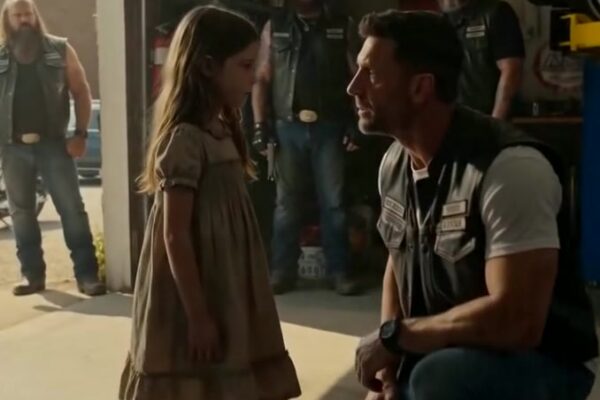
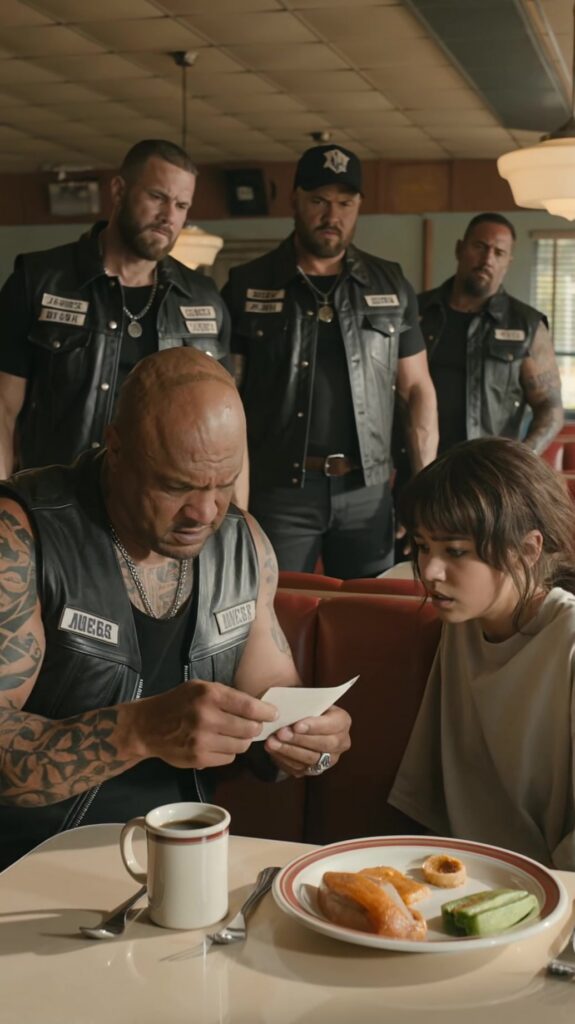
Jonas was built like a boulder and shaved his head because hair only gave people something to grab. The patches on his vest marked a life he rarely talked about: the Devil’s Wake, an outlaw club that ran from the desert to the outskirts of St. Louis. He’d survived knife fights, raid nights, and the kind of deals that kept you staring at your hands afterward to make sure they were still yours. He’d learned to recognize danger by the taste of it—metallic and faint, like blood in your mouth.
This morning, that taste was already there.
He sat in the corner booth with two of his riders, Big Al and Rina, pretending they were just hungry travelers. Rina had her helmet on the seat beside her and a hand near the inside of her jacket. Big Al watched the windows. Jonas watched the room—waitress, cook, trucker, two tourists with maps. Nothing obvious.
Then the bell over the door gave a thin, reluctant jingle, and the ordinary day cracked.
A girl stumbled in like she’d been pushed out of a nightmare. She wore an oversized beige T-shirt that hung off one shoulder, and her hair looked like it had been combed by wind. Her skin was too pale for the desert light outside. She took two steps, saw Jonas, and froze with a certainty that made his stomach drop.
Not because she knew him.
Because she’d been looking for him.
She slid into the booth across from his before the waitress could ask questions. Her hands shook as if the tremor had a life of its own. Around her upper arm, a strip of tape had been wound too tight, leaving the skin mottled and angry.
Jonas shifted, putting his body between her and the windows. “Hey,” he said softly, the way he’d spoken once to a stray dog that looked ready to bite. “You hurt.”
Her eyes were huge and dry, as if she’d used up her tears somewhere far away. “Don’t stand up,” she whispered. “Not yet.”
Big Al half rose anyway, fists clenching, but Jonas lifted two fingers without looking back. Stay. Wait.
Jonas reached toward her arm. “Who did this?”
She flinched at his touch, then forced herself still. He peeled the tape back slowly, careful not to tear skin. He’d ripped duct tape off people for less noble reasons, but this was different; he watched her face for every twitch, every intake of breath, every sign that she might bolt.
“What did they do to you?” he asked again, voice rougher now.
Her gaze darted to the front window, to the sunlit road beyond, to the heat shimmering over the asphalt. “They’re close.”
“Who?” Rina asked, leaning in just enough to hear.
The girl swallowed. “Not a who. A mark.”
Then she slid her shaking fingers under the collar of her shirt and drew out a small, plain envelope, flattened by sweat and pressed against her chest as if it had been her only shield. She thrust it at Jonas with a desperate force that nearly knocked his coffee.
He took it, confused for only a breath. The paper was warm from her body and slightly damp. “What is this?”
She leaned in so close he could smell dust and stale adrenaline on her breath. “Read it. Now. Before they see me.”
Jonas turned the envelope over. No name. No address. Just a black symbol stamped in the corner: a thin ring bisected by a vertical line, like an eye slit shut.
He felt the room tilt.
That symbol was not a gang tag. Not a cartel brand. It belonged to something that didn’t fight for turf but for silence. The kind of people who didn’t kill you quickly because quick left questions behind.
Jonas’s hands went cold. His pulse found his throat.
“Down,” he snapped, and the word came out like a gunshot.
He yanked the girl toward him and dropped to the floor beside the booth, pulling her under the table’s shadow. Rina slid off her seat on the far side, already reaching for the pistol she kept in her waistband. Big Al moved like a truck shifting gears, slow only because he was making sure the floor didn’t creak.
Across the diner, the waitress paused mid-step, sensing something without understanding it. Jonas caught her eye and shook his head once, hard. Don’t move. Don’t talk. Don’t give them a reason.
The engines arrived before the first motorcycle appeared. A low, collective snarl that made the window glass vibrate. Jonas risked a glance. Through the bright dust outside, a pack of bikes tore down the road, black shapes cutting through sunlight like razors.
Behind them came a white truck—boxy, spotless, anonymous in a way that felt deliberate. No logos. No plate he could see. The kind of vehicle that belonged to nobody, which meant it belonged to somebody very dangerous.
The girl pressed into Jonas’s side, shaking so hard her teeth clicked. “They tracked the envelope,” she whispered. “Or me. I don’t know which.”
Jonas tore the envelope open with a thumb, careful not to rip the page inside. He unfolded a single sheet of paper, creased and refolded so many times it looked tired.
His eyes found the first line, and for a second he forgot the engines, the guns, the waiting violence outside. The words hit him like a blunt object to the chest.
JONAS MERCER—IF YOU’RE READING THIS, THE GIRL WITH YOU IS YOUR DAUGHTER.
His mouth made a sound that wasn’t a laugh or a sob. “No,” he breathed, because no was easier than yes.
The girl stared at him, searching his face like she was searching for a life raft. “My mom said you wouldn’t believe it,” she said. “She said you’d want proof.”
He read faster, eyes skimming lines that felt both impossible and inevitable. A name—Lena Hart. A date—fifteen years ago, a summer in Tulsa when Jonas had been running from a job gone wrong. Lena had been a waitress with bruises she covered with bracelets, a laugh that sounded like it belonged to someone who still trusted the world. Jonas had left because staying would have gotten her hurt. He’d told himself he was saving her.
The letter said otherwise. It said Lena had tried to find him. It said she’d been watched. It said she’d been taken last week.
And at the bottom, written in a hand that wavered like it was fighting pain: THEY CALL THEMSELVES THE CIRCLE. THEY WANT WHAT YOU STOLE. THEY WILL USE HER TO GET IT.
Jonas’s mind flashed back to a locked safe he hadn’t opened in years, buried under concrete in an abandoned garage. Something he’d taken from a man who had begged in a language Jonas didn’t understand. Something with that same black symbol stamped on the case.
Outside, tires screamed as the motorcycles fanned out, boxing the diner in. Shadows moved past the window—helmets, shoulders, the glint of chrome. The white truck rolled to a stop with a measured calm that made Jonas’s skin crawl.
“Jonas,” Rina murmured, eyes hard, gun ready. “We’re not walking out the front.”
Jonas looked at the girl—his daughter, according to ink and fate and a past that had finally caught him. Tape marks on her arm. Dirt ground into her knuckles. Fear in every breath. And beneath it, something else: stubbornness. A will to survive that felt painfully familiar.
“What’s your name?” he asked, because he needed something true to hold on to.
“Mara,” she said. “My mom—Lena—she called me Mara.”
Jonas nodded once, as if sealing a vow. The engines outside idled like predators waiting for the first mistake. Somewhere in the diner, the cook whispered a prayer. Jonas folded the letter and shoved it into his vest, close to his heart.
“Okay, Mara,” he said, voice steady now, the way it got right before the world turned violent. “You did good finding me.”
He pulled her in tighter behind the booth and glanced toward the kitchen, toward the back door that led to an alley of trash bins and sun-baked gravel. He could already see the route in his head, the angles, the cover, the timing. He could also see the other thing, the deeper truth the letter had dragged into daylight.
The Circle hadn’t come for an envelope. They’d come for him.
And for the first time in a long time, Jonas Mercer was afraid—not of dying, not of pain, not even of the men outside.
He was afraid of failing someone who had his blood.
The diner’s bell jingled again as the front door handle turned. Jonas raised one hand, and his riders tightened like springs. He whispered to Mara, “No matter what happens, you stay behind me.”
Mara nodded, jaw clenched. “They said you’d run.”
Jonas’s eyes narrowed, and a grim, dangerous calm settled over him. “They don’t know me anymore,” he said. “And they never knew what I’d do for family.”
Then the door swung open, sunlight knifing into the diner, and the war that had been hunting Jonas’s past stepped into the present.