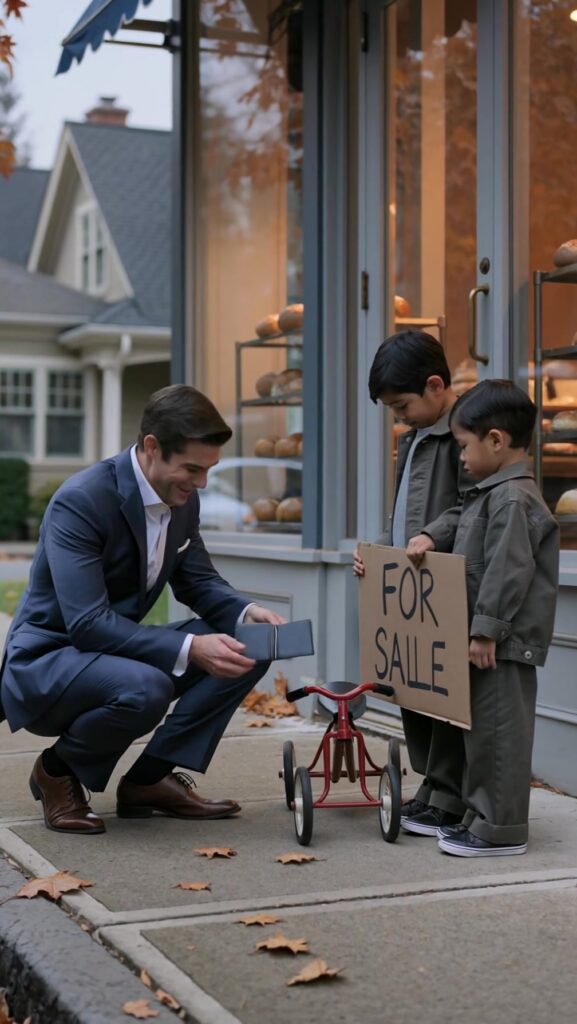
The red pedal car sat crooked on the pavement like a toy abandoned by a careless giant. Its paint, once fire-engine bright, had dulled to a stubborn maroon under weeks of rain. A cardboard sign, torn from a shipping box and lettered in thick black marker, leaned against its front wheel: FOR SALE. The letters bled slightly from damp, as if even the ink had grown tired of holding itself together.
Outside the bakery, late autumn had made the street cautious. Leaves slid in dry whispers along the curb. The morning traffic had thinned, and the air smelled of yeast and cinnamon and the faint sting of cold. Behind the glass, warm light fell on trays of glossy rolls and sugared twists. People inside moved with the unthinking confidence of the well-fed—laughing softly, lifting cups, tapping phones, living in the simple assumption that the day would keep its promises.
The boys did not share that assumption.
The older one stood with his back straight, shoulders square the way you do when you’re pretending to be older than you are. His coat was too thin and too short, the cuffs exposing raw wrists. The younger boy stayed pressed to his side, half hidden, fingers locked into the older boy’s sleeve like a lifeline. Their cheeks were chapped, their noses red. The older one kept wiping his face as if he could scrub away the look of fear.
They had been there long enough for the bakery staff to notice and long enough for no one else to decide it was their problem.
Then the dark car came.
It eased to the curb with a soft, expensive hush. The engine idled like something that could afford to wait. A man stepped out—tall, clean-cut, blue suit sharp enough to slice the air. His shoes made a small, precise sound on the pavement. He paused as he shut the door, the way someone pauses before entering a room where they don’t know the rules.
He looked at the sign first, then at the pedal car, then at the boys. His attention caught on them with a sudden drag, as if he’d walked into a story he was meant to ignore but couldn’t.
He crossed the sidewalk slowly and crouched down to meet their eyes. He made himself smaller on purpose, trying not to be one more towering thing in a world already too big.
“Is this car for sale?” he asked, his voice gentle and careful.
The older boy nodded. It wasn’t a small nod; it was a decision. His lips trembled as he forced the words out.
“Yes, sir,” he said. “We need medicine for our mom.”
There was a pause—a slip in the man’s expression where something softened, then tightened again, like a hand briefly unclenching and then remembering it had to hold on. He glanced at the younger boy, who stared at him with the wary stillness of an animal that expects a hand to either feed or strike.
The man reached into his wallet. A bill appeared between his fingers, crisp, pale, and suddenly out of place among the damp leaves and the battered toy. “You don’t have to sell it,” he said. “How much is the medicine? I can—”
The older boy’s hands clamped on the red steering wheel until his knuckles blanched. He shook his head once, fiercely, as though refusing to let this moment be easy.
Then, very softly, he lifted his eyes. His voice dropped until it nearly vanished into the cold air.
“Mom said… find the man who bought this car for my first birthday. She said he’s our father.”
The bill slipped slightly in the man’s grasp. His breath caught, not loudly, but with the unmistakable sound of a body surprised by its own past. The color drained from his face in a slow, almost deliberate retreat. He stared at the pedal car as if it had started speaking.
The paint was chipped near the right wheel. The chrome handlebar was bent inward like a broken promise. And on the front, just above the faux grille, there was a shallow scratch—a crescent of missing paint that exposed dull metal beneath.
His eyes fixed on that scratch.
He knew it the way you know the scar on your own skin. He could see the moment it happened: his knee bumping the toy while he carried it up a narrow stairwell; the careless laugh he’d made; the quick, thoughtless apology he’d offered to no one.
For a second he was not a man in a blue suit on a quiet sidewalk. He was a younger man in an ill-fitting jacket, standing at the top of a cheap apartment staircase with a gift in his arms and a thousand reasons not to turn back.
The younger boy shifted, frightened by the sudden silence, and pressed even tighter into his brother. “Eli,” he whispered, as if the older boy’s name was a shield.
The older boy—Eli—swallowed hard. He glanced toward the bakery window where the warm light trembled on glass, then back at the man. He added one more sentence, and in it there was a child’s faith twisted into a weapon because it was the only sharp thing he owned.
“She said… if you still loved us, you’d stop.”
The man’s throat worked. His eyes shone, quickly, as if he’d turned them toward a light too bright to look at. He did not reach for the bill again. He did not offer it like a neat solution. Instead, he put his wallet away with a slow, careful motion, as if he didn’t deserve the speed of convenience.
“What’s your mother’s name?” he asked, though the question looked like it hurt.
Eli hesitated, measuring truth against danger. Then he said it. The name fell into the space between them like a dropped plate, impossible to ignore.
The man flinched, eyes closing briefly. When he opened them again, his gaze was wet and unguarded. “She told you… to look for me?”
“She didn’t have the strength to come,” Eli said. His voice tried to stay steady and failed at the edges. “She said you’d recognize the car. She said you’d know the scratch.”
The man’s hand rose, hovered, and then touched the red metal lightly, the way you touch a hot stove to see if it’s really hot. His fingertips traced the crescent gouge. His breath shuddered.
“I did know,” he whispered.
Behind them, the bakery door opened and a bell chimed, releasing a wave of warmth and buttered air. A woman stepped out holding a bag of bread. She saw the tableau—man crouched, boys rigid, the little red car between them—and hesitated, then kept walking, as if it were none of her business. The bell fell silent again.
The man straightened slowly, but he didn’t tower over them the way he might have. He stood as if he were afraid that standing too quickly would break something fragile—something inside all three of them.
“Where is she?” he asked. “Take me to her. Right now.”
Eli’s mouth opened, and for the first time, his brave posture cracked. His chin wobbled. “She’s at home,” he said, and the word home sounded thin. “She said to sell the car if you didn’t stop. She said… if you didn’t stop, then we’d know.”
“I’m stopping,” the man said. The words came out harsh with urgency, like a brake slammed too late. He looked at the younger boy. “What’s your name?”
The younger boy stared at him as if names were a kind of trap. Eli answered for him, voice gentler now, almost protective. “Noah.”
“Noah,” the man repeated, as if tasting it, as if it might anchor him. He turned back to Eli. “And you’re Eli.”
Eli’s eyes widened. “How do you—”
“I kept a list,” the man said, and the confession sounded like a sin and a prayer at once. “I told myself it was for someday. I told myself I’d come back when I could be someone you wouldn’t hate. I told myself a lot of things.” He swallowed, and when he spoke again his voice was raw. “I didn’t know she was sick.”
Eli’s face hardened—not with anger, but with exhaustion. “We didn’t know where you were,” he said. “Mom wouldn’t let us hate you. She said hate was heavy. She said we didn’t have room to carry it.”
The man blinked, and a tear slid down his cheek, quick as a thief. He didn’t wipe it away. He looked at the boys as if seeing the cost of his absence etched in every red knuckle, every chapped lip.
He reached into his pocket and pulled out his car keys. He held them out—not to command, but to offer. “Get in,” he said softly. “We’ll go together.”
Eli didn’t move at first. He looked down at the little red car as if it were the last piece of childhood he had left. The cardboard sign flapped faintly in the breeze, tugging at its own corners.
The man crouched again and picked up the sign. His fingers lingered on the black letters. Then, with a slow, decisive motion, he tore it in half. The sound was small, but it landed like thunder. He dropped the pieces into the trash bin beside the bakery, as if burying a version of the world where the boys had to sell their joy to buy survival.
He lifted the red pedal car carefully—carefully enough that its bent handlebar didn’t scrape the sidewalk. “This stays with you,” he said. “It was never meant to be currency.”
Noah’s grip loosened from Eli’s sleeve. For the first time, the younger boy’s eyes moved from the ground to the man’s face. There was fear there still, but also something else, faint and dangerous: hope.
Eli exhaled as if he’d been holding his breath for years. He nodded once, slow. Then he reached down and took Noah’s hand.
They walked to the dark car together. The man opened the door for them with trembling hands. The bakery’s warm light spilled onto the sidewalk, catching on the red paint of the pedal car in his arms. For a moment, it looked bright again, not because the scratches were gone, but because someone had finally stopped long enough to see them.
As the car pulled away from the curb, the street behind them returned to its quiet, the leaves rustling like pages turning. Inside the dark vehicle, three breaths moved in uneven rhythm toward the same destination—toward a small apartment, a sick woman, and the kind of reckoning that no amount of money could buy, only face.
And on the seat beside the man, the red pedal car rested like evidence: of a birthday once celebrated, of a father once lost, and of a promise that had waited in the cold until someone finally came back to keep it.