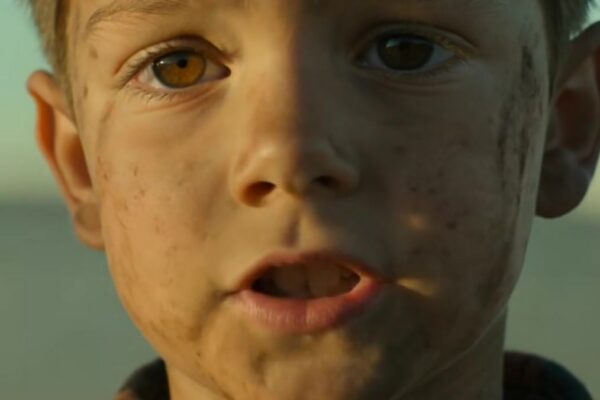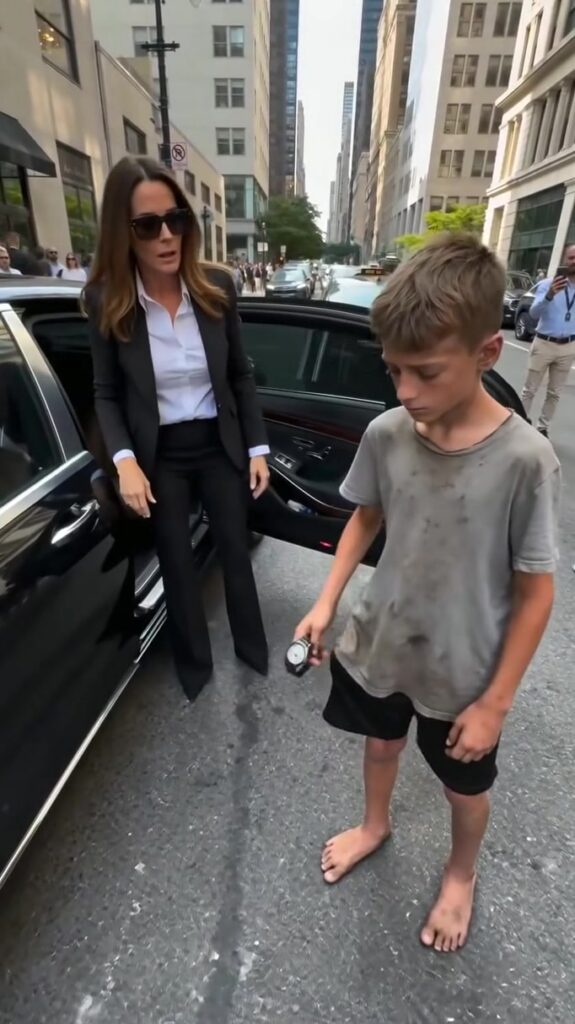
The street had been designed to swallow people whole. Horns bickered in metallic bursts. Vendors shouted prices that dissolved into exhaust. Commuters moved with faces tilted toward their private storms. In the middle of it all, a barefoot boy stood beside the curb as if someone had dropped him there and forgotten to pick him up. He was too still for the city’s rhythm, too quiet for the noise. His clothes clung to him in thin layers—dusty, damp at the knees—yet no one offered him a coin, a glance, a name. He was an absence shaped like a child.
On any other day, he might have remained invisible until the sun went down and the streetlights replaced him with shadow. But then the black luxury sedan arrived—polished, predatory, the kind of car that made the crowd subtly part. It rolled forward in a patient crawl, its windows tinted like secrets. Inside sat Celeste Arman, the woman people recognized from magazine covers and court filings, from charity galas and whispered accusations. Her driver kept both hands on the wheel, knuckles pale, because rich people hated surprises almost as much as they hated delays.
The boy stepped out from the curb without haste. He didn’t dart, didn’t beg, didn’t even flinch at the heat rising from the asphalt. He lifted one hand and placed it on the hood—just a touch, soft as a question. The car’s forward motion died as though the touch had reached into the engine and turned it off. The crowd noticed because the street noticed: brakes sighed, horns strangled mid-complaint, even the air seemed to hold its breath.
Celeste’s door opened with an expensive click. She emerged in a cream suit that looked like it had never met dirt, her hair pinned back, her mouth already set to issue a command. Irritation slid over her face like a practiced mask. “What are you doing?” Her voice carried cleanly, the kind of voice that expected the world to rearrange itself. People leaned in as if the scene had become entertainment. A guard at the corner shifted his weight, uncertain whether to intervene or merely watch something happen to someone else.
The boy didn’t answer. He stared at Celeste as if her makeup, her jewelry, her polished life were just thin paper over a truer image. His gaze wasn’t rude. It was older than he looked. Then, slowly, he raised his other hand and opened it. A wristwatch lay in his palm—small, battered, its glass split in a jagged smile, its leather strap torn. It was the kind of thing an old man might keep in a drawer out of stubborn sentiment. The boy held it up with a trembling care, like an offering.
Celeste’s expression faltered. Not the melodramatic kind of shock people performed when cameras were near—this was a crack in a wall. Her eyes fixed on the watch as though it had weight enough to drag her backward in time. She knew that watch. She’d known the warm pulse of it against skin, the way its second hand stuck sometimes and then lurched forward as if remembering to live. She had bought it once, in a cheap seaside market, laughing because the vendor had sworn it would never stop. She had clasped it around the wrist of a man who had promised her a future.
That man was supposed to be dead.
Celeste felt her throat tighten with a memory she had trained herself to mislabel. Not tragedy, she’d told herself. A closed chapter. A necessary loss. She could still taste the salt of that night: the black water slapping the pier, the distant storm, the panic in her own breath. Adrian Vale had stood at the edge of the dock with the same watch glinting on his wrist, telling her to run, to leave him, to save herself before the men in the dark suits found them. She had obeyed because obedience was what survival had demanded back then. Later, she’d read the headlines: BOAT FIRE CLAIMS LOCAL MAN. BODY NOT RECOVERED. She’d signed papers, paid off questions, built an empire on the foundation of a grave with no body.
Now a barefoot boy held the evidence like a key.
“Where did you get that?” Celeste asked, and the composure she was famous for sounded suddenly thin, as if stretched over a scream. The boy’s lips parted, but no sound came out. His throat worked like he was swallowing words that didn’t want to be born. He pointed—first at the watch, then at Celeste—then he tapped two fingers against his own chest. A gesture that could have meant anything to the crowd, but to Celeste it landed with the clarity of a gunshot: He belonged to it. He belonged to her.
Her driver murmured, “Ma’am, should I call—” and she lifted a hand to silence him without looking away from the boy. She stepped closer, ignoring the grime on the street, ignoring the eyes that feasted on her discomfort. Up close, she saw the boy’s details: the faint bruise-yellow around one eye, the scar under his chin shaped like a crescent, the way his fingers curled protectively around the broken watch. He smelled of rain and alleyways. But beneath that was something else—something achingly familiar in the set of his jaw.
Celeste’s mind raced through years she had kept locked: the hospital she had paid to keep quiet, the nurse who had asked too many questions, the file that had vanished from the cabinet after a midnight visit. Adrian had wanted to take their child and disappear. Celeste had wanted control. In the end, she had told herself there had been no child—only a rumor, only a threat. But rumor did not grow into bone and blood. Threats did not stand barefoot in broad daylight and look at her like they remembered her voice.
She reached for the watch with a hand that barely obeyed her. The boy didn’t pull away, yet he didn’t surrender it immediately either. He held it between them, forcing her to meet him in that narrow space of truth. When she touched it, the cold metal bit her skin and her vision blurred for a heartbeat. The watch was stopped at 3:17—an insignificant time, unless you were the kind of person who remembered the minute you turned your back on someone you loved.
Celeste swallowed. “Who are you?” she asked, softer now, and the question was not for the crowd. It was for herself, for the part of her that had been buried under boardrooms and champagne and ruthlessness.
The boy’s mouth formed a sound at last, rough and reluctant, like a door creaking open. “Mara’s,” he said—one word, a name. He glanced toward the far end of the street, where an older woman stood half-hidden behind a fruit cart, her hands clenched around an apron, her eyes pleading and furious all at once. Celeste recognized her too. Mara had been a housekeeper once, back when Celeste’s life still had rooms that weren’t made of glass. Mara had disappeared the same year Adrian did.
Celeste’s heartbeat became loud enough to drown the street. Mara took a step back as if ready to flee, but the boy didn’t move. He watched Celeste steadily, as though daring her to choose what kind of monster she would be now.
In the silence that followed, Celeste felt the city’s attention hover—people waiting for the rich woman to dismiss the poor boy, to toss him away like an inconvenience. Her security detail began to edge forward. A passerby raised a phone to record. Celeste could have ended it with a sentence, could have ordered the boy removed, could have returned to her car and driven away from the past like she had always done.
Instead, she drew in a shaky breath and turned slightly, angling her body to shield the boy from the cameras. “Get in,” she said to him—not as a command, but as an invitation that terrified her. Then, quieter, to her driver: “Lock the doors. And take us off the main roads.”
The boy hesitated only long enough to look toward Mara. The older woman’s eyes shone, and she gave the smallest nod, a blessing made of fear. He climbed into the back seat, the watch still in his hand, as if it were the only proof that this moment was real. Celeste slid in beside him, ignoring the scandal she was planting in public soil, ignoring the headlines that would bloom by evening.
As the car eased away, the city resumed its roar. Horns complained again. Vendors shouted. People forgot, quickly, because forgetting was the street’s true talent. But inside the moving darkness of the sedan, Celeste stared at the broken watch and realized the past had not come to punish her with ghosts.
It had come to collect what it was owed—blood, truth, and the kind of reckoning money could never buy.
And somewhere ahead, beyond the main roads, there waited an answer to the question that had just cracked her life open: if Adrian Vale had not died, then what had he become—and what had he left behind for this boy to carry into her world like a silent blade?