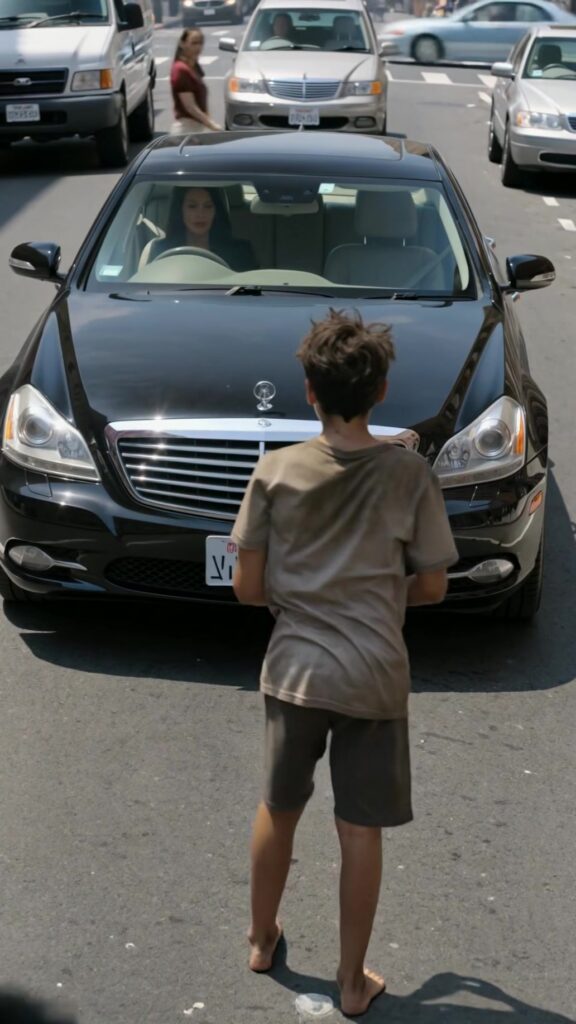
He wasn’t begging. Not with his hands out, not with a sign, not with the practiced tilt of the head that made strangers feel briefly generous and then proud of themselves for it. He stood in the middle of Briarwood Road as if the painted lines belonged to him, as if the asphalt were the last solid thing in his life and he’d decided to claim it. His sneakers were too thin for the early-evening cold, his jacket zipped up to his chin, his hair pressed flat by wind and bad luck. Cars slid around him like water around a stone—impatient horns, narrowed eyes behind glass, people pointing and swearing as they swept by. A delivery van jerked into the opposite lane and the driver leaned out to shout something ugly. The boy did not flinch. He didn’t even turn his head. There was a calm in him that didn’t look brave so much as emptied-out.
From the sidewalk, a woman with a grocery bag lifted her phone, hesitated, and then lowered it again. A man in a suit stepped off the curb as if to intervene, got one look at the boy’s face—flat and distant—and stepped back. People knew how to respond to tears and pleas; they had fewer rules for someone who stood there like a closed door. The boy’s name was Eli Mercer, though no one in the stream of commuters knew that, and even if they had, it would not have made the scene easier to understand. Eli had already tried the things a fifteen-year-old is supposed to try when the world tilts: he’d called the number written on a crumpled clinic pamphlet, he’d asked the neighbor for a ride, he’d waited outside the locked office of a social worker he’d seen twice. He had gotten apologies and voicemail and the soft way adults looked past him when they decided he was a problem with no convenient solution. So now he stood in the road, not to be saved, but to be noticed by someone who could not afford to ignore him.
The traffic light down the block turned green. The line of cars surged. A gray sedan swerved, missing him by a breath. Eli watched the faces pass: a teenager laughing into earbuds, a mother arguing with a child in the backseat, a man drumming the steering wheel in rhythm with a song only he could hear. None of them slowed. His heart did not race like it used to when danger came close; it sat heavy and steady in his chest, like a weight he’d accepted. The night before, he’d found the old watch in the back of a kitchen drawer, tucked in a little velvet pouch that smelled faintly of tobacco and lavender. The watch didn’t work. The face was cracked, the hands frozen at 6:17, and the leather strap had split, but it still held a sliver of warmth when he pressed it to his palm. He’d slipped it into his pocket like a last message from someone who could no longer speak.
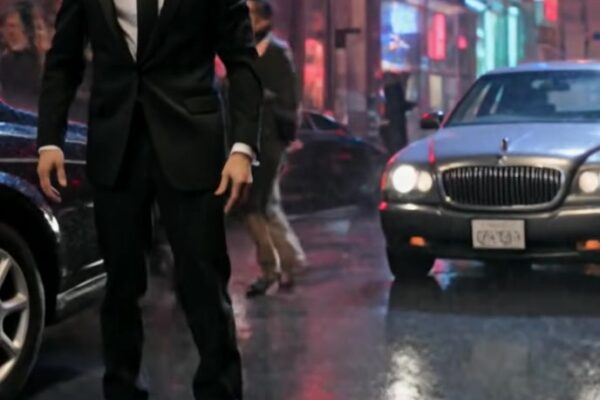
Then the black luxury car appeared—sleek, glossy, almost silent. It didn’t belong on Briarwood Road, where rusted pickup trucks and tired hybrids were the usual. It floated toward him like a thought. For a moment Eli did nothing. He watched its reflection swallow the streetlights. He waited until it was close enough that he could see the driver’s hands—manicured, steady—on the wheel. Then, without drama, he stepped forward and placed his knuckles against the hood. A single, controlled tap. Not a strike meant to dent metal. Just contact—enough to force a pause in the universe. The car braked hard, tires whispering. The driver cursed and the passenger-side window tintedly flashed with movement. Eli kept his hand where it had landed, as if he were holding the car in place through sheer will.
The door opened and a woman stepped out, tall, impeccably dressed, her coat the color of wet ink. A thin diamond band caught the light as she slammed the door behind her. Her face was arranged in annoyance, the kind that came from being interrupted rather than endangered. “What are you doing?” she demanded, voice carrying over the idling engines behind her. “Are you trying to get yourself killed?” Her eyes flicked over him—his too-short sleeves, the raw spot on his knuckle, the set of his shoulders—and filed him under nuisance. She glanced past him at the traffic backing up, already imagining the meeting she’d be late for, the apology she’d have to make, the irritation she’d swallow with a smile later.
Eli didn’t answer. He stared at her with an expression she couldn’t categorize. Not fear. Not defiance. Something like recognition, but colder. The woman’s impatience sharpened. “Move,” she said. “Now.” She reached for her phone, thumb poised over a screen as if one press could summon authority, could sweep a boy off a road and out of her night. Eli slowly pulled his hand from his pocket. The watch lay in his palm like a small, broken animal. He lifted it between them.
At first she only saw what it was: cheap, old-fashioned, useless. Her mouth tightened. Then her eyes caught the engraving on the back—two initials framed by a tiny, worn-out star. The color drained from her face in stages, as if the body, unwilling, were surrendering to a truth it had fought for years. Her anger faltered. She took a step closer, not noticing the honking cars or the chorus of voices rising behind her. “Where did you get that?” she asked, quieter now, as if she were afraid the question would snap something that was already cracking.
Eli’s throat moved. Words crowded his tongue—an explanation, an accusation, a plea he’d sworn he would not make—but none came out. He simply held the watch steady, forcing her to look. The woman’s breath caught. She stared at the frozen hands. 6:17. Her gaze jerked to the boy’s face as if searching for a familiar angle. Eli saw in her eyes the exact moment she understood the watch wasn’t random, and that the boy holding it had been forged somewhere near the same fire that had burned her life in half.
She whispered, “That can’t be,” and the whisper was not meant for him. It was meant for the world, for whatever kept dead things buried. Her lips parted as if she might call out a name. Instead she said, “Eli?” Like a question she hated herself for asking. The sound of his name spoken by her—the wrong mouth, the wrong history—hit him harder than any fist. His fingers tightened around the watch until the cracked glass bit his skin. The traffic behind them blurred into an indistinct roar. Eli felt himself go utterly still, frozen more completely than the watch in his hand.
The woman’s eyes shone, not with tears yet, but with something near panic. She stared at him as if he were a ghost made solid. “You’re not supposed to exist,” she murmured. “Not here. Not after—” She cut herself off, swallowing whatever came next. Her hand lifted, hovering uncertainly near his sleeve, as though touching him might prove he was real or might shatter him. Eli finally found his voice, and when it came it was raw. “My dad is gone,” he said. “And you took the only thing he left me that could tell me why.”
Her face twisted as if struck. For a heartbeat, the polished woman standing in the road looked like someone else—someone younger, frightened, caught mid-decision years ago. “I didn’t take it,” she said, but the words lacked strength. Her eyes fell again to the watch, to the initials, and then to the boy’s blood on the cracked glass. The light changed; clouds slid over the sun, turning the street a darker shade of gray. Around them, people shouted, engines revved, but the space between Eli and the woman felt sealed, suspended. She leaned in, voice so low only he could hear. “Your father didn’t disappear,” she whispered. “He ran. And he ran because of me.”
Eli’s lungs forgot how to work. The watch felt suddenly heavy enough to pull his arm down. He stared at her, the world narrowing to the shape of her mouth forming impossible words. He had come to the road prepared for anything—sirens, bruises, being dragged away like a stray dog. He had not prepared for the sound of a confession delivered in perfume and silk. The woman’s hand finally touched his sleeve, barely there, a contact as controlled as his tap on her car had been. “Get in,” she said, and whatever was behind her eyes now was not annoyance but fear—fear of what he knew, fear of what she would have to reveal next. “Before someone calls the police. Before you decide you can do something worse than stand in the road.”
Eli didn’t move. He looked down at the watch, at the hands locked forever at 6:17, and he understood with sick clarity that this moment had been waiting for him all along. He had stopped the right car. He had put the broken timepiece in front of the right person. And the world had stopped for a second—just long enough for something buried to crawl back into the light. When he lifted his eyes to hers again, there was no begging in him. There was only the question that had driven him into the street like a dare. “Where is he?” he asked.
The woman’s mouth trembled. She glanced down the line of cars, at the people watching, at the ordinary lives idling around their extraordinary collision. Then she looked back at Eli, and her voice came out thin and final, as if she were reading a sentence already written. “If I tell you,” she whispered, “you won’t be able to go back to being a boy.”
Eli’s fingers loosened. The watch rested in his palm, broken but undeniable. He held it up one last time, not as proof, not as a threat—just as the only truth he trusted. “I already can’t,” he said.
And in the hush that followed, as the black car waited with its door open like a mouth, the woman nodded as if accepting a verdict. Whatever came next, it would not be the kind of help a stranger offered out of pity. It would be the kind that rewrote names, histories, and the reason a watch had stopped at 6:17 in the first place.