The woman wasn’t hiding from the police. Not the way the sirens wanted the city to believe.
She lay curled in the shadow of a wrecked teal sedan, its rear quarter panel caved like a fist had punched it. The impound lot smelled of wet iron and old gasoline. Rain had frozen into a thin glaze on the windshields, and the cold burrowed through her coat as if cloth were only rumor. Blood had dried in a crescent along her cheekbone where she’d been struck, and every time she breathed, something sharp complained under her ribs.
Against her chest, her daughter trembled—small, bright in a yellow jacket that seemed foolishly cheerful in the dark. The woman, Marisol, pressed one shaking hand over the child’s mouth, not to silence a scream—there was none—but to stop the little sobs that kept gathering and breaking like waves. Marisol’s other hand gripped the edge of a tire, fingers numb, knuckles white.
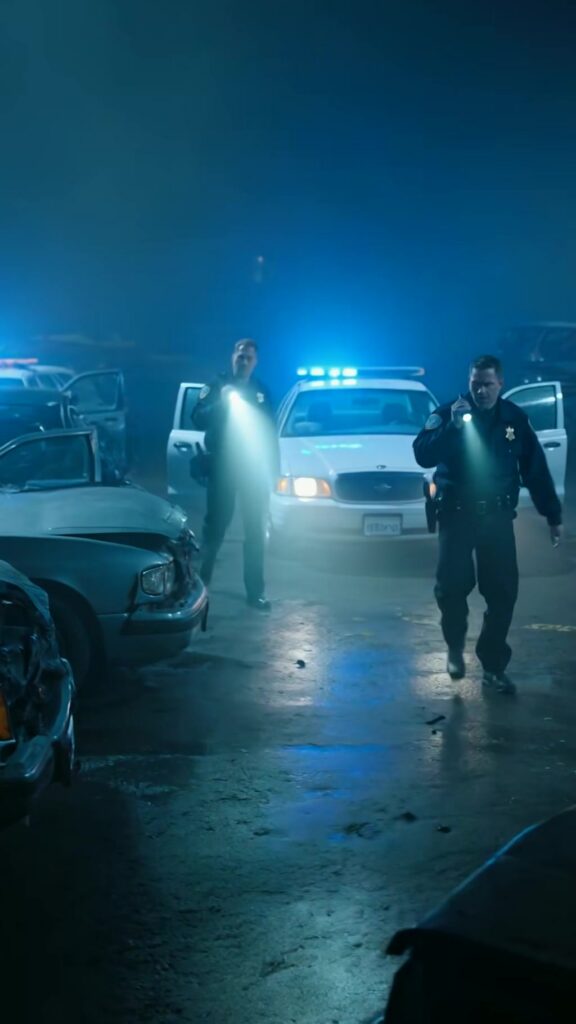
Flashlights lanced between rows of crumpled metal. Boots scraped gravel. Voices cut clean through the clatter of distant gates and the hiss of rain.
“Check every corner,” a man barked. “She has to be here!”
The command rolled through the lot like a sentence handed down.
Marisol squeezed her eyes shut for a heartbeat and heard, as if it were happening again, the sound of a door opening behind her—hinges squealing, fluorescent light spilling into a dim hallway—and the instant she understood she had stepped into someone else’s world.
Three hours earlier, downtown, she’d been mopping a corridor on the twenty-second floor of a glass tower that belonged to people who never emptied their own trash. She worked nights because nights were quiet, because the day care closed too early and the rent didn’t. She kept Elena with her because she had no one else, and she told herself the building was safe, guarded, watched. Elena had dozed in a chair by the vending machines, a knitted hat slipping down over her eyes.
Marisol had pushed her cart past doors labeled with names she could not pronounce. She was supposed to skip the executive suite—always skip it—but a phone had rung in there, shrill and lonely, and she’d thought maybe someone had left it behind. She’d turned the handle and slipped into a room smelling of leather and expensive citrus.
Two men stood near the window. One wore a suit. The other wore a uniform that meant something in this city, a dark-blue coat with a badge that gleamed even in the low light. A black duffel bag sat open on the desk like a mouth. Inside: bundled bills, a silver pistol, and a thick envelope with photographs fanned like cards.
Marisol froze. The suited man’s hand moved, slow and familiar, toward the photos. The uniformed man—Captain Reyes, his name stitched above his pocket—held the bag as calmly as if it were groceries.
“We’re done,” the suited man said, voice smooth. “No more delays.”
Captain Reyes replied with a weary patience that made Marisol sick. “There’s always a delay. You want it clean, you wait.”
Then the suited man pulled one photograph free and held it up to the light. Marisol saw a school gate. A girl in a yellow jacket. Elena’s face, smiling, unaware. The room tilted.
Marisol’s mop bucket slipped from her fingers, the wheel squealing as it hit the wall. The men turned. For a fraction of a second, Captain Reyes’s eyes met hers, and in them she saw not surprise but calculation—cold, quick, already deciding what to erase.
Marisol ran.
She grabbed Elena, still half asleep, and fled down stairwells that echoed with her footsteps. Behind her, she heard a door slam and the thud of pursuit. She burst into the street where rain fell hard and bright in the city lights. She didn’t look back until she was two blocks away, until she heard the first siren and realized it was not coming to save her.
By the time she made it to the impound lot fence, the story had already been written somewhere above her head: MOTHER ABDUCTS CHILD, FLEES CUSTODY. Her phone lit up with a number she didn’t recognize and a voice on the other end that said, too politely, “You’re making this harder.”
Now, hidden behind wreckage, she listened as the lie hunted her.
“She can’t get out,” an officer said, close enough that Marisol could hear the condensation in his breath. “Units are set on the exits.”
“She’s dangerous,” another voice answered. “She took the kid.”
Marisol almost laughed at the cruelty of it. Dangerous, yes—dangerous because she had seen a captain of police hand a duffel bag of money and a gun to a man rumored to make people vanish. Dangerous because she had heard her daughter’s name spoken like a bargaining chip.
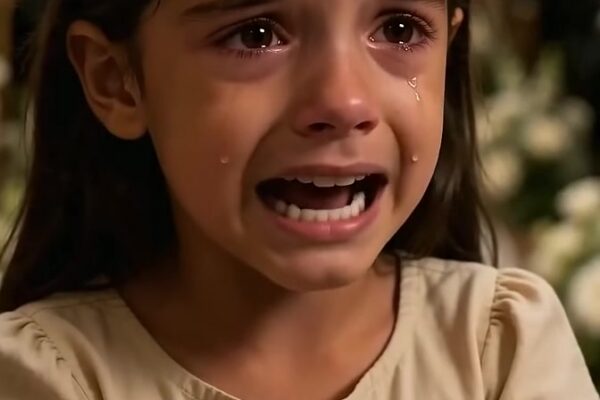
Elena’s fingers twitched beneath Marisol’s arm. The child was trying to pull her hand away, desperate for air, and Marisol loosened her grip an inch. Elena sucked in a shallow breath, eyes wide, cheeks wet. Marisol lowered her mouth close to Elena’s ear.
“Baby, you have to be quiet,” she whispered. “Just a little longer. I promise.”
Elena nodded, the motion so small it seemed like a shiver.
Light slid across the teal car’s shattered windshield and passed. Someone moved a few yards away, a flashlight beam swinging like a metronome. Marisol counted in her head, the way she did when Elena had fevers, as if numbers could hold a body together.
Then Elena did something that drained the warmth from Marisol’s spine.
Slowly, carefully, the child opened her fist.
A metal disc lay in her palm. A badge. The kind that made doors open and mouths shut. It was smeared with mud where Elena must have clutched it while they ran, but the engraved number caught the light, crisp and undeniable. Beneath it, two words were etched like an accusation.
CAPTAIN REYES.
Marisol stared until her eyes burned.
“Where did you—” she began, but Elena leaned close, her breath trembling against Marisol’s wrist.
“He dropped it,” Elena whispered. Her voice was so small it barely made sound. “The man… the one who grabbed you in the stairs.”
Marisol’s mind snapped back to the stairwell: a hand catching her shoulder, a weight slamming her into the railing, the taste of blood. She’d kicked and twisted and somehow gotten free. In the chaos, a badge could have torn loose. She’d been too busy surviving to notice.
Elena’s eyes lifted to hers, solemn in the dark. “That’s the man who came to my school,” Elena whispered, and her words landed like a bullet. “He talked to my teacher. He said he was my friend.”
For a moment, all Marisol heard was the rain and the distant wail of sirens, and beneath them the faint, steady roar of the city that did not care who it crushed.
Captain Reyes hadn’t chosen Elena from a photograph after Marisol had seen him. He’d chosen Elena before. The photo wasn’t evidence; it was a plan. The sight of it on the desk hadn’t made Marisol a witness by accident. It had made her a problem by design.
“Marisol!” someone shouted from the other side of the lot. “We know you’re here! Put the child down and come out with your hands up!”
The voice used her name with the intimacy of a neighbor, but it carried the practiced authority of a man who knew he would be believed. Marisol’s stomach tightened. If she stepped out, they would not ask questions. They would not read the truth in her bruises. They would take Elena and leave Marisol to rot in a story that was already being broadcast.
Marisol’s gaze dropped to the badge in Elena’s palm, cold and heavy, a piece of the man who was trying to erase them. It wasn’t enough to save them by itself, but it was something tangible—something that could be photographed, traced, proven. Something that could not be talked away as easily as a poor woman’s word.
She slid the badge into her own pocket and pressed her forehead to Elena’s.
“Listen to me,” she breathed. “No matter what happens, you stay with me. You hold my hand and you don’t let go. Can you do that?”
Elena swallowed hard and nodded. Her small hand found Marisol’s sleeve and clamped down with fierce trust.
Marisol lifted her eyes over the hood of the teal car. A chain-link fence bordered the lot, topped with coils of razor wire that glimmered like teeth. Beyond it, a service road ran parallel to a drainage canal. On the other side, sodium lamps cast pale circles on puddles. She could see officers moving in those circles, their beams cutting, their bodies purposeful. This was a net, and nets tightened.
Her heart hammered, but beneath it, something steadied—an anger older than fear. The kind that came from being looked through all her life, from being told to clean and quiet and accept whatever fell on her head.
Captain Reyes had counted on that. He had counted on her being invisible.
“Over there,” an officer said, and a flashlight snapped toward their row.
Marisol scooped Elena up, pain flaring hot along her ribs, and crouched low. She moved, step by step, between the carcasses of cars, using metal and shadow as cover. Elena’s arms locked around her neck, silent as instructed, but Marisol felt the child’s heartbeat against her collarbone like a frantic bird.
Somewhere close, a radio crackled. “Negative on sector three. Sweep again. Captain wants this wrapped.”
Captain wants this wrapped. Marisol’s jaw clenched until it ached.
She reached the edge of the row and peered through a gap between a rusted SUV and a flattened hatchback. The fence was thirty feet away. The service road beyond it looked empty for the moment. A camera pole stood at the corner of the lot, its lens pointed away, blind to this sliver of darkness—either by chance or by someone’s careful hand.
Marisol’s mind raced: the badge, the photo, the duffel bag. The building. The suited man. Names she didn’t have. Proof she didn’t yet possess.
“Mama,” Elena breathed, barely audible, “are they going to take me?”
Marisol tightened her grip. “Not if I can breathe,” she whispered back. “And I can breathe.”
A beam of light skimmed across the ground near her feet. Boots crunched closer. Marisol leaned forward, readying herself to sprint for the fence, to cut her hands on wire if she had to, to crawl through mud and ice if it kept Elena alive.
She wasn’t hiding from the police.
She was hiding from the man who could turn them into police.
And as the sirens wailed like a choir for the guilty, Marisol prepared to do the only thing left that felt like power—run toward the truth, even if it tore her apart getting there.