The county road had a name on maps—Old Mill Spur—but locals treated it like a forgotten sentence, something you passed through without reading. On that afternoon it looked harmless enough: pale ribbon of asphalt, sun glittering off a ditch that still held rainwater, cornfields standing at attention on either side. No traffic. No noise beyond cicadas and the soft click of a bicycle chain.
Ethan pedaled ahead of his father in that careful, earnest way children have when they’re trying to prove they can be trusted. His helmet was a size too big and his elbows swung wide, but he stayed on the right edge as if he were balancing on a narrow beam. Behind him, Mark let the distance stretch, pretending to relax while counting everything—every driveway, every shadow under the sycamores, every place a dog might burst out.
They’d argued about this ride at breakfast. Mark’s sister had said the road was empty, safe. Mark had said empty didn’t always mean safe. Ethan had looked up from his cereal with the same stubborn softness that had survived the divorce and the custody schedules and the new apartment, and said, “If it’s empty, nothing can happen.” Mark had laughed then, and promised himself he would not let his fears become Ethan’s.
The sound that arrived first didn’t belong to the landscape. It was an engine note sharpened by impatience, too heavy for a farm truck, too quick for the old sedans that sometimes wandered out here. It rose like a swarm, then snapped into a single scream as a car crested the shallow hill behind them.
Mark’s hands tightened on his handlebars. In his mirrorless, over-the-shoulder glance he caught the flash of a dark sedan, sun catching its windshield, closing fast. He shouted Ethan’s name, but the wind stole half of it. Ethan did look back—just a flick of eyes—and his front wheel drifted toward the gravel shoulder, startled by the sudden presence behind him.
The sedan didn’t slow. It moved left as if to pass, then slid back right, edging toward Ethan with a deliberate, lazy confidence. Mark watched the gap shrink to almost nothing. Gravel pinged under Ethan’s tires; the boy’s shoulders tensed, his bike wobbled. Mark’s chest emptied as if someone had punched the air out of him. This wasn’t careless. Careless people swerved wide and corrected. This was a predator testing the fence.
Mark threw himself forward, legs pumping until his knees screamed. “Ethan! Brake!” he yelled, and at the same time he reached for the one thing he’d taught himself never to do: ride into the line of a car. He angled his own bike toward the center just as Ethan’s front tire skated on loose stones. The boy’s foot slipped off a pedal. For a heartbeat, Ethan teetered on the edge of falling beneath the sedan’s path.
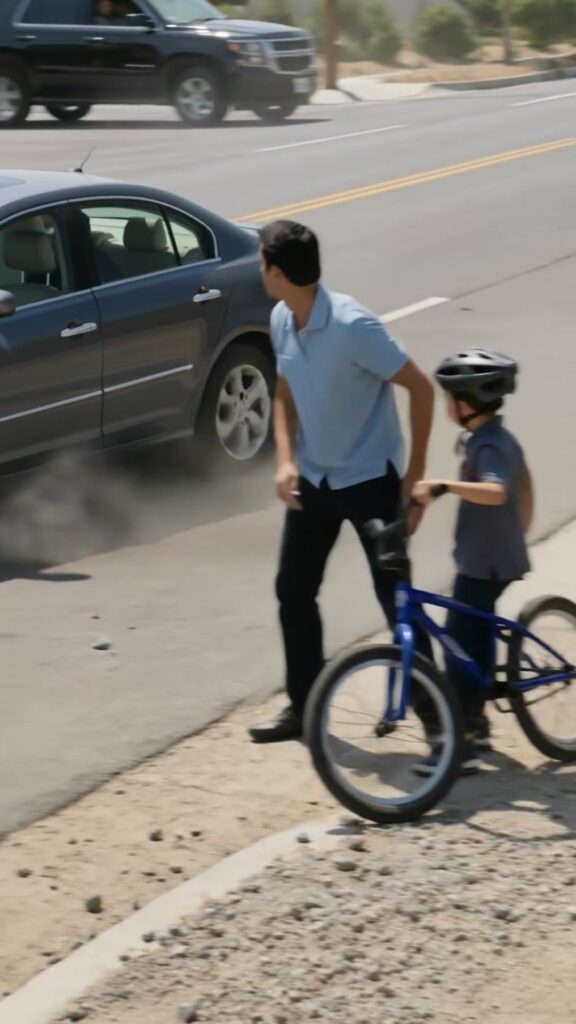
Mark lunged off his bike and caught Ethan by the back of his shirt, yanking him hard enough to send both of them stumbling into the ditch grass. A horn blared. The sedan’s brakes shrieked, loud and long, leaving a smear of rubber on the sun-warmed road. Dust rose in a dirty halo. Mark’s palms were scraped raw. Ethan’s face was white, eyes huge, breathing in quick, panicked gulps.
The car stopped with its front bumper angled toward them, as if it had been aiming and had merely missed. For a moment there was only ticking heat and Ethan’s sob that he tried to swallow. Then the driver’s window slid down.
The man behind it looked clean, almost polished, like someone who’d stepped out of an office rather than a rural road. His hair was neatly cut; his shirt collar lay flat. He didn’t wear sunglasses, but his eyes had a dark shine that made Mark think of wet stones. He smiled—not apologetic, not surprised. A smile like a door being locked.
“You should teach your kid where he belongs,” the man said. His voice carried easily, casual and sure, as if he were offering advice about mowing patterns or fence posts. “Road’s not a playground.”
Mark felt something inside him go cold and clear. Not fear, exactly—fear had already burned through him—but the hard certainty that this moment wasn’t random. He thought of the court hearing two months ago. The new job he’d taken that came with a nondisclosure agreement and a badge he rarely mentioned. The anonymous email he’d deleted without reading because he didn’t want to carry darkness into his weekends with Ethan. He looked at Ethan’s trembling hands and the red line blooming on his knee and decided he was done protecting innocence with denial.
Mark reached into the pocket of his cycling jersey and pulled out his phone. He didn’t point it like a weapon; he raised it slowly, letting the driver see the screen, the recording icon. The man’s grin widened, amused. “Call whoever you want,” he said. “You think someone’s coming for you out here?”
Mark didn’t answer. He shifted his body so he was between Ethan and the sedan, and he pressed the phone with two fingers, triggering a location beacon he’d never needed outside of training drills. It was a quiet action, almost tender—tap, hold, confirm—like checking on a sleeping child. Ethan watched him with wet eyes, not understanding. Mark kept his gaze on the driver and listened.
At first there was nothing but the idling engine. Then, under it, a new sound: the muted, even roll of tires on asphalt coming from the far end of the road. Mark didn’t look away from the sedan, but he saw the driver’s eyes flick, just once, toward his rearview mirror. The confidence in his face hesitated, as if someone had interrupted a thought.
From the hill behind them, a black SUV appeared, moving without urgency, taking up more of the lane than necessary. From the opposite direction—past the cornfield bend—another SUV emerged, matching the first’s pace. Then a third, sliding into view on a dirt access road that shouldn’t have been visible from here unless you knew it existed. Their windows were tinted; their paint absorbed sunlight instead of reflecting it. They didn’t rush. They didn’t need to. The road was narrow, the ditches deep, and the fields thick with summer growth.
The driver’s smile drained away as if someone had pulled a plug. His hand, which had rested lightly on the steering wheel, tightened. For the first time he looked directly at Mark, not at the situation. He searched Mark’s face the way men search pockets. “Who are you?” he asked, the casual tone cracking at the edges.
Mark finally glanced down at Ethan. He brushed a thumb across the boy’s cheek, wiping away a tear and a streak of ditch dirt. “Stay behind me,” he murmured. Ethan nodded, too shocked to argue. Mark straightened and raised his phone a fraction higher, letting the driver see that he hadn’t been pretending. He hadn’t been bluffing. He had been waiting.
The SUVs rolled closer, one stopping ten yards behind the sedan, another ten yards in front, the third angling to block the shoulder. Doors didn’t fly open. No sirens screamed. It was quieter than a confrontation deserved, which made it worse. Mark could feel Ethan’s small hand clutching the back of his shirt, anchoring him to the only solid thing the boy knew.
The driver licked his lips. His gaze darted to the cornfields, to the ditches, to the narrow strip of road that now belonged to someone else. He swallowed, and the sound carried. “Look,” he began, as if bargaining were possible with the geometry of this trap.
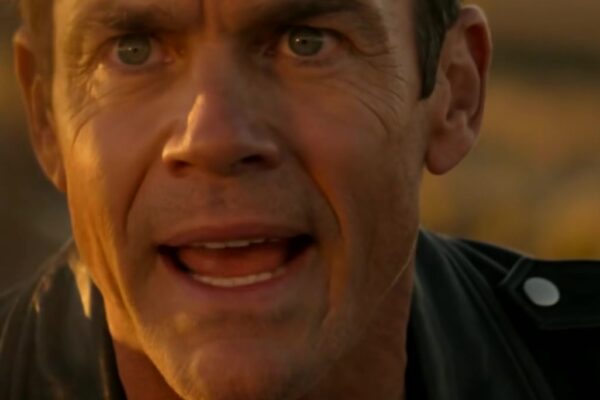
Mark stepped forward until the sedan’s hood filled his vision. He could see the driver clearly now—how the polish had been a mask, how fear made a person look more honest. Mark’s voice came out low and steady, the tone he used when Ethan’s nightmares woke him at night. “You picked the wrong road,” he said. “You thought empty meant no witnesses.” He glanced at Ethan, then back to the driver. “It just meant you wouldn’t see the trap until it closed.”
Behind the tinted glass of the nearest SUV, a silhouette shifted. A door clicked. The sound was small, ordinary, and final. Mark didn’t move until he felt Ethan’s trembling begin to slow, the boy’s breath finding rhythm again, as if the body understood safety before the mind could name it. The afternoon remained bright. The cicadas kept singing. But the road was no longer a road. It was a lesson, laid out in sunlit asphalt: you could ride carefully, you could ride bravely, and still the world could lurch. What mattered was who had planned for the lurch—and who had mistaken loneliness for freedom.