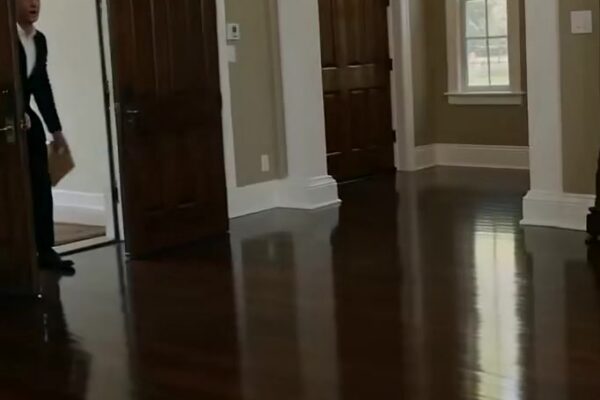
He came home early, the way men do when they are trying to fix something they can’t name. The afternoon sun should have been bright, but the sky had the dull color of old steel, and the wind pushed at his coat like it wanted him to turn around. In his left hand he carried a bouquet—clumsy, mismatched stems from the corner florist because he hadn’t trusted himself to choose roses without feeling ridiculous. In his right, a small paper bag that smelled faintly of vanilla and cinnamon. He’d been rehearsing what to say all day, the words packed like fragile glass in his throat: I’m sorry. I’ve been gone even when I’ve been here.
He climbed the stairs to the apartment and paused at their door, listening. He expected Elena’s voice, humming or scolding the kettle, the soft narration she always did when she was alone, as if the baby deserved a running commentary. Instead, the hallway held nothing but the distant murmur of traffic. The silence felt pressed, deliberate. He slid his key into the lock and turned it as quietly as he could, the metal clicking like a secret.
The door swung inward with a gentleness that didn’t belong to him. For a moment he stood at the threshold, bouquet and bag held out like peace offerings. The air inside was colder than it should have been, a thin draft sliding along the floor. Their living room light was off. Curtains were drawn halfway, letting in a gray wash that made everything look older—sofa, rug, the framed ultrasound photo on the shelf. He took one step, then another, and something in his chest tightened, the way it had the night the doctor said the word “complication” and watched him pretend he understood.
He heard it then—a wet, repetitive sound. Scrub. Scrub. Scrub. The noise wasn’t loud, but it was relentless, like a clock counting down. He moved toward it, past the coffee table, past the baby books Elena had arranged into hopeful stacks. His eyes caught on white smears across the rug, like snow that had been trampled. A broken plate lay near the edge, jagged as a threat.
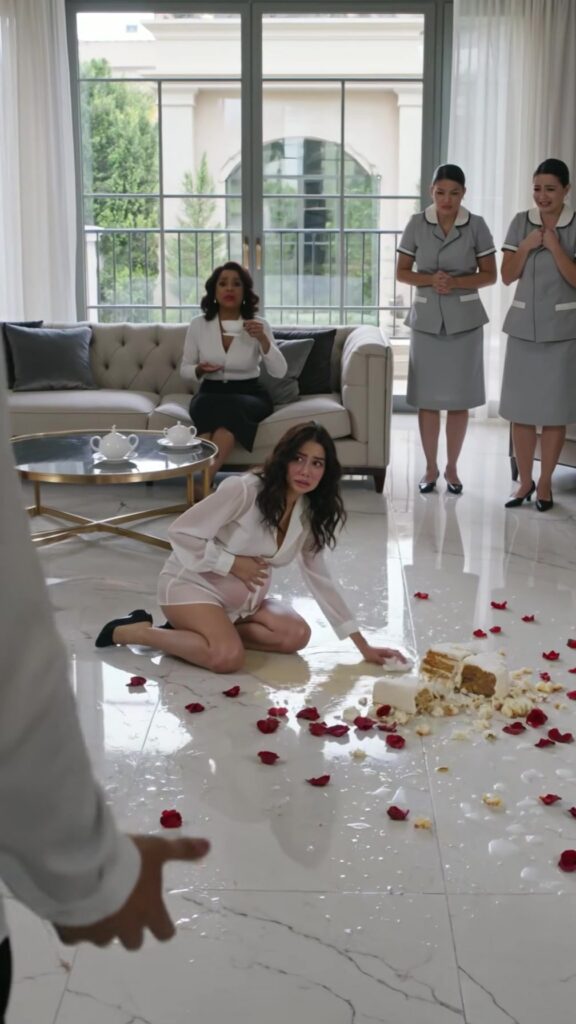
In the middle of the room Elena was on her knees. Her belly rounded forward beneath a worn sweatshirt, the fabric stretched and rumpled. One hand braced against the floor; the other worked a sponge so hard her knuckles blanched. Her shoulders shook in small, terrified jerks. Tears dropped onto the boards, mixing with the sticky mess she was trying to erase. Her hair, normally tied neatly in a braid, hung loose and damp against her cheek. She looked too small for her own body, like she’d been folded in on herself to make room for someone else’s anger.
Beside her, a cake lay destroyed, its careful frosting crushed into a pale ruin. He recognized it—she’d shown him the picture on her phone two days ago, proud of ordering something special for his birthday because this year, she’d said, would be different. The cake’s candles were scattered like little bones. His bouquet slipped in his fingers. One stem snapped with a soft, final sound, and flowers thudded to the floor.
At first he didn’t see his mother. Then he did—sitting in the armchair by the window, as composed as if she were waiting for tea. Her handbag rested on her lap. Her coat was still buttoned, pearls at her throat, lipstick unblurred. She held a small cup in one hand and stared at Elena’s scrubbing as though it were the day’s entertainment. When she noticed him, her eyes narrowed slightly, not in surprise but in calculation, as if she’d already decided what story she would tell him.
“You’re home,” she said, voice even. “Finally.”
He couldn’t answer. His mouth had gone dry. The paper bag in his right hand crumpled, the pastry inside giving a faint sigh. He stared at Elena, waiting for her to look up and laugh—tell him it was a terrible accident, that she’d dropped the cake and was overreacting. But there was no humor in her body. Only dread.
He said her name anyway, softly, like a prayer he didn’t trust. “Elena.”
Her scrubbing slowed. She lifted her head. Her eyes were red, swollen, shining with a pain that had nowhere left to hide. She did not speak. She simply looked at him as if she’d been holding her breath for hours and didn’t know whether she was allowed to release it.
In that silence, he heard everything: the sharpness of his mother’s judgments, the old childhood obedience stitched into his bones, the countless times Elena had tried to smile through discomfort because she believed love meant endurance. He saw, with sick clarity, the way he had left Elena alone with a woman who treated tenderness like weakness. The room seemed to tilt, the gray light turning harsher, exposing details he’d missed—faint bruises on Elena’s wrists where fingers had held too tightly, a reddened mark along her jaw as if someone had snapped her face toward an order.
“What happened?” he asked, the words scraping out of him. He looked at his mother, then back at Elena. “Tell me.”
His mother’s sigh was practiced. “She’s emotional. You know how they get. I only asked her to be careful. A cake isn’t cheap, and she—” She gestured at the mess with delicate distaste. “She made a scene.”
Elena flinched at the word scene, as if it were a slap. The sponge trembled in her hand. She opened her mouth, but no sound came. Her throat worked, swallowing something bitter.
Something in him finally broke loose. He stepped forward and knelt beside Elena, ignoring the sticky frosting soaking through his trousers. He took the sponge from her hand gently, as though it were a weapon that had been forcing her to hurt herself. “Stop,” he said, not to her but to the entire room. “Stop. You don’t have to do this.”
Elena’s breath hitched, a small animal sound she tried to hide. He put one hand against her shoulder and felt how tense she was, muscles locked as if she expected punishment for resting. He turned his head to his mother. “What did you say to her?”
His mother’s posture stiffened. “Don’t take that tone with me. I came to help. If you weren’t always working—”
He stood, slowly, because if he moved too fast he feared he might do something irreversible. The bouquet lay on the floor between them, a bright, broken offering. “Help doesn’t look like this,” he said, voice low. “Help doesn’t leave my wife on the ground like she’s begging.”
His mother’s mouth tightened. “Your wife,” she repeated, as if testing the phrase for weakness. “She’s sensitive. She should learn to respect—”
“No,” he cut in, and the single word came out with a force that surprised him. He looked at Elena again, at the silent apology in her eyes, and something fierce rose up in him—shame transformed into resolve. “You’re leaving. Right now.”
The room went very still. Even the traffic outside seemed to pause. His mother stared as though he’d spoken in a language she didn’t recognize. “Excuse me?”
He walked to the door, opened it wide, and held it there, letting the cold hallway air spill into the room like a verdict. “You can call it disrespect. You can call it ungrateful. But you are not staying here another minute.” He pointed to her handbag with a steady hand he didn’t feel. “Go.”
His mother rose, outrage coloring her cheeks. For a second he thought she might refuse, might dart toward Elena with one last cruel sentence. Instead she swept past him, pearls trembling at her throat, and stepped into the hall with the dramatic stiffness of a woman who believed the world had betrayed her. “You’ll regret this,” she snapped, and her heels struck the floor like punctuation.
He shut the door. The click of the latch sounded louder than any shout. For a moment he leaned his forehead against the wood, letting his eyes close. Then he turned and crossed the room back to Elena.
She was still on her knees, frozen in the posture of obedience. He crouched and took her hands. They were cold. “Look at me,” he said.
Elena’s gaze lifted, wary and exhausted. A tear slipped down her cheek, leaving a clean line through the mess on her face.
“I’m here,” he said, and this time he meant it in a way he never had before. He pulled her up carefully, guiding her to the sofa, and wrapped a blanket around her shoulders. He picked up the crushed bouquet and set it on the table anyway, imperfect and bruised. “We’ll clean this later. Or we won’t. It doesn’t matter.”
Elena’s lips parted, and her voice came out like a whisper from underwater. “I tried,” she said. “I tried to make it nice. She said I’d ruin everything. She said I was… I was trapping you.”
The words hit him with a dull thud. He knelt in front of her, pressing his forehead to her knuckles. “You’re not trapping me,” he said. “You’re building a home, and I’ve been letting someone else set it on fire.”
Elena’s shoulders finally sagged. She began to cry in a way that was less terror and more release, deep sobs that shook her entire body. He held her, feeling the baby shift between them, a small reminder of what mattered. In the dim, cold room, surrounded by ruined cake and broken flowers, he understood that the surprise he’d meant to bring home was not the bouquet or the sweet bread in the paper bag.
It was his choice. Finally, unmistakably, his choice.