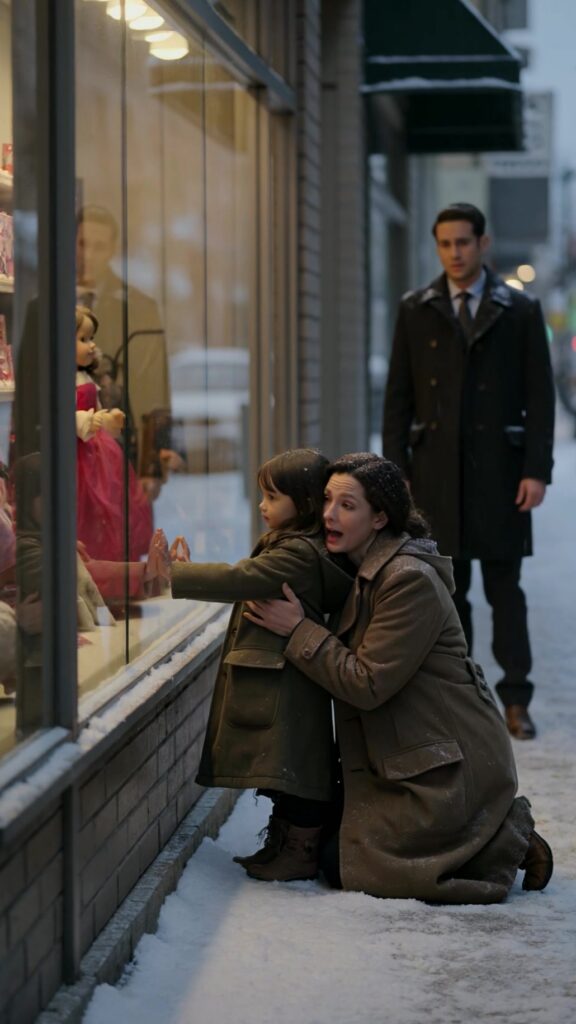
Snow came down in slow, patient flakes, the kind that made the city feel briefly forgiven. It gathered on the awnings and lamplight and the shoulders of people who kept their faces tucked into their collars. On the corner of Ashford and Ninth, a toy store window glowed like a hearth. The glass held a whole universe of color: tin trains looping in mechanical circles, plush bears with stitched smiles, a miniature carousel turning lazily on a hidden motor.
A little girl stood so close to the pane that her breath clouded it. She was small enough that the displays were above her eye line, forcing her to tip her chin up in quiet devotion. Both hands were flattened against the cold, fingers splayed as if she could steady herself against wanting. Inside, under a warm spotlight, a doll in a bright dress sat propped against a toy vanity, hair shining like spun honey.
“Look,” the girl murmured, as if speaking too loudly might make the light go out.
Her mother crouched beside her, knees damp with slush, scarf pulled high to hide the tremble in her mouth. She had the weary gentleness of someone who apologized to the world even when the world had done the harm. “Baby,” she said, choosing each syllable like it cost money, “we can’t do that this year. Not the fancy doll.”
The child didn’t plead. She didn’t make a scene. She only nodded, the sort of nod that looked practiced—too practiced for someone whose front teeth were still coming in uneven. That restraint cut through the street noise sharper than a cry would have.
A few steps away, a man in a charcoal coat slowed and then stopped as if a hand had closed around his spine. He’d been walking with purpose, because he’d trained himself to always be going somewhere: a meeting, a flight, a hotel lobby, anywhere that wasn’t a room with memories in it. He turned his head at the word “birthday” and found himself staring into the toy store glass, where the window’s reflection overlaid the child’s face with the bright interior, turning her eyes into dark pools lit from within.
Something inside him went very still. The shape of her mouth—soft at the corners, like she held back sentences. The slight crease when she tried to be brave. He knew that expression the way sailors knew storms.
Ten years had not erased the hospital smell from him. He remembered the fluorescent hum and the thin sheets and the doctor’s voice speaking like a man reciting numbers. He remembered Lena’s hand in his, cool and damp, her lips moving around promises she didn’t have the breath to finish. He remembered the nurse placing a tiny, swaddled body in Lena’s arms for a brief hour, and Lena looking down as though she’d discovered a second heart inside her chest.
They told him the baby didn’t survive. They told him complications took Lena too. They told him not to ask questions because the answers would only bruise him more. And he—hollowed, obedient in his grief—had fled. Not just from the hospital, but from anything that could tether him to that night. He changed cities. He changed jobs. He learned to outrun silence. He learned to run from his own heart because it kept dragging him back to a face he’d only seen for an hour.
Now that face—some version of it—was reflected in a toy store window.
“Excuse me,” he heard himself say, surprising his own throat with the sound. “I’m sorry. I didn’t mean to listen in.”
The mother rose at once, protective like a blade. She put herself between him and the child with the reflex of someone who had learned what men could take. The girl stepped back, shoulders drawing inward.
“It’s fine,” the mother replied, too quickly, too carefully. “She’s just looking.”
The man lifted his hands slightly, palms open, no sudden moves. He nodded toward the doll. “Let me buy it for her. Please.”
For a heartbeat, the mother’s face flickered with something close to longing. Then it hardened into alarm. “No.” The word landed like a door being bolted.
“I’m not—” he started, then stopped, aware that men always said what they weren’t. He swallowed. “I just… I want to do something good. That’s all.”
The mother shook her head harder, eyes cutting briefly to the toy store entrance, then to the darkened street behind him. As if calculating exits. “You don’t understand,” she said, voice dropping.
His chest tightened. “Then tell me.”
She looked down at the child, and the girl looked up with the patient confusion of someone used to adult secrets. The mother’s hand found the girl’s shoulder and gripped, not to hurt, but to anchor.
When the mother looked back at him, recognition—sharp and unwilling—flashed across her features. Not the wary recognition of a stranger. Something older. Something complicated.
“You were never supposed to see her,” the mother whispered. “Not like this. Not alive.”
The man felt the sidewalk tilt. “What did you just say?”
The mother’s breath came in visible bursts. “Walk away,” she urged. “Please. Don’t do this here.”
“Her name,” he demanded softly, afraid that loudness would shatter him. “What is her name?”
The little girl tugged her mother’s sleeve. “Mama?” she asked, uncertain.
The mother’s eyes glossed with old fear. “Mara,” she admitted, like confession. “Her name is Mara.”
The man’s knees almost gave. Mara. Lena had wanted Mara. He heard Lena’s voice as clearly as if she were standing in the snow, laughing weakly at a name she said sounded like dawn.
“That’s impossible,” he said, and hated how small his voice was. “They told me—”
“They told you what they needed you to believe,” the mother cut in, then clamped her mouth shut, instantly regretting the words.
He stared at her, scanning her face like a document he’d missed the fine print on. “Who are you?”
The mother’s jaw trembled. “I’m the person who carried her out,” she said. “I’m the one who signed what they put in front of me.”
Behind her, the toy store’s bright display continued its innocent performance, oblivious. The mechanical train looped. The carousel turned. And in the glass, the child’s face floated between them like an accusation and a miracle.
He forced air into his lungs. “Why?” he asked. One syllable full of ten years of running. “Why would anyone do that?”
The mother looked past him, as if the answer might be written in the falling snow. “Because your father was on the hospital board,” she said, voice raw. “Because your family made donations with strings attached. Because the day Lena died, there were lawyers in the hallway faster than there were grief counselors.”
His mind rejected it, then grasped it with sudden, vicious clarity: his father’s controlled smile at the funeral, the way the estate attorney had asked him to sign forms while the earth was still wet. He remembered how quickly everything had been handled, how little he’d been allowed to see, how his questions had been met with pity that felt rehearsed.
“You took her,” he said, the words scraping his throat.
“I saved her,” the mother answered fiercely. “They were going to make her disappear into someone else’s life, someone richer, someone easier to control. I was a nurse on that floor. Lena—” Her voice broke on Lena’s name. “Lena begged me, before she slipped away. She said if anything happened, don’t let them own her child. So I did the only thing I could. I ran.”
He stood there, the city spinning around one fixed point: the little girl’s eyes, watching him with cautious curiosity. Not fear. Not yet. As if she could sense that something invisible had shifted.
“Mara,” he said, tasting the name. The girl blinked at hearing it from him, her brows knitting. She took one step forward, then another, small boots crunching on salted snow.
“Do I know you?” she asked.
He wanted to say yes. He wanted to claim her with the kind of certainty that could rewrite a decade. But the truth was a knife: he had not been there for scraped knees, for first words, for birthdays where the best present was simply a warm room. He had been running. He had been obedient to a lie because grief had made him easy to manage.
He knelt, lowering himself to her height so he wouldn’t loom. His breath shook. “I think,” he said carefully, “I think I was supposed to.”
The mother tightened her grip on the girl’s shoulder, torn between escape and surrender. Above them, the toy store bell jingled as someone entered, spilling a slice of warm air onto the sidewalk that smelled faintly of cinnamon and plastic and possibility.
“If you call anyone,” the mother said, voice hard, “they’ll come. They’ll take her from me. From you. They’ve been waiting for a mistake for years.”
The man looked at the child again, at the brave nod she’d given her mother, at the way she had learned not to ask for too much. Something in him, long starved, moved—slowly, painfully—toward life. He realized he had spent ten years outrunning a wound that could only be healed by standing still inside it.
He rose, not towering, but steady. “Then we don’t make a mistake,” he said. “We make a plan.”
The mother’s eyes narrowed. “Why would you help?”
He glanced at the doll in the window, then back to Mara. “Because I’ve already lost her once,” he said, and his voice didn’t break this time. “And because I’m done being the kind of man who runs when his heart finally catches up to him.”
Mara looked between them, then reached out—hesitant, deliberate—and touched the edge of his coat sleeve with two fingers, as if testing whether he was real. The contact was feather-light, but it stopped him more completely than any locked door ever could.
Snow kept falling, soft as ash, while the toy store lights held steady and the city hurried past. On that corner, in the space between a lie and a life, a little girl by a window had no idea she was doing something enormous: she was turning a man around, making him face the one thing he’d been fleeing—his own heart, finally ready to come home.