At first, it sounded like a joke—one of those dares shouted across a fairground because everyone was half-drunk on dust and music and the idea that nothing truly dangerous could happen under string lights.
The annual Whitlock County Auction had spilled beyond the livestock pens and into the carnival rides. Men in hats leaned on railings. Women with paper plates of pie clustered near the cider stand. Kids ran between boots and shadows, pretending the air smelled like freedom instead of manure and money.
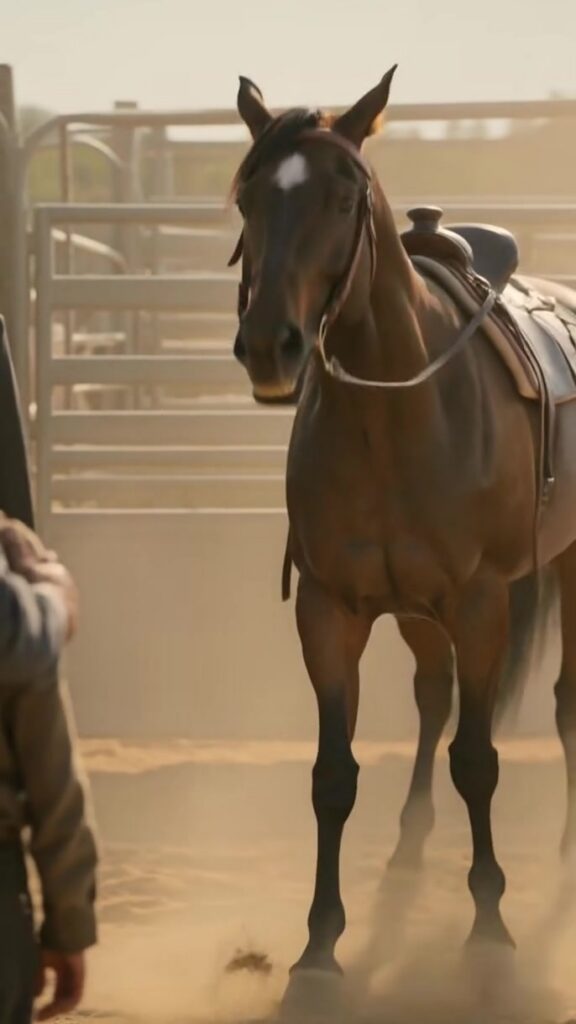
In the far corral stood the reason people kept glancing away as if their eyes might get bitten: a black horse with a ragged mane and a stripe of white on its nose like a scar. His name was Bramble, and he had arrived three days earlier on a trailer that looked chewed at the edges. The auctioneer had called him “spirited stock,” but everyone else used simpler words: wild. Mean. Unbreakable.
The horse’s owner—if “owner” was the right word—was a thick-necked man with hands like blocks of wood. His name was Dalton Voss, and he’d made a show of Bramble’s temper all afternoon, yanking the lead rope just enough to make the animal rear, then smiling as people flinched. It was a kind of performance, cruelty packaged as entertainment.
“No one can ride him,” Voss had announced, loud enough for the whole crowd to hear. “Not without losing teeth.”
That was when the boy spoke.
He wasn’t more than twelve. Slight in the shoulders, hair the color of dried wheat, boots too big for his feet. He stood at the fence as if he’d been rooted there for hours, staring at Bramble the way a person might stare at a locked door they already knew the key to.
“I can ride it,” he said.
People laughed. Not cruelly at first—more like the laugh you give a puppy that has snarled at a lion. A few shook their heads. Someone behind the boy muttered, “This will end badly.”
Voss’s grin widened. “Sure you can,” he said, the words dripping with amusement. “What’s your name, kid?”
“Eli,” the boy answered. He didn’t puff up. He didn’t posture. He simply kept his gaze fixed on the horse.
“Eli,” Voss repeated, savoring it. “And how do you figure you’ll ride a horse that throws grown men?”
Eli’s mouth twitched, not quite a smile. “By asking him,” he said.
More laughter. Someone said, “That’s not how horses work.”
But Eli didn’t react. He stepped forward, and the casual cruelty of the crowd faltered into something else—curiosity with teeth.
Voss lifted a hand as if to stop him, then let it drop. The show was too good to interrupt. “Go on,” he said. “Let’s see it.”
Eli unlatched the corral gate. The metal clink sounded too loud. Inside, Bramble’s head snapped up. His ears went forward, then pinned back. His body coiled like a spring, muscles rippling under a coat that shone as if it had never known a brush.
People expected an explosion—hooves, teeth, a lunge. They leaned in despite themselves.
Eli didn’t rush. He didn’t approach like a boy chasing a dare. He walked like someone entering a church: calm, controlled, as if he understood that any sudden movement would be a lie the horse could smell.
When he was ten paces away, he stopped. He didn’t lift his hands. He didn’t reach for the rope dangling from the post. He simply breathed, slow enough that the air around him seemed to thicken.
Bramble’s nostrils flared. His tail lashed once. He shifted his weight, ready to strike.
Then he paused.
Watching the boy.
The crowd went quiet in a way that felt unnatural, as if someone had turned down the volume of the entire world. Even the rides seemed to slow, their distant music thin as a memory.
Because something felt wrong.
Not wrong like danger—wrong like the expected story had been stolen and replaced with a different one.
“Why isn’t it attacking?” someone whispered, the question sliding through the silence like a blade.
Voss frowned. The grin slipped off his face as if it had never belonged there. He tightened his grip on the fence rail until his knuckles paled.
Eli took one more step. He angled his body sideways, presenting less of himself, eyes soft—not challenging, not begging. He made a sound low in his throat, not a word, more like a note you’d hum to settle a restless baby. Bramble’s ears flicked toward it.
Then, impossibly, the horse lowered his head.
Not all the way. Not in submission. In consideration.
Eli reached out, slow as sunrise, and brushed his fingertips along the air near Bramble’s muzzle—close enough for the horse to smell, not close enough to trap. Bramble breathed out, a warm gust that ruffled the boy’s hair.
The fence line rustled with uneasy shifting. People who had come to watch a child get punished by nature now stared as if they’d glimpsed a trick of physics.
Voss pushed off the fence and stalked to the gate. “Who taught you that?” he demanded, voice rough, stripped of showmanship.
Eli didn’t look at the crowd. He didn’t even look at Voss. He kept his attention on Bramble, as though the horse were the only honest thing in the corral. When he finally answered, it was quiet, but it carried.
“My mother,” Eli said. “Before you sold her.”
It was one sentence, and it changed the air the way lightning changes the sky.
Voss’s face altered—first confusion, then a tightening around the eyes that looked like recognition trying to claw its way out. His mouth opened and closed once. The noise of the fair seeped back in at the edges, but no one moved.
Eli turned his head slightly now, just enough for Voss to see the boy’s profile. “Her name was Mara,” Eli continued, voice steady. “She said if I ever found Bramble, I should speak to him like he wasn’t a weapon.”
A murmur rose from the crowd—Mara was a name some of the older ranchers remembered. A woman who could gentle a colt with a hand on its neck and a song under her breath. A woman who’d vanished after a bad winter and a stack of debts no one wanted to claim.
Voss swallowed. “That’s—” He stopped, as if whatever excuse he’d meant to offer tasted like rust. His gaze flicked to Bramble. For the first time, he looked at the horse without pride. Without ownership. With something that might have been fear.
Eli stepped closer and laid his palm against Bramble’s cheek. The horse shivered, then leaned into the touch with a slow, careful weight, as though he’d been waiting years for permission to remember.
“She didn’t sell herself,” Eli said. “You traded her work and her horses to cover your gambling, and you told everyone she ran off.”
Voss’s jaw flexed. He glanced around, realizing too late that the crowd was no longer his audience. They were witnesses.
Eli’s eyes lifted to meet his, clear as cold water. “I’m not here to ride him,” he said. “I’m here to take him home.”
Somebody behind the fence whispered, “Home?”
Eli nodded once, as if answering them too. “To the ridge house,” he said. “To the place she said she’d return to when she could.”
Voss let out a short, humorless laugh. “You don’t have papers,” he snapped, reaching for the latch as though anger could rebuild control. “You don’t have money. You don’t have—”
Bramble moved then. Not in a lunge. In a sidestep that placed his body between Eli and the gate, head lifting, eyes dark and sharp. The horse didn’t bare teeth. He didn’t strike. He simply made it clear, with the quiet authority of an animal who had learned what human hands could do, that he would not allow the boy to be grabbed.
The crowd drew a collective breath.
Eli rested a hand on the horse’s shoulder. “Easy,” he murmured, and Bramble’s muscles loosened, but he did not move away.
Voss froze. His gaze darted from the horse to the boy, and for a flicker of a moment his bravado collapsed into something smaller—panic, perhaps, or the knowledge of a debt coming due.
From the edge of the crowd, Sheriff Barlow stepped forward, his badge catching the light. He hadn’t spoken all afternoon. Now his voice came out calm and final. “Dalton,” he said, “we’re going to have a conversation.”
Voss’s eyes widened. “This is about a horse,” he protested, too fast. “A kid making up stories—”
“It’s about a missing woman,” Barlow corrected. “And a boy who knows things he shouldn’t.”
Eli climbed the fence rail with the deliberate care of someone who understood heights and consequences. He swung his leg over Bramble’s back bareback, settling not with triumph but with familiarity, like returning to a seat at a table that had been held for him.
Bramble shifted under him, testing, then stood steady.
The fairground, for all its noise, seemed to wait.
Eli looked once at the people who had laughed. Their faces were different now—somber, uneasy, hungry for meaning. He didn’t scold them. He didn’t bask. He only tightened his knees slightly and leaned forward, touching his forehead to the horse’s mane for a heartbeat.
“Let’s go,” he whispered.
Bramble walked to the gate without being led. Barlow unlatched it, eyes narrowed at Voss, who looked suddenly older, as if the weight of his lies had finally found his shoulders.
Eli guided the horse out into the open, where the lights made Bramble’s coat shine like stormwater. The boy didn’t look back.
Behind him, voices rose—questions, accusations, the first cracks in a story the town had swallowed because it was easier than digging.
And the laughter that had greeted a child’s dare was gone, replaced by the kind of silence that follows when a joke turns into a reckoning.
On the road that led away from the fair, Eli rode Bramble toward the dark line of the ridge, toward a house that might be empty, toward a truth that might hurt. But the horse’s gait was steady beneath him, and in the boy’s posture there was no fear—only the fierce patience of someone who had waited long enough to bring something stolen back where it belonged.