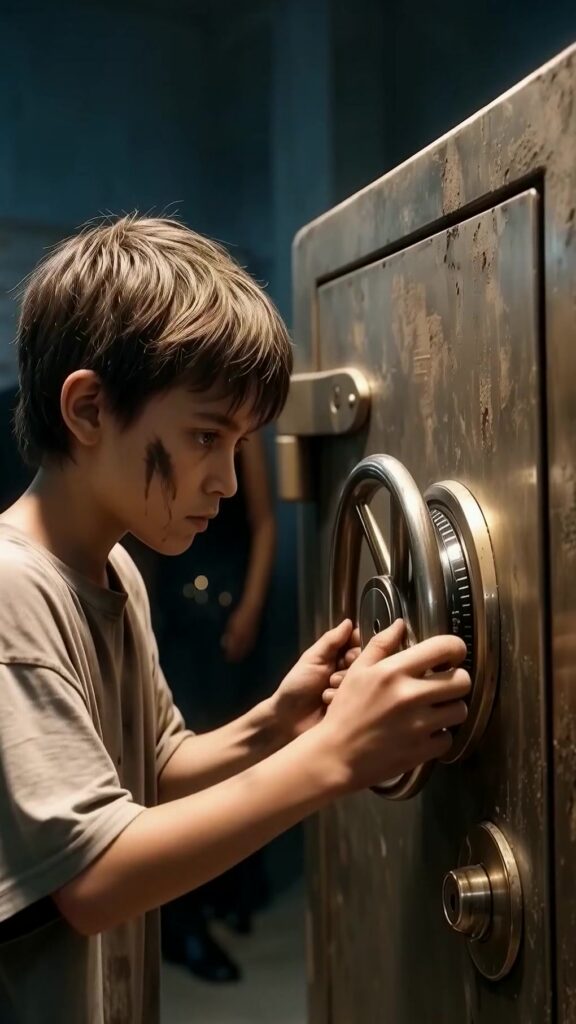
Everything was under control. That was what the banners said above the stage, what the host repeated into the microphone with a grin polished by sponsors, and what the guards told themselves as they watched the crowd surge and settle like a living tide.
The event had a name that sounded like a dare: THE VAULT NIGHT. Cameras hung from black trusses. A panel of commentators sat under a spill of studio lights. On the floor, behind a velvet rope, people craned their necks to look at the object everyone had paid to see—an upright cylinder of matte alloy, scarred by time but cleanly staged, as if the museum had delivered a relic and the production crew had given it a makeover.
It was called the Kestrel Vault. It had been found bricked into the basement of a demolished banking hall, fused to its own pedestal, as if someone had tried to bury it in plain sight. The vault had no handle. No keyhole. No keypad. Just a flat plate with a thin seam like a closed eyelid. Every engineer who had been allowed near it had come away frustrated, and every rumor had grown teeth.
Inside, people said, was a fortune. Inside was a confession. Inside was a name that could topple a city.
The host, Jory Vale, held his hands out as if he were calming a storm. “Tonight,” he said, “we see if the legends are true. Our contestants have signed the same contract. Three attempts. If you fail—you leave.” He smiled, bright as an emergency light. “No second chances.”
The first teams had been what everyone expected: locksmiths with briefcases, hackers with laptops, an ex-military engineer with a portable scanner and a swagger that soured when his equipment blinked red. They tried heat, magnets, vibrations, sophisticated guesses. They whispered into headsets and argued under their breath. Their attempts ended in the same way: a short sequence of cold beeps from the vault’s plate, and then nothing. The cylinder didn’t even shudder. The seam remained unbroken.
Jory turned their failure into entertainment. “You see?” he teased, as the crowd laughed in relief at being spared the discomfort of mystery. “Everything under control.”
When the last scheduled contestant was escorted away, the stage manager motioned frantically from the wings. A new figure had stepped through a service door as if he belonged there. He was too young to have a credential hanging from his neck. Too small to have pushed past security by force. Yet no one seemed to touch him, as if the guards’ hands had forgotten their purpose.
He walked straight toward the vault.
Jory’s voice became a little sharper. “Hold on. Who is that?” His smile remained, but it tightened around the edges.
The boy looked up, and the lights caught his face in a way that made him appear older than he was. Not by years. By weight. He had dark hair cut too short, and eyes that didn’t search the room for approval. In his hand he carried nothing.
“I can open it,” he said.
The words fell into the hall and did not bounce. They stayed where they landed.
Behind the ropes, someone snorted, a quick skeptical sound. Someone else murmured a prayer. The commentators leaned forward as if their chairs had shifted.
Jory recovered first. “Alright,” he said, voice smooth again. “Alright, kid. That’s… bold. Do you have a team? Tools? A permit?” He glanced at the guards, daring them to fix the problem without ruining the footage.
The boy’s gaze returned to the vault, not to Jory. “No,” he said. “Just me.”
Jory’s grin widened with practiced cruelty. “Good. That means it’s simple.” He stepped aside and made a show of sweeping his arm. “Rules are rules. Three attempts. Fail—you leave.”
The boy did not nod. He did not roll his shoulders or ask for time. He approached the cylinder as if he were approaching a sleeping animal that already knew his scent.
Up close, the Kestrel Vault looked less like a bank safe and more like an instrument: the metal was seamless except for the plate at chest height, and a faint pattern—almost a fingerprint swirl—was etched into its surface. The boy raised his hand and hovered over it.
A technician, hearing the hush, whispered into his headset. “We didn’t authorize any—”
Then the boy placed his palm flat against the plate.
A clean, mechanical sound cut through the air: a series of beeps, not the dismissive chirp that had met the others, but something more deliberate. The lights on the trusses flickered as if the power draw had shifted.
Jory’s smile faltered. He leaned closer, microphone lowered without thinking. “What did you do?”
The boy didn’t answer immediately. His fingers pressed, then relaxed, as though he was listening through the metal. The beeping slowed into a steady pulse, patient as a heartbeat.
“This safe remembers me,” the boy said.
Jory’s laugh came out wrong. “That’s not how safes work.” He tried to turn to the crowd, to make a joke of it, but his eyes kept returning to the plate as if expecting it to blink.
The boy kept his palm in place. “It’s not a safe,” he replied. “It’s a promise.”
“What are you talking about?” Jory demanded, the performance slipping into something else.
The boy’s voice stayed calm, almost careful. “My father locked my name inside.”
Silence pooled in the room, thick and immediate. Even the cameras seemed to hesitate, their motors softening. In the front row, an older woman’s hand flew to her mouth. A man beside her stared as if he had just remembered a photograph he had tried to burn.
There were people in that hall who knew the name the boy didn’t say. There were people who had made careers out of never saying it.
Jory’s face changed—first confusion, then recognition, then a quick calculation of risk. He swallowed. “Your father is—”
“Gone,” the boy said. Not bitter. Not proud. Simply a fact, like weather. “But he built this. He said it would only open for me when I was ready to carry what he couldn’t.”
Jory’s hand twitched toward his earpiece. The stage manager was shaking his head wildly from the wings. Security shifted, uncertain whether to rush forward or stay still. Someone at the commentary desk mouthed, “No.”
The vault answered first.
THUD.
The cylinder shivered as if an internal weight had moved. The seam—so fine it had looked like a scratch—darkened. Another sound followed, quieter, a long exhale of pressure releasing.
The boy removed his hand.
For a moment nothing happened. Then the plate’s etched pattern glowed faintly, as if warmed from beneath. The seam widened the width of a blade, then a finger. Metal separated with a sound like ice cracking on a frozen lake.
Light spilled out.
Not the bright, sterile LED beam of a gimmick, but a warm, living light that made the air look dusty with gold. The crowd froze. A few people instinctively leaned back as if the glow carried heat. The cameras adjusted, whirring softly, hungry to capture a thing no one had believed would occur.
Jory took an involuntary step toward it, then stopped, as though afraid to cross an invisible line. His voice came out hoarse. “Is this… real?”
The boy stared into the opening without surprise. He looked like someone standing in a doorway he’d dreamed of too many times. “Yes,” he whispered. “It’s real.”
Inside, the vault was not filled with stacks of cash or glittering bars. It was a narrow chamber lined with velvet-black foam, the kind used to cradle fragile items. Resting in the center was a small metal box, no bigger than a book, sealed with wax the color of dried blood. A simple paper label lay beneath the wax, protected under a thin layer of clear resin.
Even from the stage, people could read what was written there.
A name.
The boy’s name.
And beneath it, in smaller letters, a sentence that made the air feel suddenly thin: FOR THE DAY THEY COME TO CLAIM YOU.
Jory’s mouth opened, then closed. He glanced at the audience, at the cameras, at the exits. The guards were no longer watching the boy. They were watching the doors, as if expecting someone else to arrive now that the vault had done what it was built to do.
The boy reached in and lifted the metal box with both hands. It was heavier than it looked; his shoulders dipped slightly under the weight. He held it against his chest, and the vault’s light dimmed as if it had completed its only task.
He looked at Jory then, truly looked, and the host flinched at the steadiness of it. “You said if I fail, I leave,” the boy said. “I didn’t fail.”
Jory forced a laugh that sounded like a door trying not to slam. “No,” he managed. “No, you didn’t.”
“Then I’m leaving anyway,” the boy replied. He turned toward the nearest exit, moving with the same quiet certainty he’d arrived with.
Behind him, the vault began to close, not with a bang but with a slow, final click, like a lid being set back onto a coffin. The lights overhead steadied. The crowd remained frozen, too afraid to applaud, too afraid to boo, unsure which emotion would make them complicit.
As the boy passed the velvet rope, a woman reached out, fingers trembling, and stopped an inch from his sleeve. “What’s in the box?” she asked, voice breaking on the last word.
The boy did not slow. “Proof,” he said. “And a map.”
“A map to what?” someone else called out.
He paused at the doorway, silhouetted by the hallway beyond. For the first time, something like pain flickered across his expression—not soft, but sharp, like a cut that never healed properly.
“To everyone who helped him disappear,” he said. “And to everyone who will try to make me disappear next.”
Then he stepped out of the light of the stage and into the darker corridor, carrying his name as if it were both shield and target.
Onstage, Jory Vale stood very still, microphone dangling in his hand. His producers shouted questions he didn’t answer. The commentators spoke in frantic whispers, then fell silent, because the story had moved beyond their words.
Everything had been under control.
Until the vault remembered who it belonged to.