No one noticed him at first. Not because he blended into the air or vanished like a trick, but because the city had learned a cruel talent: to look straight through the wreckage of other people and keep moving.
At the curb of Halden Street, where buses hissed and vendors shouted into the wind, he stood with his feet bare against the grit. The soles were blackened, the skin split at the heel, as if the road itself had tried to claim him. His shirt had once been white; now it carried the gray of every wall he’d leaned against. He swayed in place—not drunk, not ill in the ordinary sense—just exhausted in a way that made exhaustion look like a permanent state of being.
People passed with headphones, coffee, deadlines. A man in a pressed suit stepped around him without breaking stride. A teenage couple laughed and veered away, laughter thinning as it went. A delivery cyclist glanced, frowned, and looked elsewhere. The city’s pulse refused to include him.
He did not move.
It wasn’t stubbornness. It was waiting. The kind that grips your ribs and holds them. The kind that makes the seconds feel like stones. He’d been standing there for nearly an hour, and each time someone’s shadow crossed his face, his eyes lifted with a cautious hope—then dropped again when the shadow kept going.
There were stories people would have invented if they’d bothered to look: addict, vagrant, lunatic, danger. The truth was simpler and stranger. He had come to this corner because he knew it. Because he had once stood here in polished shoes and checked his reflection in a window before crossing the street. Because the memory of that man—the man he had been—felt like a knife tucked somewhere behind his heart.
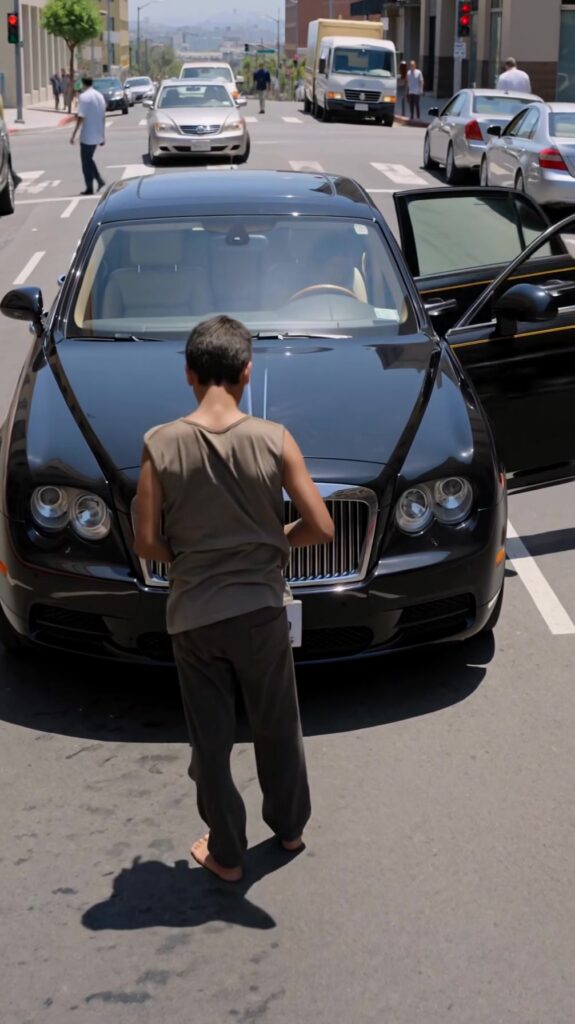
The traffic light clicked to green. Cars surged forward in a bright, impatient line. In the middle of them, he stepped off the curb as if the asphalt had pulled him.
A horn blared. Someone shouted. A driver swore into the air. He kept walking, not reckless, not frantic, just sure. He angled toward a car that didn’t belong to this street, not really: a new sedan, paint glossy as wet ink, chrome too clean for the dust. It had the sort of presence that made other cars lean away. It stopped at the line with a smooth, expensive quiet.
He approached it as if he recognized it by smell.
He raised his palm and placed it on the hood.
Not hard. Not a strike meant to bruise metal. Just enough to say: stop.
The sedan halted. The line behind it snarled into horns and gestures. But for the space of a breath, everything on Halden Street seemed to pause around that hand on that shining surface.
The driver’s door opened.
A woman stepped out the way women step out when they have always been expected. Composed. Perfectly balanced. Her coat fell in a straight line; her hair was pinned with deliberate care. Sunglasses hid her eyes until she lifted them away. Even without the glasses, she looked like someone accustomed to being obeyed—someone whose name traveled ahead of her into rooms.
“What are you doing?” she demanded, not loud, but sharp enough to cut through the noise.
He did not answer.
He stared at her as if she were the last piece of a puzzle he’d carried for years. His face was hollow, but his gaze held a heat that didn’t match his raggedness. It wasn’t pleading. It wasn’t anger. It was recognition—heavy and unwavering.
“Sir,” she said again, and the word sounded like a barrier, “move away from the car.”
He swallowed. His throat bobbed. His hands trembled not from fear but from effort, the way hands tremble when they’ve carried too much for too long. Slowly, he reached into the torn pocket of his jacket. For a moment, the crowd that had begun to notice leaned closer, sensing conflict, spectacle, something to record.
His fingers closed around a small object.
He drew it out and held it up between them.
An old wristwatch, its strap cracked and patched, the face scuffed with a spiderweb of fractures. The kind of thing pawn shops refused and children played with until it broke for good. Yet he held it with reverence, as if it were a relic.
He offered no explanation. No plea. No accusation. Just the watch, hovering in the air like a question.
At first, the woman’s expression barely changed. She looked at it as one would look at a stranger’s trash. Her mouth tightened, irritation flickering across the surface of her poise.
Then her eyes narrowed.
Because beneath the scratches, there was something unmistakable: a tiny engraving along the rim, letters almost rubbed smooth but still there if you knew where to look. A name, and a date. Something private. Something the world was never meant to touch.
Her breath caught, audible even through the street’s roar.
She took a step closer, as if the watch had hooked her and pulled. The expensive certainty in her posture wavered. Her lips parted and then pressed together, as if she’d almost spoken a word that would expose her.
“Where did you get that?” she asked, and her voice was different now—lower, carefully controlled, but threaded with something dangerous.
He still did not answer. He only tilted the watch so the light hit the broken face. The hands were frozen at a time that looked random unless you understood the habit: he had stopped it himself, years ago, the moment a call came through and the world shifted on its axis. He hadn’t meant to stop time. Only to mark it.
The woman reached out, then hesitated, as if touching it might burn. Her fingers hovered, then closed around the watch with a strange tenderness. She turned it over once, twice. Her thumb traced the engraved letters like a prayer.
Her throat worked. The crowd, sensing the change, quieted in confused ripples. Even the horns softened, as if the street itself leaned in to listen.
She lifted her eyes to him. The hardness in them was still there, but it had been cracked open, and behind it something older moved—something like fear, or regret, or a grief she had kept wrapped and hidden beneath money and reputation.
“You’re supposed to be—” she began, then stopped. The sentence wouldn’t finish. It couldn’t. Not out loud, not here.
He finally spoke, his voice hoarse as if it had been unused for days. “I’m not.”
Two words, and the air around them changed.
She drew closer until her perfume—clean, expensive—mixed with the scent of street dust and rain. She leaned in, lowering her voice so only he could hear. Her words disappeared under the city’s noise, swallowed deliberately, but her face told the story: a confession forming, a name she didn’t dare speak, a question that could ruin her if anyone caught it.
His shoulders tightened as if each syllable struck him. He listened without blinking. When she finished, he let out a breath that shook. He looked down at his bare feet, then up again, and something like decision settled into his expression.
The woman straightened abruptly, as if remembering the world around them. She slid the watch into her palm and closed her fingers hard, knuckles whitening. When she spoke again, she addressed him but also the street, the cameras beginning to rise, the eyes that had finally noticed.
“Get in,” she said, sharp, final. “Now.”
He didn’t move immediately. He glanced at the crowd as if searching for a face he knew, for proof that the city could witness mercy as easily as it witnessed misery. Then he looked back at her, and for the first time his eyes softened—not into forgiveness, not yet, but into something that acknowledged the strange bridge between them.
He walked around the hood of the car with slow, careful steps, and every step felt like crossing a line he’d drawn years ago. When he reached the passenger side, he paused, hand hovering over the door handle, as if touching it might return him to another life or erase this one.
The woman, still standing by the open driver’s door, glanced once more at the watch in her fist. She held it like evidence. Like a key. Like a threat.
On Halden Street, traffic waited, people whispered, and the restless city held its breath—because something private had surfaced in public, something broken had been recognized, and the cost of that recognition was about to be paid.
He opened the door.
And the moment he sat down, everything changed.