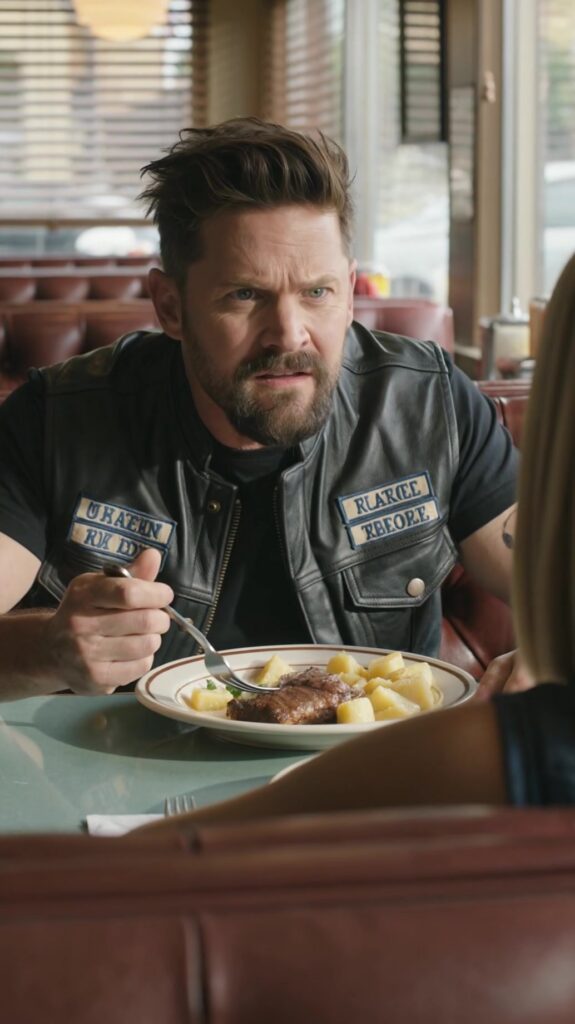
The diner off Route 9 smelled like burnt coffee and wet asphalt, the kind of place that didn’t ask questions unless you bled on the floor. Late afternoon light slid through the blinds in narrow stripes, turning the chrome fixtures into knives. A man in a black leather vest sat alone in a red booth, jaw working methodically on a mouthful of tough steak as if chewing could keep the rest of the world out.
His name was Eli Rourke, though most people in the county called him Rook—like the chess piece, hard to corner and built to move straight through trouble. His knuckles were scarred, his hands stained with grease, and his forearm carried ink: a skull with a cracked crown and a thin ring of thorns around it. It wasn’t art. It was a marker.
The bell over the door chimed, and a little girl walked in like she belonged there, small boots tapping a careful rhythm. Blonde hair, neat as if someone had combed it with patience, and eyes too steady for someone her age. She didn’t look lost. She looked assigned. She crossed the tile floor and slid into the booth across from Eli without waiting to be invited, settling her hands on the tabletop as if she’d done it a hundred times.
Eli kept chewing. He didn’t look up. Strangers talked to him when they wanted something, and he’d learned years ago that wanting was a prelude to hurting. The waitress hovered near the counter, tracking the odd pairing with the cautious interest of someone who’d seen too much and still wanted to see more.
Then the girl leaned forward and pointed with a clean, blunt finger at the skull tattoo on his arm. “My dad has that,” she said, voice soft but clear. “He told me never to trust somebody who doesn’t.”
Eli’s jaw stopped mid-grind. His fork froze halfway between plate and mouth, a small, ridiculous pause that felt louder than the jukebox. It wasn’t the mention of the tattoo that hit him—it was the phrasing, the cadence of it, a line that had once been spoken in smoky garages and whispered in back rooms as deals were made over trembling hands.
Eli lowered the fork so slowly the tines barely clinked against the plate. He looked at her for the first time. Her gaze didn’t flicker. It held. “Say that again,” he murmured, and he hated the edge of fear he heard in his own voice.
“Never trust somebody who doesn’t,” she repeated. “It’s a warning. He said it’s how you tell who’s pretending.” She said pretending like she’d learned the word in a lesson that came with consequences. “He said to find the man with the skull and tell him, and he’d know what to do.”
Eli felt the diner tilt. Years collapsed like scaffolding. The warning had belonged to one man: Daniel Carter—club golden boy turned ghost story—who’d used it as a rule and a joke, a way to test loyalty and catch liars when smiles were cheap. Daniel had died in a warehouse fire six years ago. That was what the papers said, what the club swore, what Eli had tried to believe when he’d stood by a closed casket and watched men in patched vests pretend their grief was rage.
“What’s your name?” Eli asked, forcing himself to breathe. “And who is your dad?”
The girl didn’t hesitate. “I’m Wren,” she said. “My dad is Daniel Carter.”
The sound that left Eli wasn’t a word. It was the kind of inhale you take when you see headlights in the wrong lane. Eli’s eyes flicked across the diner: the trucker with his back to the wall, the old couple splitting pie, the teenager wiping tables while pretending not to listen. He suddenly saw angles and exits and reflections in the window glass. Anyone could be here for him. Anyone could be here for her.
“Who brought you?” Eli asked, lowering his voice as if danger had ears. Wren turned her head toward the window, where rain made thin rivers down the pane. “A lady with red hair,” she said. “She waited in a car. She said if you believed me you’d look in the napkin holder.”
Eli’s stomach tightened around the name he didn’t speak. Mara. Daniel’s shadow, his fixer, the only person who could calm him with a look. Mara had vanished the same week Daniel died, swallowed by the same story, the same smoke. Eli reached for the chrome napkin dispenser as if it might bite. His hands had held pistols steady; they’d reattached a chain in the dark while sirens screamed nearby. Now they trembled.
He pulled out a stack of napkins and found, tucked between two of them, a small black key taped to a folded slip of paper. The note was written in tight, slanted letters he recognized from old shipping manifests and coded club ledgers. It didn’t waste ink on greetings. It didn’t soften the blow. It said: SHE’S ALIVE. DON’T TRUST KNOX.
Knox was the current president. Knox had taken Daniel’s chair after the fire. Knox had stood at the memorial and promised revenge with tears that never quite reached his eyes. Knox had insisted Eli stop asking questions, stop visiting the burned site, stop digging. Knox was expecting Eli at the clubhouse that night. Eli’s phone buzzed as if the universe had timed it for drama—one text, two words: Tonight. Mandatory.
Eli folded the note until it disappeared into his palm. He stared at Wren. She watched him like she’d been told to watch, as if her job was to confirm he understood. “Where’s the red-haired lady now?” he asked. “Did she tell you?”
Wren shook her head. “She said she can’t be seen with me,” she answered. “She said men who smile too much will take me away.” Her voice wavered on the last part, just barely. Then she straightened again, brave as a match in wind. “She said you’d keep me safe.”
Eli swallowed, his throat suddenly dry. Safe was a word that didn’t belong in his life. But Wren sat across from him carrying a dead man’s rule like a lantern, and the lantern had lit up a room Eli didn’t want to see. If Daniel had lived, if Mara had survived, if Knox had lied—then the club wasn’t just rotting. It was rigged.
Outside, the rain thickened, turning the parking lot into a mirror. Eli slid out of the booth, placing cash on the table without counting. He moved around to Wren’s side and knelt so his eyes were level with hers. “Listen to me,” he said quietly, each word measured. “If anybody asks, you don’t know me. You never saw me. You understand?”
Wren nodded, slow and solemn.
“Good,” Eli said, and he hated that his next words sounded like a vow. “You’re coming with me. And we’re going to find the truth about your father.”
He took her hand. It was small, warm, and trusting in a way that made Eli’s chest ache. As they walked toward the door, Eli glanced once more at the napkin dispenser—empty now, harmless. It wasn’t harmless. It was a fuse. Somewhere out there, Mara had struck the match, and Knox, with his polished smile and borrowed authority, was standing too close to the powder. Eli pushed open the diner door, letting the rain wash over him like a baptism he didn’t deserve, and stepped into a war that had been waiting six years to begin.