He had walked through that corridor a thousand times without slowing down. In the early years, he had sprinted down it with a phone glued to his ear, the kind of hungry pace that made assistants jog to keep up. Later, when the building carried his name in brushed steel letters, he’d taken the same path with the calm rhythm of ownership, nodding at the glass, the light, the hush.
The corridor was a promise made physical. Polished floors that never showed footprints. Walls of clear paneled glass that held the city like a framed photograph. Silence that cost money—paid for by insulated ceilings, discreet white-noise vents, and the unspoken fear of making the wrong sound.
He had designed this place to be untouchable. He had built it after he’d sworn he would never again live in a kitchen where the heat didn’t work and the landlord came pounding with red eyes and louder fists. He had protected it like a fortress, so no one could look at him the way they used to look at his mother—like she was a mistake someone kept making.
That morning, he moved through the corridor on autopilot, mind already half in the boardroom. An acquisition. A press release. A meeting with lawyers who spoke as if the law were a language that belonged only to them.
Then he saw the bucket.
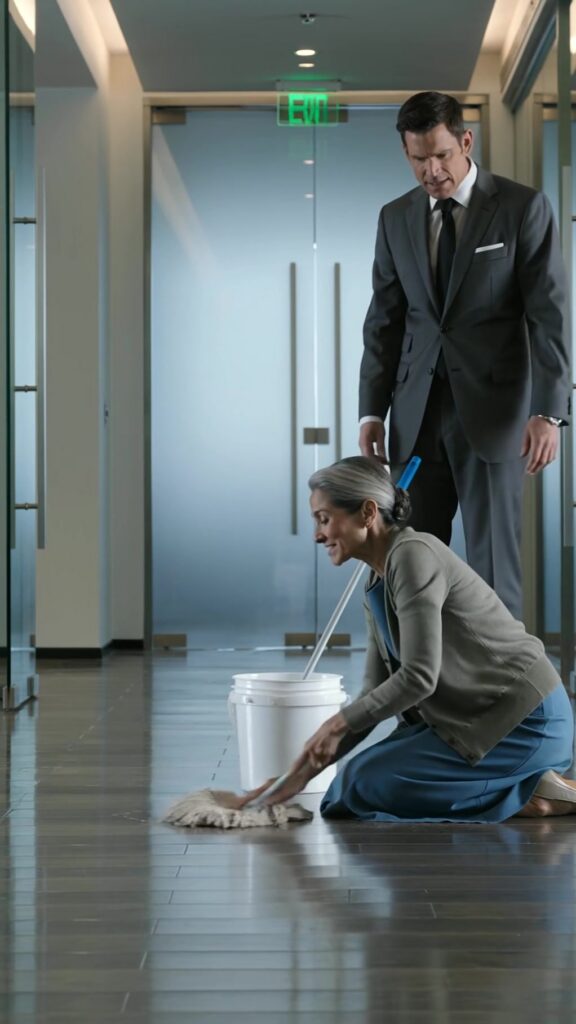
White plastic. A thin metal handle. A damp ring on the floor beside it, like a bruise on a perfect face. At the far end of the corridor, near the corner where the glass turned and the executive wing began, a figure knelt with a mop.
His first emotion was irritation, clean and immediate. This was not the kind of building where someone cleaned by hand in the middle of the day. This was the kind of building where machines did their work at night, silently, and left no trace of effort behind.
He walked faster, jaw tight, already forming the words he would say to Facilities. To Security. To whomever had allowed this mistake to appear in his sightline.
Then the woman lifted her head.
Gray hair pulled back with a plain clip. Skin that had learned what time did to it and endured anyway. A faded cardigan—soft, worn thin at the elbows—hanging on shoulders that had held too much for too long. Eyes that were tired, and familiar, and so painfully out of place in this corridor of expensive silence that his stomach lurched.
His mother.
The city outside the glass blurred. His breath caught as if the air itself had turned thick. For one second, all he could hear was the old sound of her cough in a dark apartment, the scrape of her shoes on cold stairs, the quiet way she used to say, “It’s okay, baby,” when it wasn’t.
He took a step toward her, and his voice betrayed him. It cracked on the first syllable like something old snapping under strain.
“Mom?” he said, the word too small for the room. “What are you doing here? Why are you… why are you cleaning the floor in my company?”
She blinked at him as if he were the one who didn’t belong. Then she gave him the smallest smile—a careful, practiced curve, the kind mothers wear when they’re trying to keep their children from seeing what hurts.
“One of your employees said it needed to be done,” she said softly. “So I did it.”
The sentence hit him in the chest, not as an insult but as a confession. There was no anger in her voice. No complaint. Only apology—like she had made an error by existing in the wrong place, like she ought to smooth herself into something less noticeable.
He looked down at her hands. They were wet, red around the knuckles, the skin creased from chemical water. Those hands had once cut vegetables in a diner until midnight and then come home to braid his hair and help him with homework under a flickering lamp. Those hands had signed permission slips she couldn’t read without squinting. Those hands had pressed a fevered cloth to his forehead and promised the world would change.
He opened his mouth to tell her she didn’t have to do anything, not anymore, never again. But before he could, the sharp click of heels sliced through the silence.
A younger woman entered the corridor with the effortless authority of someone who had never been forced to ask. She wore a white blazer with sculpted shoulders and a silver watch that flashed when she moved her wrist. Her hair was pinned perfectly. Her lipstick was a shade that looked like it had been chosen by a consultant.
She stopped near his mother, not kneeling, not bending. Her posture created a hierarchy without a word.
Her voice came out calm, almost entertained. “She wanted work,” she said, as if discussing a coffee order. “Here, everyone earns their place.”
The corridor seemed to narrow. Even the city outside the glass felt held back, waiting.
He turned his head toward the woman in white slowly, like the movement might keep his temper from igniting. He knew her. Of course he did. Alina Mercer. Head of Client Relations. Too polished to be accidental. Too connected to be easily removed. The kind of employee investors liked because she smiled like a guarantee.
He had hired her two years ago after she’d charmed three board members and somehow made the coldest of their clients laugh. He had told himself she was an asset. He had ignored the whispers about how she spoke to people below her in the org chart.
Now she stood over his mother like she was proving a point.
His hand curled into a fist so hard his knuckles whitened. “Who told you—” he began, then stopped, because the truth was already creeping in. His mother didn’t have an ID badge. She wasn’t on payroll. She shouldn’t have been past the lobby desk, much less scrubbing the executive corridor.
Alina’s smirk didn’t flicker. She tilted her head, pretending curiosity. “Unless,” she said, voice softer, sharper, “she forgot to tell you who gave the order.”
His mother’s face changed in an instant. The careful smile fell away like a curtain. Something small and terrified tightened around her eyes. She lowered her gaze, as if the floor might protect her.
“Please,” she whispered, the word barely audible. “Don’t make this worse.”
Don’t make this worse.
He stared at her. That wasn’t a request from someone embarrassed about cleaning. That was a plea from someone who had been cornered. Someone who had been threatened with consequences she couldn’t afford to explain.
His heartbeat turned loud, thudding in his ears. “Mom,” he said, trying to keep his voice steady, “what did she do?”
His mother’s fingers trembled as she reached into the pocket of her cardigan. Her hand came out holding a folded piece of paper, creased so many times it looked tired. The paper had been handled, hidden, unfolded and refolded—treated like something dangerous.
She held it out to him as if it weighed more than it should.
“Before you say anything,” she murmured, tears pooling but not falling, “read what she made me sign.”
He took the note. It was warm from her pocket. His eyes went to the top line and his stomach dropped as if the floor had given way.
It wasn’t a cleaning assignment. It was a waiver. It was a statement, typed in clean corporate language, declaring that she had entered the building without invitation, that she had asked for menial tasks, that she accepted responsibility for any injury, any humiliation, any misunderstanding. It said she agreed she had not disclosed her relationship to the company’s CEO to avoid “conflict of interest.”
At the bottom was her signature—shaky, but there.
His mother’s name on a page designed to erase her.
He looked up at Alina, and for the first time her confidence wavered—not with guilt, but with calculation, as if she were measuring the cost of what she’d done against the power she thought she held.
He could see it then, the entire shape of the cruelty. This wasn’t random. This wasn’t “everyone earns their place.” This was a trap laid carefully in the corridor he’d walked a thousand times. A test. A message. A demonstration of who could be made small inside his empire.
His mother’s voice came again, almost inaudible. “She said if I told you… it would make you look weak.”
Weak. The word that haunted every poor child who dared to dream of wealth. The word he’d spent his whole life outrunning.
He lowered the note and met his mother’s eyes. In them he saw the old apartment, the long shifts, the sacrifices she never named. He saw her trying to protect him from shame even now, kneeling on a floor he’d promised she would never have to scrub again.
He turned back to Alina. His voice, when it came, wasn’t loud. It didn’t need to be. It carried the weight of every security camera in the ceiling and every contract in the building.
“Get your badge,” he said. “And come with me.”
Alina’s smile tried to return. “If this is about optics—”
“No,” he said, cutting her off. “It’s about the fact that you used my company like a weapon.” He glanced at his mother, then back at Alina. “And you did it in my corridor.”
For the first time, Alina looked uncertain. “You can’t just—”
“Watch me,” he said.
His mother reached for his sleeve with damp fingers. “Please,” she whispered again, and he hated that word on her lips, hated what it meant she’d learned to expect from people with polished shoes.
He crouched beside her, careful not to let the anger in him spill onto her. “You don’t have to be afraid,” he said, voice gentler. “Not here. Not ever again.”
She shook her head, tiny and stubborn. “You don’t understand,” she breathed. “She knows things. She said… she said she could take everything you built and turn it against you.”
He looked down at the note in his hand—at the corporate phrasing, the legal traps, the subtle violence of signatures demanded from trembling fingers—and he understood more than she realized.
This wasn’t just about cleaning a floor.
It was about who held the pen.
He stood, the paper still in his fist. The corridor’s expensive silence returned, but it felt different now—less like luxury, more like a courtroom waiting for a verdict.
“Then we’ll see,” he said, not to Alina, not even to his mother, but to the building itself. “We’ll see what happens when the person who built this place stops walking through this corridor without slowing down.”