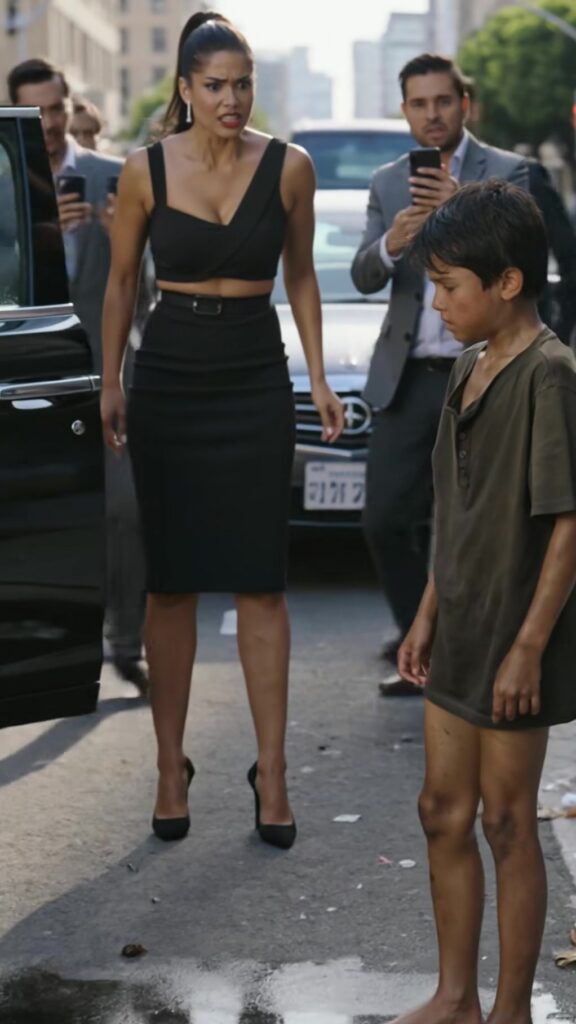
No one noticed the boy at first—because the city had trained itself not to. In the midday crush, among honking taxis and vendors shouting prices into the thick air, a barefoot child was an ordinary part of the street’s noise. He was thin, sun-browned, and moving with the practiced economy of someone who’d learned early that wasted motion cost meals. He poked through black bags beside an overflowing bin, not with desperation but with method, as if the trash were a filing cabinet and he knew exactly which drawer hid what he needed.
Some people glanced at him the way they glanced at potholes: quick, annoyed, and then gone. A man in a crisp shirt stepped around him without breaking stride. A woman with a stroller tightened her grip and pulled her child closer, as if poverty were contagious. A security guard across the street watched him with bored eyes, ready to shoo him away if he wandered too near the bank’s glass doors.
The boy’s name was Ilya. He had once answered to it when someone said it gently—his mother, in a different life. Now the name lived inside him like a hidden coin, kept for emergencies. Out here, he didn’t need a name. He needed patience.
At his feet sat a plastic bucket the color of old milk. It was half full of water so dark it looked like oil, flecked with grit and torn leaves. Anyone who noticed would assume it was for washing the sidewalk, or for rinsing hands, or for anything that made sense on a street where boys like him sometimes offered quick cleaning jobs for spare change. But Ilya didn’t offer anything. He didn’t call out. He didn’t chase customers. He waited.
Waiting was his talent. He could wait through hunger that made his stomach feel like a claw. He could wait through cold nights tucked under a stairwell. He could wait through the slow ache of remembering a door that once locked behind him with a familiar click. Most of all, he could wait for a particular sound—a low, deliberate engine note that didn’t belong to the street’s battered cars.
It arrived like a shadow sliding across the sun. A black luxury car eased into view, smooth as poured ink, its windows tinted to secrecy. The crowd parted instinctively, as if the vehicle carried its own gravity. Ilya straightened. His hand found the bucket handle. His fingers tightened until his knuckles went pale.
For a moment, the car’s glossy side mirrored him: a small, dirty boy in a city of clean lies. Then the car slowed near the curb—near the trash, near him—because the driver intended to avoid a pothole. The boy stepped forward.
In one second, he swung the bucket and threw its contents across the car’s side.
The filthy water slapped the paint with a wet, obscene sound. It ran in streaks over the door and the wheel well, carrying grit like sandpaper. The street didn’t just quiet; it held its breath. Vendors stopped shouting. A cyclist froze mid-pedal. Phones appeared as if conjured, screens raised to capture the moment before consequences landed.
The car door opened with a precise click. A woman stepped out as if the street were a stage built for her. She wore a pale coat despite the heat and a sharp expression that looked practiced. Her hair was pinned back neatly, and her eyes were the cold, assessing kind that made people apologize before they knew why.
“Are you insane?” she demanded, voice cutting through the silence. She looked at the grime dripping down her car as if it were a personal insult. “Do you know what that costs? Who are you?”
Ilya didn’t flinch. He held the empty bucket at his side, its plastic rim trembling slightly from the effort. His chest rose and fell too fast, but his eyes stayed fixed on her face. Not on her jewelry, not on her shoes—on her, like he’d memorized her from a photograph.
“You ruined everything,” he said. His voice was cracked, too old for his small throat, and it carried farther than it should have. “You ruined him.”
The woman’s anger paused, as if her mind had tripped on a step it didn’t expect. She drew in a breath. Her gaze flicked over him, trying to place him in a category: thief, nuisance, street rat, extortion. None fit the way he was looking at her.
“What are you talking about?” she said, slower now. “Get away from my car before—”
“Before you call them?” Ilya asked. “Before you make someone else do it for you?” He lifted his chin. “You don’t remember me. You don’t remember anything you throw away.”
A murmur rippled through the crowd. People leaned in. A teenager whispered, “This is going viral.” Someone laughed nervously. Someone else said, “Leave the kid alone.”
Ilya reached into the torn pocket of his shorts and pulled out something wrapped in a scrap of plastic. He unwrapped it carefully, as if it were a relic, and held it up. It was a small key on a plain ring. Attached was a tag, scratched and bent, with a number stamped into it.
The woman stared at the key. Her face changed with terrible speed. First confusion, then recognition like a bruise blooming beneath skin. The color drained from her cheeks. Her lips parted, but no sound came. For a heartbeat, she looked less like a rich stranger and more like someone caught at the edge of a cliff.
“Where did you get that?” she whispered.
“He kept it,” Ilya said. “Even when he didn’t have a door for it anymore. Even when he couldn’t remember my name, he remembered the number.” He tapped the tag with a dirty fingernail. “You told him it was temporary. You said it was just until the papers were done.”
The crowd shifted. A woman near the front covered her mouth. Several phones tilted higher, zooming in.
The rich woman took a step forward, and another, as if pulled. She seemed to forget the dirty water on her car, the eyes watching her, the danger of being recorded. Her gaze locked on Ilya with something sharper than anger now—fear, and the desperate need to control a story that was slipping away.
“Stop,” she said. “Stop talking.”
“He died in a room that smelled like bleach,” Ilya continued, his voice growing steadier as if truth itself steadied him. “He kept asking for the file. He kept saying your name. They told him no one was coming.” The word “died” made the street sway slightly, as if the heat had thickened. “He wasn’t supposed to be there. He was supposed to be home.”
For a long moment, the woman didn’t move. Then her shoulders lifted with a strange, silent breath. She looked around, at the cameras, at the gathered mouths, at the security guard who had begun to cross the street with sudden purpose. Her eyes returned to the key in the boy’s hand, and something in them hardened—not cruelty, but calculation, the cold steel of survival.
She walked closer until she was within arm’s reach of him. The air between them tightened. Ilya’s grip on the key ring became white-knuckled.
“Ilya,” she said softly, and the sound of his name on her tongue struck him like a slap. His stomach lurched. He hadn’t told her. No one on this street knew it. The phones kept recording, but the crowd’s chatter fell away entirely, as if even the city wanted to hear.
Ilya swallowed. “How do you know—”
She leaned in until her breath brushed his ear, and whatever she whispered was swallowed by the distance, by the traffic that resumed in hesitant starts, by the cruel luck of every microphone pointed the wrong way. Her lips barely moved, but her words landed inside him with the weight of a door slamming shut.
Ilya’s eyes widened. The key slipped in his sweaty fingers, clinking softly against the tag. His face went slack, then tightened, as if he’d bitten down on a scream. His knees trembled, and for the first time since the bucket flew, he looked like a child again—small, exposed, and suddenly unsure of where to stand.
The woman straightened. She was pale, but composed now, as if she had reclaimed control with a single sentence. She glanced at the phones and lifted a hand, not in greeting, but in warning—an unspoken promise that anyone who followed this would regret it. Then she looked back at Ilya and spoke aloud, carefully, for the crowd to hear.
“You’re mistaken,” she said. “You’ve been told lies.”
Ilya stared at her, breath shallow, his mind racing through what she’d said into his ear. The crowd surged with questions, with outrage, with hungry curiosity. The security guard reached them at last, hand outstretched. Somewhere, a siren began to rise.
But Ilya didn’t move. He held the key like it was the only solid thing left in the world, and his eyes followed the woman as she stepped back toward the car—toward the black shine now streaked with mud, toward the life that could erase evidence with a signature.
In the reflection of the wet door, Ilya saw himself—barefoot, trembling, and finally noticed. And he understood, with a clarity that made his throat burn, that the story was not ending. It was only beginning.